
By Gwokyalya Maria
International trade is often understood from the moment products cross borders. Less attention is paid to what comes before — the factories, workers and decisions that turn an idea into a product. In summer 2026, I saw that side of business firsthand, not in a lecture hall but inside a Chinese manufacturing company.
As a Ugandan MBA student at China Agricultural University, I interned at Kaleter, operated by Zhucheng Zhongyu Electromechanical Equipment Co., Ltd., a poultry and agricultural equipment maker in Zhucheng, Shandong. I rotated through production workshops, packaging and shipment, construction sites and the International Trade Department, joining industry events and African market research. This gave me a deeper understanding of Chinese manufacturing and the workplace culture behind it.
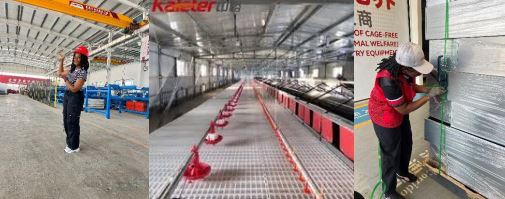
My introduction began far from the trade office. In my first weeks, I worked in the production workshops assembling poultry equipment and components — feeding systems and control equipment. I also learned how equipment is prepared, marked and checked before dispatch in the packaging and shipment workshop. For someone trained in international business, this seemed far from what I expected. It soon became one of the most valuable parts of the internship.
The factory taught me that international trade does not begin with a salesperson or a negotiation; it begins with understanding the product itself. An international customer wants to know how equipment operates and is installed, what conditions it requires and how components work together. Answering such questions requires more than knowing prices and specifications. This production experience later proved valuable when I moved into international trade.
On the factory floor I also began to understand the working culture. Punctuality, safety and adherence to procedures were taken seriously. Individual tasks were rarely isolated; one worker’s output affected the next. The efficiency I observed came not from working quickly but from coordination, consistency and understanding one’s role in a larger process. While one company cannot represent every Chinese workplace, at Kaleter I encountered a strong emphasis on discipline, teamwork and practical learning.
That understanding deepened at company project sites, where the components I had seen in production became complete poultry-farming systems. I joined on-site work — moving equipment to installation points, completing feeding troughs, aligning drinking lines and assisting with finishing. It changed my understanding of what a company sells. A customer is not merely purchasing machinery; they are relying on a complete process involving design, production, transportation, installation, technical support and performance. Seeing those functions come together brought concepts such as operations, supply chains and customer value to life.
My move to the International Trade Department aligned the internship with my academic background and let me contribute a Ugandan perspective. Much of my work involved researching African poultry markets; sector development, equipment demand, competitors, import trends and entry opportunities. As a Ugandan, the assignment carried special meaning: I saw how a Chinese company evaluates African markets while contributing my own understanding of the continent.
The research taught me that Africa cannot be treated as one uniform market. Countries differ widely in purchasing power, farming systems, infrastructure and customer needs, so successful entry requires understanding how farmers make decisions, the role of distributors and institutions, financing limits and reliable after-sales support.
It also reshaped how I view China–Africa business relations, often reduced to trade figures. From inside one company, I saw that exporting a product is only the beginning; sustainable growth requires localisation: adapting communication, building trustedrelationships and ensuring technology fits local conditions. African businesses likewise benefit from understanding the production systems behind Chinese products.

My exposure grew through industry events: Kaleter’s Third Non-Caged Laying Hens Development Forum, and VIV Select China in Shanghai, where I watched companies present technologies and build networks. I learned that a brief exhibition conversation is only the start of a longer process demanding follow-up, credibility and trust.
The most lasting lessons came from everyday interactions with colleagues. Practical learning stood out: when I did not understand a procedure, experienced employees demonstrated it first, letting me observe before trying. Even with limited technical Chinese, I learned that cross-cultural communication depends less on perfect language than on patience and a willingness to understand one another.
I also came to appreciate the collective nature of business. Equipment sold to an overseas customer has passed through engineers, production workers, quality-control staff, packaging, logistics, sales and installation crews. The customer may see one representative, but behind that person stands an entire organisation. Trade crosses borders, but its foundation is built long before a product leaves the factory.
The greatest value was seeing international business as an interconnected process. I arrived with an academic grasp of marketing, strategy and operations; I left appreciating the people, technical knowledge and cooperation that turn those concepts into practice.
For young Africans studying abroad, such experiences carry wider significance: we learn from our host countries while contributing knowledge of our own markets. As China– Africa links deepen, people who understand both environments can help build cooperation that is better informed and mutually beneficial.
I entered Kaleter expecting to learn how a Chinese company conducts business. I left with a broader lesson: meaningful international cooperation begins with understanding how people on both sides work, think and create value. Sometimes, that understanding begins not across a negotiating table, but on a factory floor.