
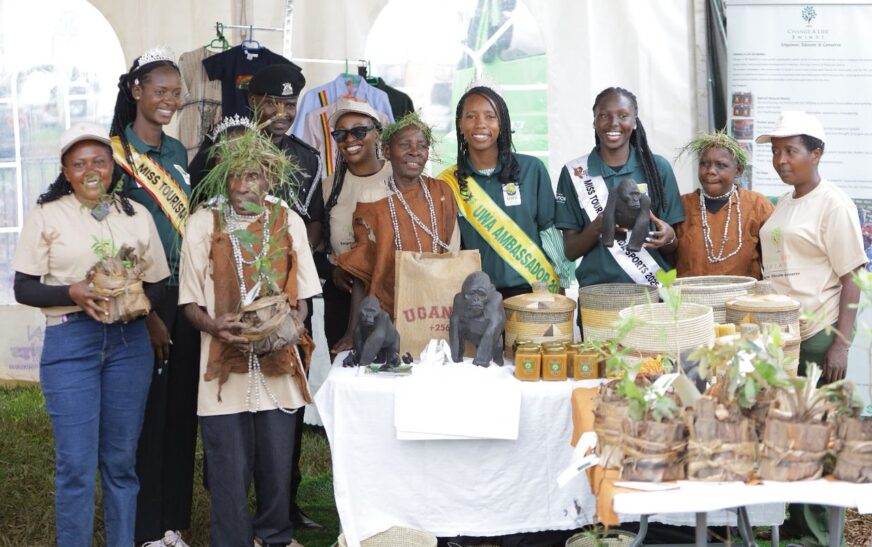
When members of the Batwa and Bakiga communities set off from the misty hills of Ruhija in Kanungu District, they carried more than bags and bundles. Carefully wrapped in leaves and woven baskets were medicinal plants, roots, and herbs—living symbols of a centuries-old healing tradition rooted deep within the forests of Bwindi Impenetrable National Park.
Their journey of more than 500 kilometers to Entebbe was not simply a trip. It was a mission: to share knowledge that has sustained their community for generations.
On Tuesday, during celebrations marking World Wildlife Day, the group arrived at the venue carrying bundles of forest plants and a story that stretches far beyond the day’s theme, “Medicinal and Aromatic Plants: Conserving Heritage, Health and Livelihoods.”
For the Batwa, the forest has always been more than a landscape, it was their pharmacy, their hospital, and their home.
A Forest Once Called Home
For generations, the Batwa lived as hunter-gatherers in Bwindi Forest, relying on its rich biodiversity for food, shelter, and medicine. But in 1991, their lives changed dramatically when the Ugandan government established Bwindi as a national park to protect endangered mountain gorillas.
Today, Mountain Gorilla populations in the forest represent nearly half of the world’s remaining numbers, estimated at just over 1,000.
While conservation efforts have been widely celebrated, the Batwa found themselves displaced from the forest they had called home for centuries. Many settled on the park’s fringes in communities such as Mpungu Sub-county in Kanungu District, living alongside their Bakiga neighbors and adapting to an entirely new way of life.
Yet even after leaving the forest, the Batwa carried something invaluable with them: knowledge.
Healing in Leaves and Roots
At the World Wildlife Day event, the Batwa working through the Change A Life Bwindi Organization displayed a wide variety of medicinal plants gathered from the region.
Visitors gathered around as community members explained how certain leaves soothe stomach pain, how roots can treat respiratory infections, and how specific herbs help heal skin diseases.
The plants are part of a vast natural pharmacy found within Bwindi’s ecosystem. The forest spans more than 321 square kilometers and is home to over 1,000 flowering plant species many of which have long served as remedies for communities living nearby.
Christina Katushabe, founder of Change A Life Bwindi, says this knowledge was shaped by generations of living in close harmony with nature.

“The Batwa grew up in the forest,” she explained. “The plants were their hospital, their pharmacy, and their source of survival. Even after leaving the forest, they have kept this knowledge alive. It remains an integral part of their identity.”
Knowledge at Risk
But beneath the pride of sharing their traditions lies a growing concern.
Much of the Batwa’s medicinal knowledge lives in the memories of elders many now in their sixties and seventies. As these elders pass on, the risk of losing centuries of unwritten knowledge grows.
Uganda itself is rich in medicinal plants, with an estimated 3,000 species recognized for their healing properties. Yet the traditional knowledge surrounding how to safely and effectively use many of these plants remains largely undocumented.
Katushabe believes indigenous communities like the Batwa should be recognized not only as cultural groups but also as custodians of valuable health knowledge.
“We need support to document this wisdom for future generations,” she said. “The Batwa knowledge is not only important for their community—it is valuable for the entire country.”
A Living Health System
Across much of the developing world, traditional medicine remains essential. According to the World Health Organization, about 80 percent of people in developing countries rely on plant-based medicine as their primary source of healthcare.
In rural Uganda, where access to formal health facilities can be limited, that dependence is likely even greater.
For the Batwa, the herbs they carried to Entebbe represent more than tradition—they are a living health system.