
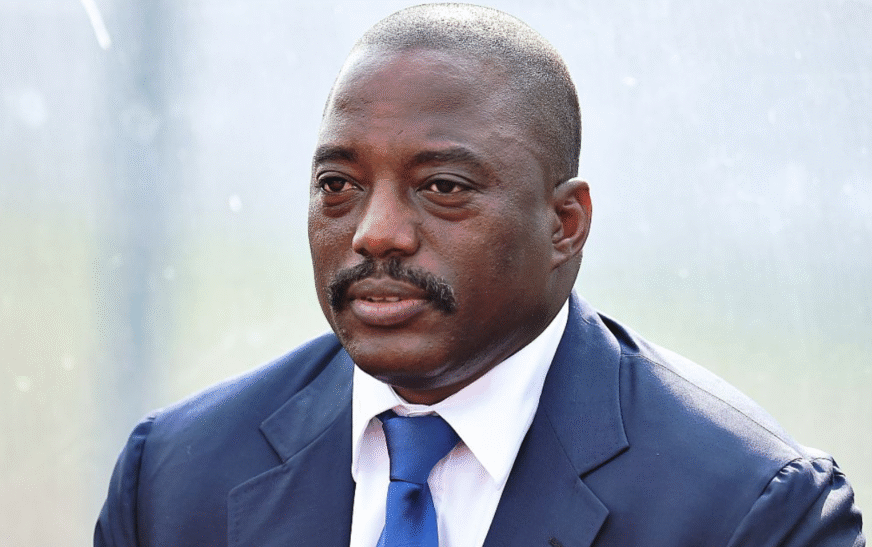
Former Democratic Republic of the Congo president Joseph Kabila has been declared a fugitive by state authorities following a treason conviction, marking a dramatic fall from power for one of Africa’s longest-serving leaders.
According to government officials, a military court in the Democratic Republic of the Congo found Kabila guilty in absentia in 2025, accusing him of supporting armed rebel groups operating in the country’s volatile eastern region. He was reportedly sentenced to death, though he remains outside the country.
Kabila, who led the country from 2001 to 2019, has strongly denied the allegations, describing them as politically motivated and part of a broader campaign to push him out of the national political scene.
The case highlights a sharp deterioration in relations between Kabila and his successor, President Félix Tshisekedi. The two leaders initially entered a fragile power-sharing arrangement following the disputed 2018 elections, but their alliance later collapsed amid accusations of betrayal and rivalry for influence.
Government officials allege that Kabila maintained links with insurgent groups destabilising the mineral-rich eastern provinces, a region long plagued by armed conflict involving local militias and foreign-backed factions. However, no detailed public evidence has been presented in international forums, and analysts caution that the charges may reflect deeper political rivalries within the country’s elite.
Kabila first assumed power in 2001 following the assassination of his father, former president Laurent-Désiré Kabila. Over the years, he consolidated control over the government and military, remaining in office beyond constitutional term limits before eventually stepping down under international pressure.

His departure paved the way for Tshisekedi’s presidency, though the transition was widely contested. Since then, the Congolese political landscape has remained tense, marked by shifting alliances and persistent security challenges.
The development comes as the Democratic Republic of the Congo continues to grapple with armed violence in its eastern regions, humanitarian crises, and concerns over governance and accountability. Observers say the pursuit of a former head of state on such serious charges is both unprecedented and indicative of deep divisions within the country’s political system.
Kabila’s whereabouts remain unclear, and it is uncertain whether he will face arrest or international legal action. His case is likely to heighten political tensions in Kinshasa and further complicate efforts to stabilise one of Africa’s most resource-rich yet conflict-affected nations.