
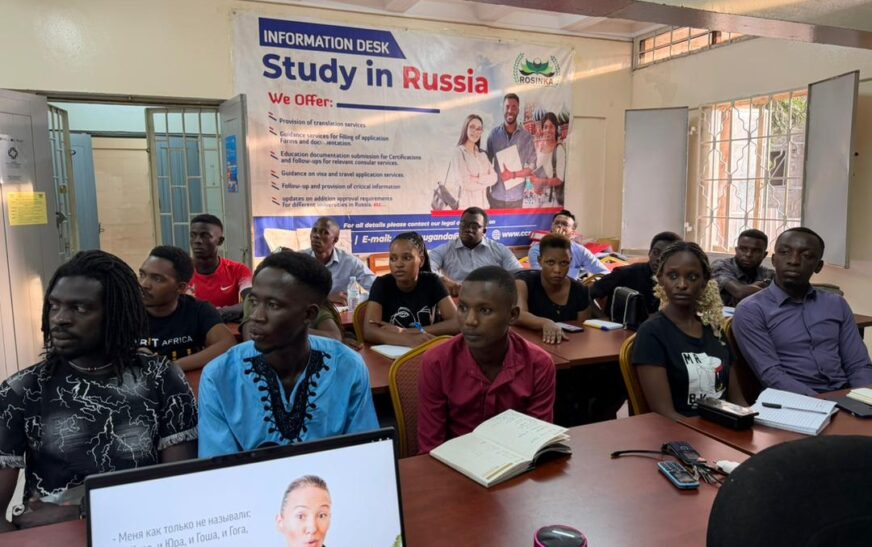
At exactly 5:00 pm on a Thursday evening, a classroom at Makerere University comes alive not with the familiar rhythms of English or Luganda, but with the sharp, unfamiliar sounds of Russian. There is no late start, no waiting for stragglers. The lesson begins on time.
On the whiteboard, strange symbols from the Cyrillic alphabet fill the space. For first-time learners like me, raised on the English alphabet the writing looks foreign and intimidating. Yet for dozens of Ugandans gathered in the room, these letters represent opportunity.
Presiding over the lesson is Olga Andreevna Atubo, a Russian language tutor whose strict approach to time mirrors the discipline of the language she teaches. One by one, students present homework written entirely in Russian. There is hesitation, laughter, and occasional correction but also growing confidence.
A Language Beyond Letters
Olga is quick to explain why Russian matters. It is not just a language, she tells her students, but a gateway to education, employment, and global engagement. Russian is one of the official languages of the United Nations, and fluency can open doors to scholarships and international careers.
What surprises many learners is how familiar the lessons can feel. Olga frequently draws parallels between Russian and Ugandan languages and cultural practices, using examples from everyday life to explain complex concepts. The approach demystifies the language and reassures learners that Russian, like any other language, can be mastered.
As more students stream into the classroom, Olga revisits the previous lesson. She explains that the Cyrillic alphabet contains 10 vowels producing five to six distinct sounds, divided into hard and soft pairs. Russian also has 21 consonants, which, through palatalization, create up to 37 unique sounds, a challenge, but one students appear eager to tackle.
Names, Greetings, and Respect
Beyond pronunciation, students are introduced to Russian social conventions. Olga explains that male Russian names typically end in consonants, while female names end in vowels. Traditionally, Russians use three names: a given name, a patronymic derived from the father’s name, and a surname that changes depending on gender.
Greetings, too, carry cultural weight. Students learn that Zdravstvuyte is a formal greeting reserved for professionals and strangers, while Privet is used among friends. Respect is embedded in language; elders and superiors are addressed by their full names, a practice that resonates with Ugandan cultural norms.
By the end of the lesson, students can greet one another, ask how someone is doing (Kak dela), and say goodbye either formally (Do svidaniya) or casually (Poka).
More Than a Language Class
The programme is ambitious. According to Olga, the elementary Russian course consists of 54 lessons, and students are expected to reach basic proficiency by 2026, with all assessments conducted in Russian.
But the lessons extend beyond grammar. Students are introduced to Russian literature, including works by Fyodor Dostoevsky and poetry by Alexander Pushkin, whose writings remain central to global literature. They also explore Russian culture, learning about traditional foods such as borscht, pelmeni, and kholodets, dishes Olga likens to Ugandan boiled and steamed meals.
Russia, she explains, is home to more than 190 ethnic groups, yet its people collectively identify as Russian a concept that sparks discussion among students.
A Longstanding Connection
The growing interest in Russian is not accidental. Uganda’s ties with Russia date back to 1962, shortly after independence, when diplomatic relations were established with the Soviet Union. During the Cold War, Ugandan students studied in the USSR on scholarships, gaining exposure to Russian language and culture.
Today, cooperation continues through scholarships, free language programmes, and cultural exchanges supported by the Russian Embassy and institutions such as the Russian House in Kampala. Russian is even being taught within the Uganda People’s Defence Forces, reflecting its strategic importance.

Students With Different Motivations
For Paul, a laboratory technologist, learning Russian began as a personal challenge.
“I wanted to learn a new language,” he says. “When I found a free Russian course online, I decided to try it.”
He hopes the language will help him secure a scholarship and experience a new culture. What has stood out most, he says, is the emphasis Russians place on politeness and respect.
Bushra, another student, joined the class because of a work programme that required Russian language skills. She describes Russian as logical and engaging, noting that even objects are assigned gender,a concept that initially surprised her but now fascinates her.
Teaching Russian in Uganda
Olga traces the origin of the programme to research conducted by the Rosinka Russian-Speaking Women’s Association in Uganda, whose members have lived in the country for years. Their findings revealed growing interest in Russian, prompting her to volunteer as a teacher.
The programme is linked to St. Petersburg State University through the Centre of Open Education and currently runs at Makerere University and King Caesar University. More than 260 students have completed the first level, many of whom later apply for scholarships abroad.
Russian is also taught at St. Augustine International School, from primary to secondary level, with plans underway to expand the language nationally.
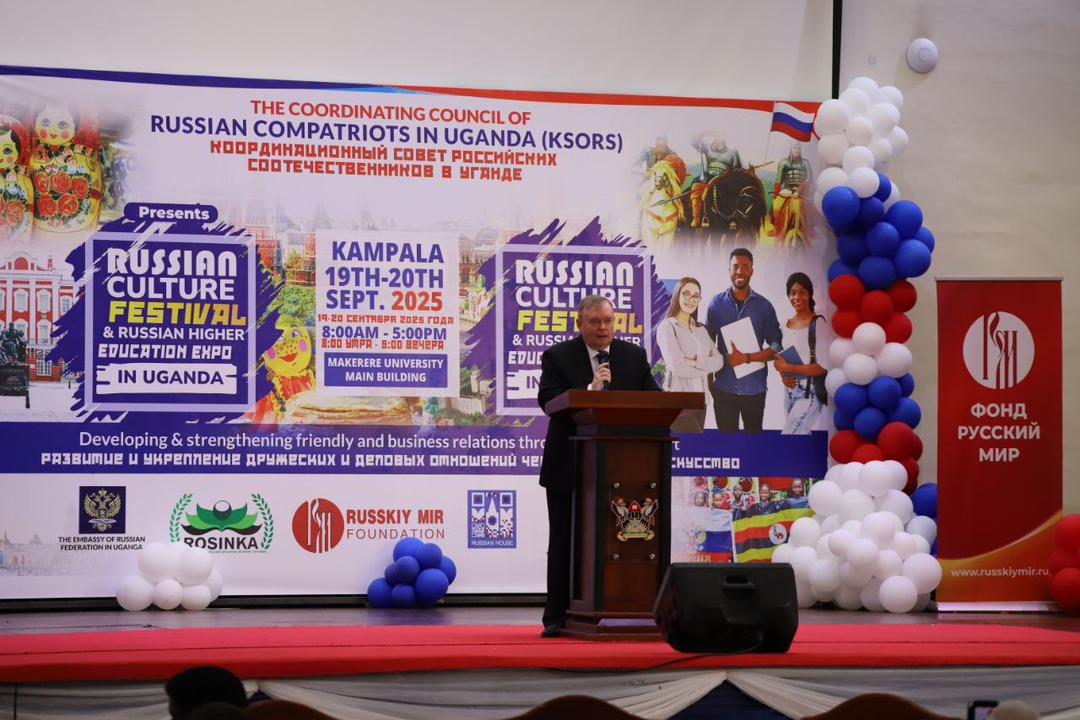
Cultural Diplomacy at Play
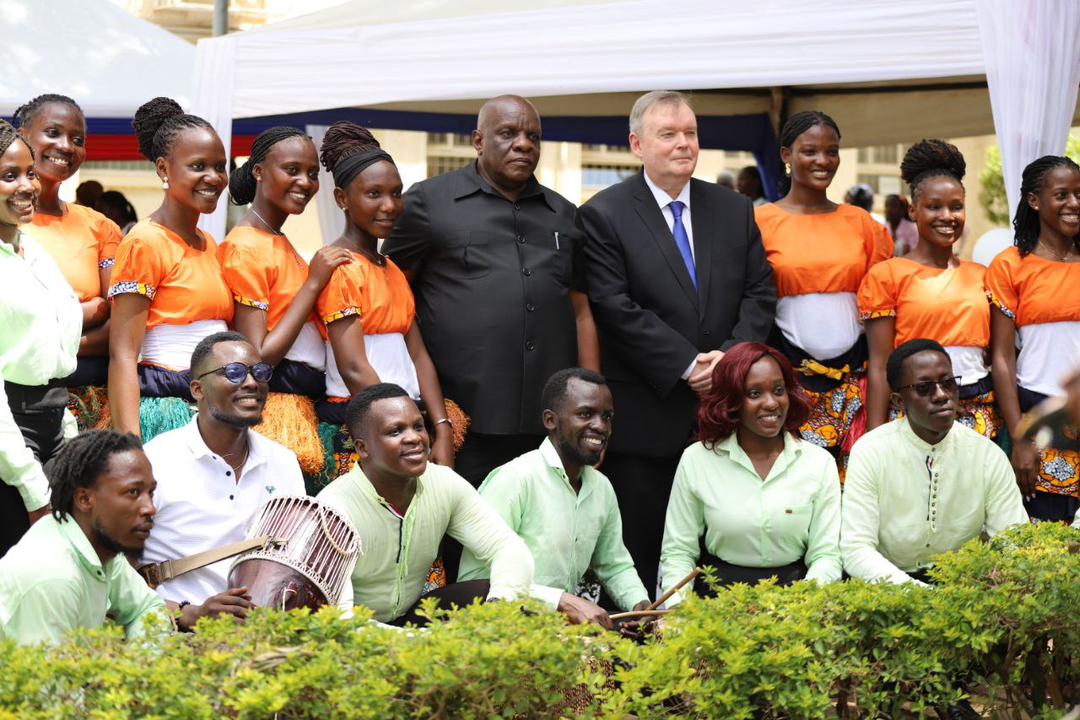
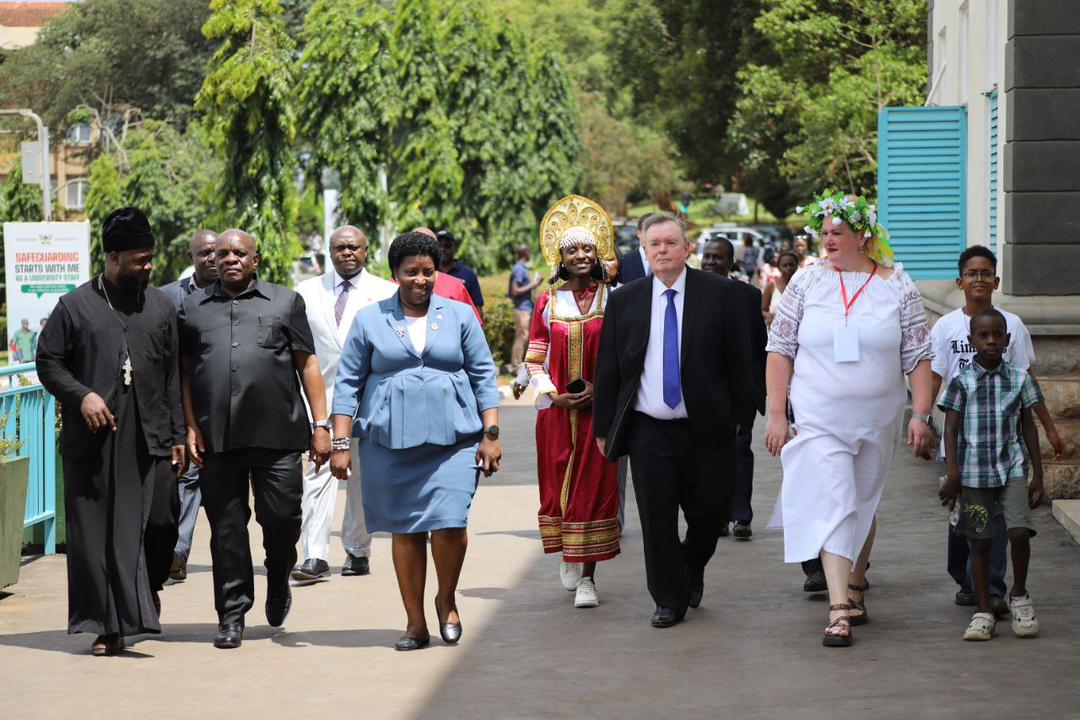
According to H.E. Vladlen Semivolos, Russia’s Ambassador to Uganda, promoting Russian language and culture is a core mission of the embassy.
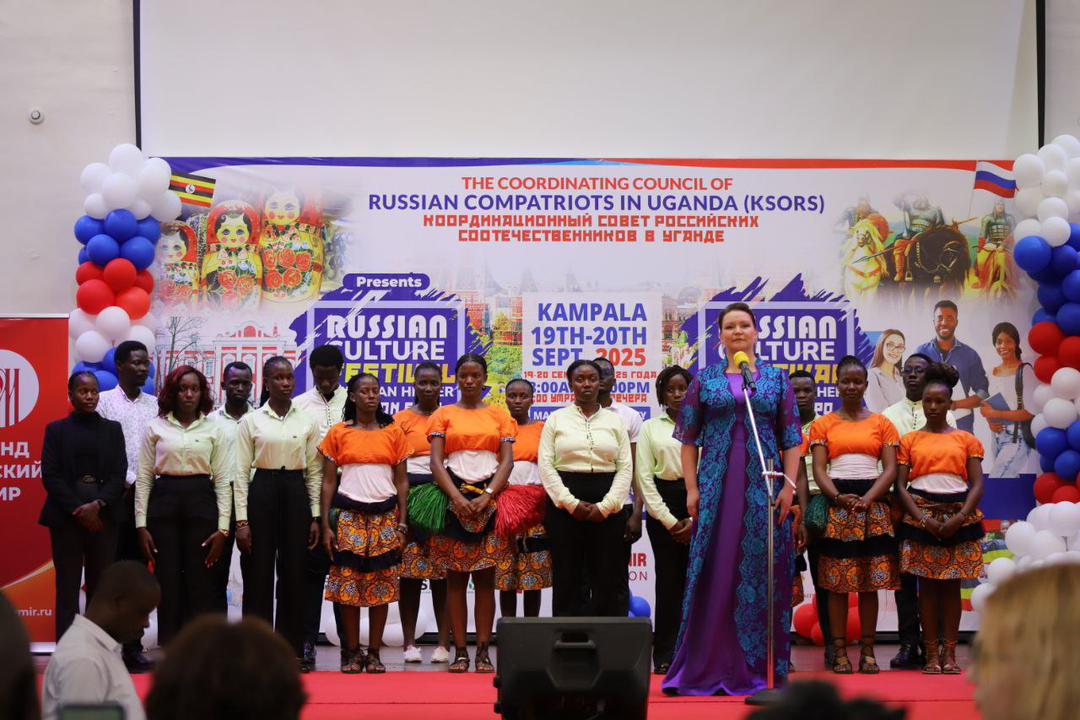
Through initiatives such as the Russkiy Mir Cabinet at Makerere University, free language courses, Olympiads, and cultural festivals, the embassy aims to deepen people-to-people relations. In 2025 alone, hundreds of Ugandan students enrolled in Russian language programmes supported by the embassy.
Semivolos notes that Russian culture shaped by literature, music, art, and history has global influence. Events such as Russian Language Day, celebrated every June 6, are used to showcase this heritage in Uganda.
A Classroom That Reflects a Bigger Shift
As the class at Makerere draws to a close, students exchange greetings this time in Russian. The Cyrillic letters on the board no longer seem as intimidating as they did at the start.
For these learners, Russian is more than a foreign language. It is a bridge to education, culture, and a world beyond familiar borders. And in a quiet classroom in Kampala, that bridge is being built one lesson at a time.