
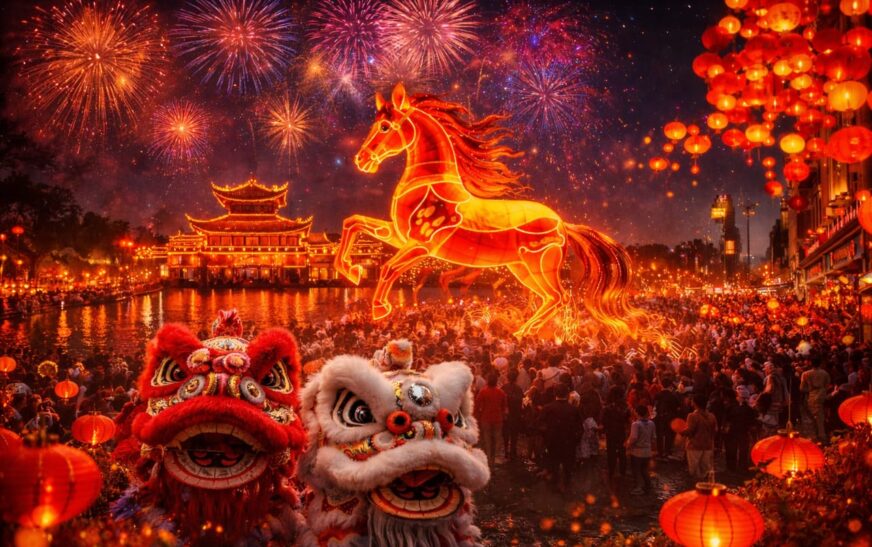
Fireworks exploded across the skies of Asia and major cities worldwide on as millions celebrated the Lunar New Year and ushered in the Year of the Fire Horse.
Known in China as the Spring Festival, the holiday begins with the first new moon between January 21 and February 20 and lasts 15 days, culminating in the Lantern Festival on March 3. In China, authorities have declared a week-long public holiday from February 17 to 23, though traditional celebrations often continue beyond this period as families reunite, travel, and take part in cultural rituals.
Under the Chinese zodiac, 2026 is the Year of the Horse — specifically, the Fire Horse — a symbol of courage, vitality, ambition, and rapid change. State media outlets such as Xinhua News Agency and CGTN have described the year as one of dynamism and progress, a theme often echoed in messages tied to economic and national development plans.
Massive travel movements were reported across China in what is widely considered the world’s largest annual human migration, as migrant workers and students returned home for reunion dinners on New Year’s Eve.
A highlight of the festivities was the 44th Spring Festival Gala, hosted by China Media Group and broadcast live to billions around the world. The show blended traditional performances, including lion and dragon dances, with modern stage effects and multilingual segments for global audiences.
Cities across China were adorned with red lanterns and horse-themed decorations symbolising luck and prosperity. Preparations began days earlier with “Little Year” on February 9, when families cleaned their homes to sweep away bad luck and make room for new blessings.
On New Year’s Eve, families gathered for reunion dinners featuring symbolic dishes such as fish for abundance and dumplings for wealth. Children and unmarried adults received red envelopes, known as hongbao, containing money to bring good fortune.
The third day of the festival, sometimes called “Red Mouth Day,” is traditionally observed by avoiding quarrels and promoting harmony. Temple visits, ancestral worship, and community performances continue throughout the week.

The Lunar New Year is celebrated not only in China but across East and Southeast Asia — as Tet in Vietnam and Seollal in Korea — and by diaspora communities around the globe.
Celebrations were reported in Hong Kong, where worshippers queued at temples at midnight to offer incense and prayers. Fireworks and countdown concerts lit the night in Vietnam, while dragon dances brought Chinatowns from New York to Buenos Aires alive with colour and sound. In Europe and the Middle East, cities such as Milan and Dubai hosted lantern festivals and cultural performances, reflecting the holiday’s expanding global reach.
This year’s festivities coincided closely with the start of Ramadan and Lent, creating a rare overlap of major global observances in the same week.
For many, the Year of the Fire Horse begins not just with fireworks and celebration, but with renewed hopes for family harmony, community resilience, and forward momentum in the year ahead.