
South Korea has urged Uganda to establish a resident diplomatic mission in Seoul as the two countries seek to deepen trade ties, following a new agreement that could significantly increase Uganda’s coffee exports to the Asian market.
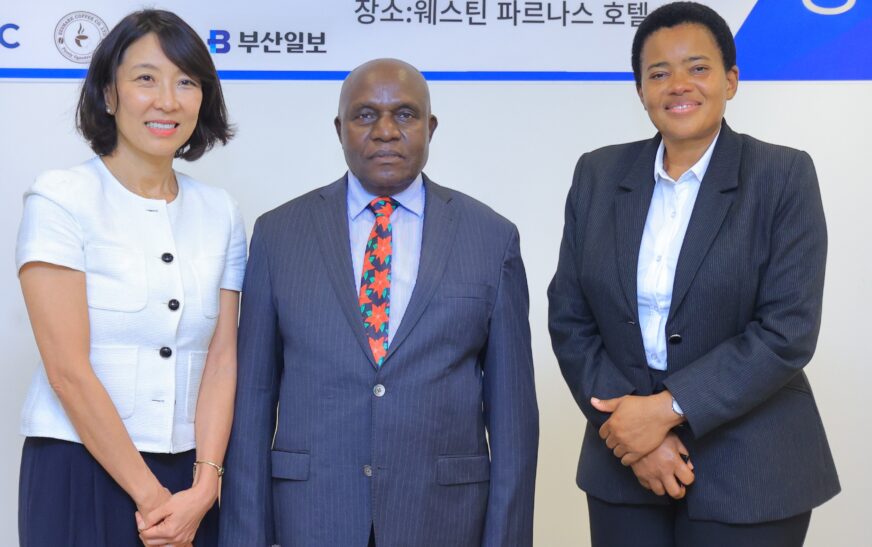
The call by the Korea International Trade Association (KITA), one of the organisers of the Uganda-Korea Trade and Investment Meeting, comes days after Ugandan coffee exporter Besmark Coffee Company Ltd signed a memorandum of understanding with South Korean firm GVCC Co. Ltd.
The agreement, signed on September 7 in the South Korean port city of Busan, provides for Besmark to become Uganda’s exclusive coffee supply partner, while GVCC will distribute the coffee in South Korea.
The first consignment of two containers is already being shipped to South Korea.
The deal is being viewed by Ugandan officials as an opportunity to use South Korea as a gateway to the wider Asian market, with the partners planning to develop Busan into a regional hub for processing, adding value to and re-exporting Ugandan coffee to markets including Japan and Southeast Asia.
But KITA says Uganda’s commercial ambitions in South Korea would be strengthened by having a permanent diplomatic presence in Seoul.
Uganda currently has no resident embassy in South Korea. Its embassy in Tokyo, Japan, is accredited to Seoul.
The absence of a resident mission comes at a time when Ugandan coffee is attracting increasing interest from South Korean businesses.
GVCC chief executive Soo-jung Lim said her company had developed an interest in Ugandan coffee after initial engagements with the Ugandan delegation at a coffee exhibition in Busan.
Lim is now targeting imports of up to one 20-tonne container of Ugandan coffee a day, a demand that Ugandan officials estimate could translate into about 3,500 tonnes annually.
Uganda’s ambassador to Japan, Tophace Kaahwa, said the scale of the proposed business would require Ugandan farmers to increase production to take advantage of the Korean market.
The coffee agreement was signed on the sidelines of the Uganda-Korea trade meeting, which brought together government officials and businesses from both countries to explore opportunities for increased trade and investment.
Uganda’s Second Deputy Prime Minister, Dr Crispus Kiyonga, who led the Ugandan delegation, welcomed the Korean company’s interest and assured it of sustained supplies.
He said Uganda also wants to move away from exporting raw commodities and increase domestic value addition before its products reach international markets.
The push comes as Uganda seeks to diversify its coffee export destinations.

Europe currently dominates Uganda’s coffee market, taking about 62 per cent of the country’s exports in the 2024/25 coffee year. Africa accounted for 23 per cent, while Asia took only 13 per cent.
South Korea therefore offers Uganda an opportunity to expand its presence in a market where its coffee exports remain relatively small.
Official data shows that Uganda exported goods worth about $7.18 million to South Korea in 2023, with coffee, tea and spices accounting for about $2.6 million. Uganda, meanwhile, imported about $100 million worth of goods from South Korea, according to officials.
The trade imbalance is one of the reasons Uganda is seeking to increase exports to the Korean market.
The new coffee agreement could provide an immediate avenue for doing so.
Uganda exported 8.6 million 60-kilogramme bags of coffee worth about $2.3 billion (Shs8.3 trillion) in the 12 months to May 2026, up from 7.4 million bags during the previous year, according to the Ministry of Agriculture, Animal Industry and Fisheries.
Robusta accounts for about 80 per cent of Uganda’s coffee exports, while Arabica, although produced in smaller quantities, is growing faster in value.
The government is now seeking to turn the growing demand into longer-term commercial relationships across Asia.
The coffee deal is also being presented as an early result of Uganda’s Economic and Commercial Diplomacy strategy, launched in 2025 to encourage Ugandan diplomatic missions to actively promote exports and investment.
For Uganda, however, the Korean call for a resident embassy raises a broader question about how effectively the country can pursue its growing commercial interests in Asia without a permanent diplomatic presence in Seoul.
The coffee agreement has demonstrated that there is demand for Ugandan products. The challenge now is whether Uganda can build the diplomatic and commercial infrastructure needed to turn that interest into sustained trade.
With GVCC already preparing to receive Ugandan coffee and targeting thousands of tonnes annually, South Korea could become an important new market—and potentially a gateway for Uganda’s coffee into the wider Asian economy.