
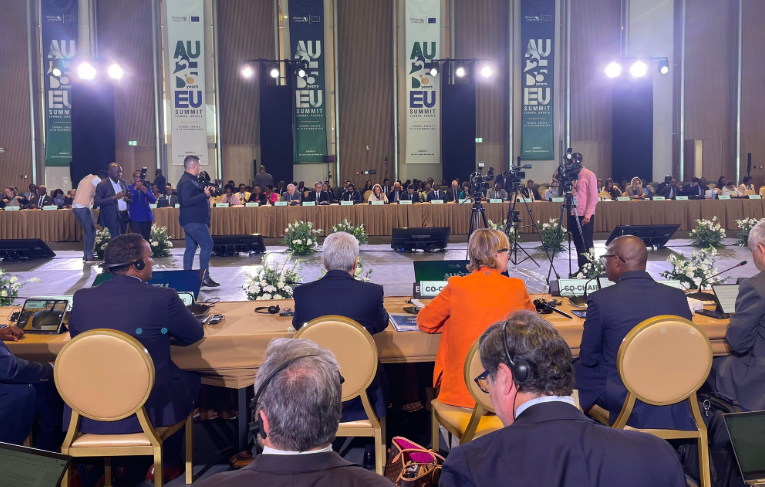
Senior Ugandan and European Union diplomats have called for a renewed, people-centred partnership grounded in peace, development, and industrial expansion as Africa and Europe prepare for the 7th African Union–European Union Summit in Luanda, Angola.
The remarks were made during a high-level dialogue at Fairway Hotel in Kampala, hosted by the Uganda Council of Foreign Relations (UCFR), as Uganda joins the continent in marking 25 years of the AU–EU partnership.
The upcoming summit, set for 24–25 November 2025, will commemorate a quarter century of political, economic, and social cooperation under the theme “Promoting Peace and Prosperity through Effective Multilateralism.”
Among the speakers at the Kampala dialogue were EU Ambassador to Uganda, H.E. Jan Sadek, Ambassador John Leonard Mugerwa, Head of International Legal and Social Affairs representing the Ministry of Foreign Affairs Permanent Secretary Bagiire Vincent Waiswa, Gen. Ivan Koreta (Rtd.), Chairperson of UCFR, and Ambassador Francis Katana, the organisation’s Executive Director.
Ambassador Mugerwa stressed that Africa’s development prospects remain inseparable from peace and stability.
“Without peace, we cannot have development. And without development, peace cannot be sustained. But the beginning point is peace,” Mugerwa noted, adding that conflicts across Africa continue to uproot communities and weaken national progress.
He highlighted Uganda’s humanitarian burden, revealing that the country now hosts about 1.9 million refugees, making it one of the largest refugee-hosting nations in the world.
“These individuals want to return home once stability is restored. They are here because they feel insecure in their countries. That is why we must work together to address the root causes of these conflicts,” he said.
Mugerwa called for predictable and long-term international support for peacekeeping efforts, arguing that Africa’s ambitions industrialisation, stronger regional trade, digital innovation, and value addition depend heavily on strategic partnerships.
He welcomed the growth in AU–EU cooperation but urged for deeper engagement, especially given this year’s partnership theme, which he said places “people at the centre.”
Mugerwa pointed to Uganda’s strong economic ties with Europe, supported by the EU’s Global Gateway Africa–Europe Investment Package, a €150 billion initiative designed to upgrade connectivity, infrastructure, and trade opportunities.
“In Uganda, our trade with the EU now exceeds €2 billion annually, and investment flows are also in the billions. If this level of engagement were mirrored across Africa, the opportunities would be immense,” he said.
He added that Africa’s population trajectory from 1.4 billion today to 2.5 billion by 2050 makes such partnerships even more vital for job creation and industrial growth.

EU Ambassador Jan Sadek reiterated Europe’s commitment to a partnership built on shared responsibility and co-ownership, noting that the Luanda Summit comes at a pivotal moment after 25 years of structured cooperation since the first summit in Cairo.
“Our two continents are bound by geography, by history, and above all by interdependency,” he said. “Europe remains Africa’s first trading partner, first investor, first provider of development and humanitarian assistance, and the first partner on peace and security.”
He noted that Africa collectively ranks as the EU’s fourth-largest trading partner, reflecting strong and expanding economic ties.
Sadek also revealed that over half of all Global Gateway flagship investments worldwide are in Africa, covering renewable energy, vaccine manufacturing, digital innovation, and major transport corridors.
“These are not promises on paper they are projects already transforming the continent,” he said, describing the €150 billion package as a catalyst for Africa’s industrialisation and value addition.
On mobility and education, Ambassador Sadek highlighted that academic exchanges between Africa and Europe have significantly expanded.
“Since 2022, more than 30,000 African students and staff have moved to Europe under EU-funded mobility schemes, and 18,000 Europeans have gone to African institutions,” he said.
He emphasized that migration cooperation continues to focus on “legality, balance, and shared responsibility.”
Looking ahead to the summit, Sadek said both continents are entering a new phase.
“This is no longer a partnership framed by systems. It is a relationship based on co-ownership and joint solutions for peace, prosperity, and people,” he noted.