
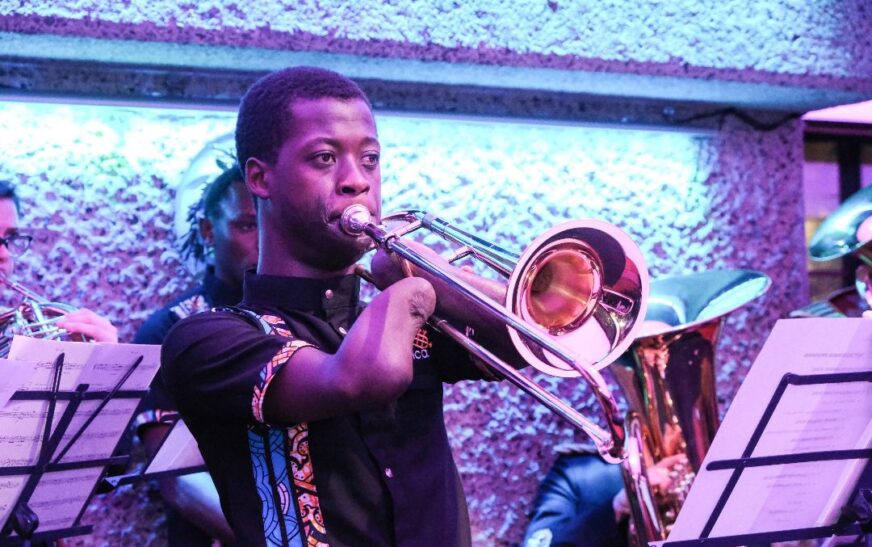
I first saw Kamukama Taddeo performing a soulful South African melody on a flat trombone. From a distance, the music pulls you in warm, steady, and impossibly precise. You instinctively want to move closer, to see the musician bring each note to life.
But up close, reality hits: Taddeo has no arms or legs, yet he plays with a mastery and grace that many musicians can only dream of.
Kamukama now works as a music teacher and life skills assistant at Brass for Africa, where he teaches and empowers children with disabilities through music—the same lessons that gave him hope and a renewed sense of purpose.
Born in Kabale, Kamukama was like any other child, with arms and legs. But at just seven months old, a tragic fire accident left him without limbs.
“I was too young to understand at the time, but I was told the fire accident took both my arms and legs,” he recalls.
Growing up in Kabale, he lived with his grandmother and loved his mother dearly. In 2007, his mother moved him to Good Shepherd Home in Kampala, a facility for people with disabilities.
“That was the saddest time of my life. I loved my mum, but I kept asking myself why she left me here. I didn’t know anyone, and I kept wondering, ‘Why am I in this place? Why is she leaving me here?’” he says.
Music Enters His Life
Life began to change in 2010 when instructors from Brass for Africa introduced music to Good Shepherd Home.
“They came, performed a little, and I was inspired. For the first time, life felt different. There was happiness where there used to be only sadness. Before that, I would just wake up and think about life and even wish to meet God soon. But after they returned, I got interested in music and found hope for life,” he recalls.
Initially fascinated by various band instruments, Kamukama soon discovered that the B flat trombone was his natural fit. Over time, he mastered it fully.
By 2013, at the age of 12, Kamukama left Good Shepherd Home and started living with a partner organization of Brass for Africa. There, he was treated like any other child and eventually moved to M Lisada Organisation, which offered an inclusive, supportive environment for children with disabilities.
“They never segregated us,” he notes. “Everything was shared, and everyone got equal opportunities. That’s why I am who I am today.”
Staying in these foundations gave Kamukama a sense of family after losing both parents at an early age.
First Music Performance
His first public performance took place at a Rotary event in Munyonyo, where he shared the stage with other performers living with disabilities. Initially shy and inexperienced, he also performed in military parades before realizing that music could break barriers.
Eventually, Kamukama performed on international stages, including Cheltenham and a renowned London jazz venue, sharing the stage with some of the world’s greatest jazz artists.
Music as Therapy

For Kamukama, music is not just therapy—it’s a healer. Before learning music, he struggled with anger, isolation, and hopelessness.
“I couldn’t share my pain or see a future for myself. I thought education didn’t matter for someone like me,” he says.
Music changed that, teaching him discipline, creativity, cooperation, and resilience. It encouraged him to leave his comfort zone, improve his memory, explore new skills, and even return to school with renewed motivation.
Becoming a Teacher and Mentor
As a music teacher and inclusion assistant with Brass for Africa, Kamukama inspires others by showing what is possible.
“When children see someone without hands teaching music, it motivates them. If I can do it, they believe they can too,” he explains.
He ensures that students learn rhythms and notes, regardless of their instrument, and adapts teaching methods to meet their needs.
Education Journey
Kamukama’s education began at St. Athanasius Primary School, where overcrowded classes made learning difficult. He later repeated a year at Train Up Primary School to build a strong foundation in reading and writing, supported by private tutors from the Mahalanobis family.
He completed primary school at Cinderella Primary School, secondary school at Tropical High School, and is now pursuing a Bachelor’s degree in Computer Science at Cavendish University, focusing on developing apps for people with disabilities.
Advocacy and Inspiration
Inspired by Australian evangelist Nick Vujicic, Kamukama uses his platform to champion disability inclusion, helping people access services such as driving licenses and national ID cards.
Future Plans
Kamukama envisions representing persons with disabilities in parliament and using his computer science training to develop tools that improve their daily lives. Musically, he continues to grow as a trombonist, aiming to create a life of skill, inspiration, and meaningful impact rather than financial gain alone.
“I want to combine my music, teaching, computer science, and advocacy to provide dignity, opportunity, and accessible services for people with disabilities,” he says.