
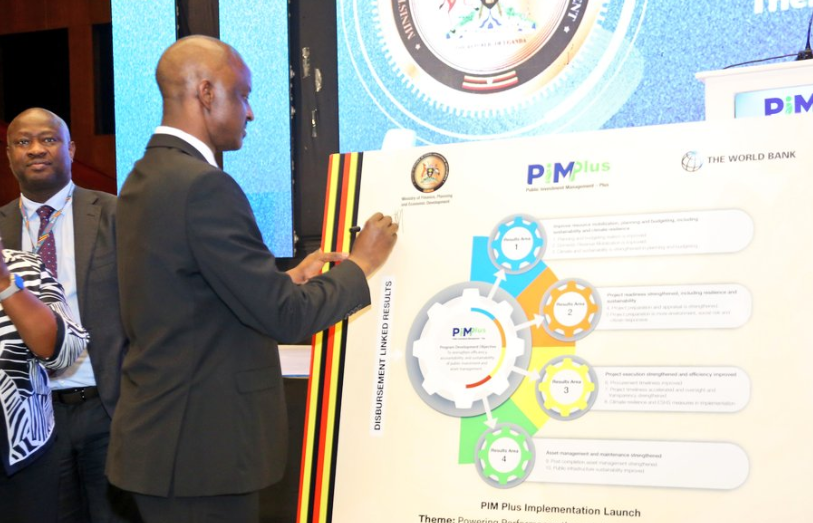

The Government of Uganda has unveiled what it calls a groundbreaking USD 200 million (Shs 830 billion) Public Investment Management (PIM) PLUS Operation—an ambitious reform intended to transform how the country plans, prepares, and delivers public investments.
At first glance, it looked like a familiar development story: the World Bank financing a system meant to strengthen government processes and enforce accountability. But beneath the speeches and camera flashes, a more subtle shift was taking place.
Presiding over the launch, Dr. Ramathan Ggoobi, the Permanent Secretary and Secretary to the Treasury, declared that PIM PLUS marked the end of Uganda’s old expenditure-driven culture.
“No more releasing money just because a budget exists. Funds will be unlocked only when Disbursement Linked Indicators and Intermediate Results Indicators are met and independently verified,” he said.
What wasn’t immediately obvious is that this Program for Results (PforR) model does more than bolster institutions, it quietly reshapes the balance of power. Under the new arrangement, resources flow only when specific milestones are met. If they aren’t, everything stalls.
In theory, the logic is undeniable. Uganda has long grappled with weak project preparation, stalled execution, poor infrastructure maintenance, and climate-related losses exceeding USD 140 million annually. PIM PLUS is positioned as the cure for a chronic governance illness.

Of the total funding, USD 40 million will fortify the Project Preparation Facility under the National Planning Authority, ensuring that projects are neither rushed nor underdesigned.
The remaining USD 160 million will support investments aligned with the National Development Plan IV and the Tenfold Growth Strategy finally giving the All Ten Ministries Strategy (ATMS) the fuel it requires.
The World Bank celebrated the milestone, issuing statements praising Uganda for adopting a model that promises transparency, efficiency, and sustainability.
Yet in a system where money moves only when targets are verified as achieved, the core of power shifts. It no longer lies in the projects themselves but in the authority to confirm whether those targets were truly met.

Author