
It should have been impossible. A theatre troupe leaving Kampala’s polished stages to perform on a jagged, rain-slicked outcrop in rural eastern Uganda? Many would have called it folly.
Yet Bantalo East did exactly that, hauling drums, lights, and costumes for more than four hours to Kachonga village in Butaleja District—armed with little more than courage, creativity, and the belief that culture belongs to everyone. And then the storm hit.
A heavy afternoon downpour turned the makeshift stage into a slippery battlefield. Sound equipment hummed dangerously, mud clung to every surface, and organisers dashed like actors in a slapstick play, shielding drums, mopping floors, and untangling lights. Children clung to rocks as if they were ships at sea; elders huddled under plastic sheeting that flapped like sails in the wind. For a moment, it seemed the rain had won.
But just when hope seemed lost, a drumbeat cut through the storm, low and defiant. Kachonga’s hills answered back. The audience rose, a chorus of anticipation, as if the land itself had decided to dance.
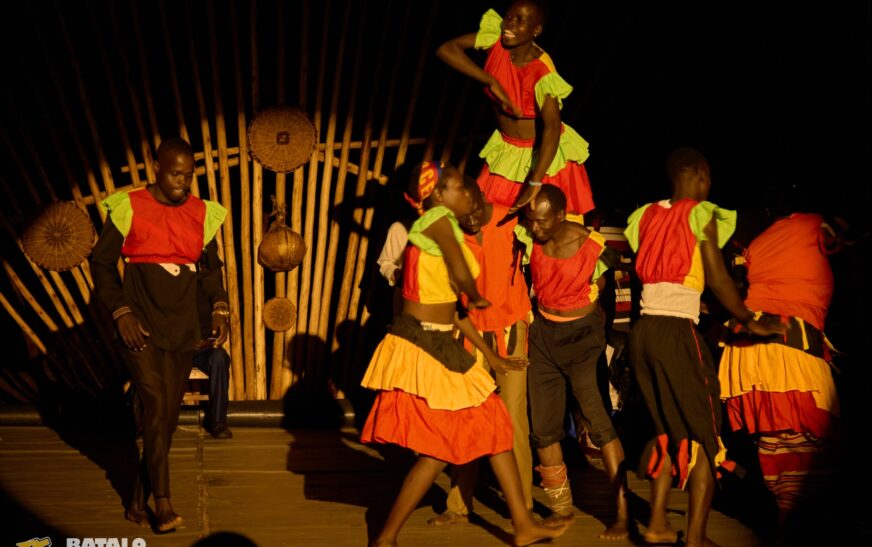
The opening act was raw and alive. Kinyole traditional dances and songs erupted, accompanied by thumb pianos, drums, xylophones, and shakers. For some, it was home—a familiar rhythm echoing from childhood. For others, it was revelation—a reminder that tradition isn’t a relic, but a heartbeat. Voices joined in, feet found rhythm on stone, and the invisible walls between performer and audience vanished.
Then came the twist. Artists from China, Switzerland, and the Netherlands joined local performers, weaving traditional movement with contemporary forms. Identity, power, and the Banyole legacy collided on stage. Sometimes the fusion was harmonious, sometimes jarring—but always electrifying. The old met the new not politely, but boldly, forcing both performers and audience to rethink what dance could be.
This collision is Bantalo East’s signature. Founded in 2013, the troupe has made it their mission to take performances beyond city theatres into communities that rarely see live contemporary art. They draw from Tabu Flo Dance Company, Breakdance Project Uganda, and other collectives, blending street dance, hip hop, and experimental theatre with traditional African forms.
“You can’t capture this in words,” said arts official Edriana Kabajungu. “Watching Bantalo East is like watching history collide with the future—and somehow, it works.”

The festival pulses with diversity: Afro House, Top Rock, Krump, New Style Hip Hop, Style Yake, and all-style crew battles brush shoulders with curated showcases. Mubiru, the director, watched as street dance collided with nods to queer nightlife and the political history of social movement.
“Every movement tells a story; every rhythm carries memory,” Mubiru said. “And yet, it’s unpredictable—always more than the sum of its parts.”
Artists from Uganda and beyond continue to take the stage, reinforcing the festival’s global vision. Alongside the performances, an urban market hums with life, selling wares inspired by the ongoing conversation between tradition and modernity.
From the storm-soaked hills of Butaleja to the bright lights of Kampala, Bantalo East is quietly rewriting the rules. Here, dance defies expectation, culture adapts, and art refuses to sit still—rain or shine, chaos or calm.