
Soroti Fruit Factory has registered average annual losses of Shs 5.5 billion, the Daily Star Uganda has learned.
According to the recently released Auditor General’s report, the company’s performance over the last four years shows that it has incurred losses averaging Shs 5.5 billion per year.
“The company’s operating loss increased by 22 percent from Shs 4.391 billion in the financial year 2023/2024 to Shs 5.371 billion in 2024/2025, further widening the accumulated deficit,” the report states.
The Return on Assets (ROA) as of June 30, 2025, stood at negative 6.49 percent, indicating that the company is failing to generate sufficient revenue from its asset base to cover operational costs.
The Auditor General also noted governance concerns at the company.
“I observed that since January 2023, Soroti Fruits Limited has not held an Annual General Meeting and has not filed any returns since December 2017. Soroti Fruits Limited has also not issued share certificates to its shareholders,” the report indicates.
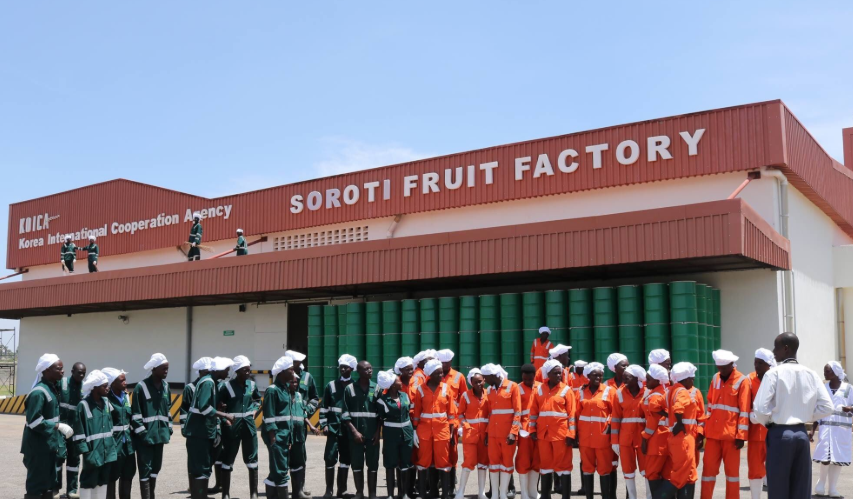
Located in Arapai Sub-county, Soroti District, the factory was launched in 2019 following four years of construction that began in 2015.

Commissioned by President Yoweri Museveni, the factory was built by the Korea International Cooperation Agency (KOICA), which signed a memorandum of understanding with the Government of Uganda through the Uganda Development Corporation (UDC), in partnership with the Teso Tropical Fruit Growers Cooperative Union (TETFGCU). The project was intended to capitalize on the abundant citrus production in the Teso sub-region and the high yield per tree.
The Government of Uganda provided land, water, electricity, and access roads, while the Government of South Korea contributed $7.4 million for machinery and staff training.
Construction began in April 2015 and was initially scheduled for completion in May 2016. Installation and commissioning of machinery were expected by October 2016, with commercial operations slated for November 2016.
However, after several delays, the factory began test runs in May 2018, with commercial commissioning planned for August 2018.
The factory processes juice from oranges, mangoes, and pineapples. It is also preparing to launch its Teso Juice brand, “Teju,” onto the Ugandan market.