
Uganda has set its sights on expanding trade and attracting investment after officially confirming its participation in Expo 2027 Belgrade, positioning the global event as a launchpad for new international partnerships.
Government officials say the country will use the high-profile exhibition to push its socio-economic transformation agenda while tapping into global conversations around sustainable development.
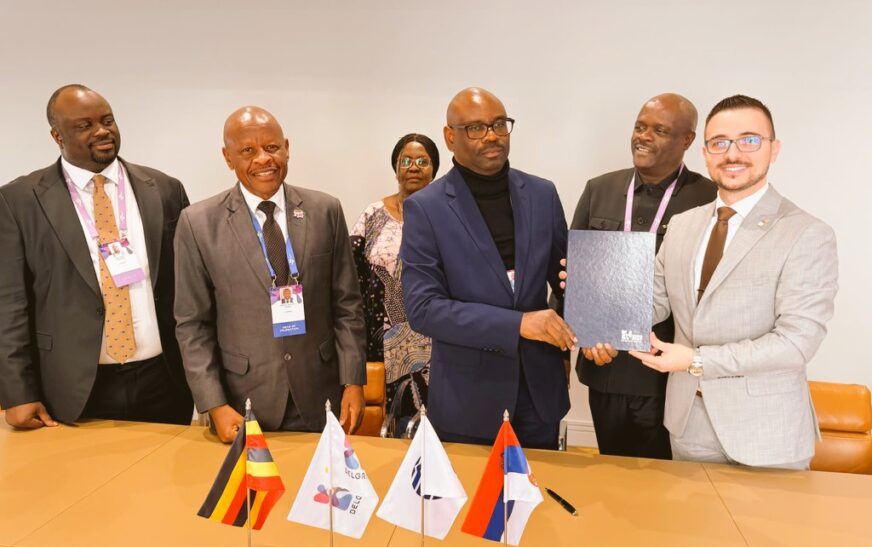
“We are looking at Expo 2027 as a strategic platform to build strong global partnerships that can drive Uganda’s transformation,” said Wilson Mbadi Mbasu following the signing of the Participation Contract.
The agreement was sealed during the 2nd International Participants Meeting held from March 10–12, 2026 at the Sava Centar in Belgrade, formally placing Uganda among more than 120 countries expected to showcase their economic and cultural potential at the event.
Uganda’s delegation, led by Gen. Mbadi, brought together key trade and diplomatic figures including Matthew Bagonza of the Presidential Advisory Committee on Exports and Industrial Development (PACEID), Ambassador Elizabeth Paula Napeyok, and Commissioner Cleopas Ndorere, among others.
For Kampala, the Expo is more than a cultural showcase—it is a calculated economic move.
Officials view the event as a gateway to new markets, foreign direct investment, and knowledge exchange, with Uganda keen to position itself as a competitive trade and investment destination.
Gen. Mbadi emphasized that Uganda’s participation will go beyond exhibition, focusing on building meaningful collaborations and learning from global innovations.
On the sidelines, Uganda deepened ties with Serbia through bilateral talks with officials including Jagoda Lazarević and Dušan Kozarev. Both sides expressed commitment to expanding cooperation in trade, education, and investment—signaling a growing partnership between the two nations.
Serbia also reaffirmed its support through initiatives like the “World in Serbia” programme, which has already benefited Ugandan students and professionals.
Despite warming relations, trade between the two countries remains modest—but rising fast.

Uganda’s exports to Serbia jumped to about $3.25 million in 2024, up sharply from just $67,860 in 2022. Coffee dominates the export basket, followed by cocoa, with cut flowers emerging as a promising addition.
Officials believe Expo 2027 could significantly accelerate this growth.
Matthew Bagonza used the moment to court global investors, highlighting Uganda’s potential across sectors such as agro-processing, energy, tourism, ICT, logistics, and healthcare.
“Uganda is open for business and offers a strategic gateway to regional and continental markets,” he said.
The country’s participation also aligns with its broader push for export-led industrialization, spearheaded by PACEID, which is shaping Uganda’s global trade strategy.
Scheduled from May 15 to August 15, 2027, Expo 2027 Belgrade will run under the theme “Play for Humanity: Sport and Music for All,” bringing together innovation, culture, and global dialogue.
For Uganda, the real goal is clear: turn visibility into value.
With the contract signed, attention now shifts to crafting a compelling national pavilion—one that not only tells Uganda’s story but converts global interest into real economic gains.