
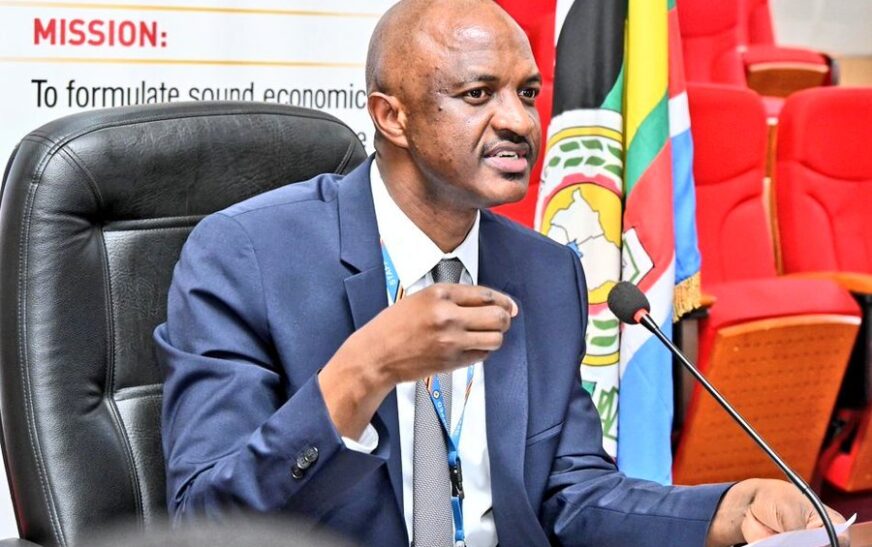
The Government has released Shs 17.444 trillion for the fourth quarter of the Financial Year 2025/26, bringing the total cumulative release to Shs 77.001 trillion, according to the Permanent Secretary and Secretary to the Treasury, Ramathan Ggoobi.
Presenting the quarter four expenditure framework, Ggoobi said the releases represent 106.4 percent of the approved budget and 95.1 percent of the revised budget, reflecting sustained fiscal operations.
“The quarter four expenditure limits have been informed by the need to sustain the momentum for implementation of the tenfold growth strategy but within the framework of the fiscal consolidation agenda,” Ggoobi said.
He added that the approach prioritises macroeconomic stability and fiscal discipline while ensuring continued investment in key sectors of the economy.
“We have maintained total expenditures within the available resources while sustaining financing to wealth creation and critical priority actions under Agro industrialisation, Tourism development, Mineral development, and Science, Technology and Innovation,” he said.
A significant portion of the quarter four release has been allocated to statutory obligations, with Shs 6.38 trillion earmarked for debt and treasury operations, Shs 2.04 trillion for wages and salaries, and Shs 343.39 billion for pensions and gratuity. Parliament, the Judiciary and the Office of the Auditor General have also received funding to support their operations.
Under the government’s growth strategy, funding has been directed towards agro industrialisation, tourism promotion, mineral development including oil and gas activities, as well as expansion of internet connectivity and digitisation.
Ggoobi said government has also fully released the remaining Parish Development Model funds amounting to Shs 542.3 billion to support wealth creation at the grassroots.
In the security sector, allocations have been made to the Ministry of Defence, State House, Uganda Police Force and other agencies to maintain national stability, while infrastructure development continues to receive substantial financing, particularly in transport, energy and urban development projects in Greater Kampala.
The health and education sectors have also received significant funding, including Shs 342 billion to National Medical Stores for essential medicines and Shs 372.88 billion to the Ministry of Health. Additional funding has been provided to specialised institutions such as the Uganda Cancer Institute and the Uganda Heart Institute.
Local governments have received Shs 519.8 billion to facilitate service delivery and implementation of development projects across the country.
Government has also set aside Shs 454.2 billion in the quarter to clear domestic arrears, bringing the total allocation for arrears this financial year to Shs 973.1 billion.

Ggoobi urged accounting officers to prioritise payment of service providers and avoid accumulation of new arrears.
“All Accounting Officers should prioritise payment of service providers, ensuring that all domestic arrears which have been released are settled, as well as non accumulation of new arrears,” he said.
He also called on citizens to actively monitor government programmes and track service delivery using available public information platforms.
On the state of the economy, Ggoobi said Uganda continues to register strong growth, with preliminary estimates indicating that the economy expanded by 8.5 percent in the second quarter of the financial year, up from 5.4 percent in the same period last year.
“The average economic growth for the first half of FY 2025/26 increased to 6.7 percent from 5.8 percent during the same period last year,” he said.
He attributed the growth to strong aggregate demand, increased investment and exports, as well as improved performance across the industrial, services and agricultural sectors.
According to the Treasury, the economy is projected to grow to 7.0 percent by the end of the financial year, with Gross Domestic Product expected to reach 68.4 billion dollars.
Ggoobi noted that the Uganda shilling has remained stable while inflation has been contained at an average of 3.3 percent, reflecting prudent economic management.
“I wish to assure Ugandans that the economy has proven to be stable and resilient despite global shocks,” he said.
He added that government will continue to monitor revenue performance and maintain prudent spending to ensure a strong close to the financial year.