
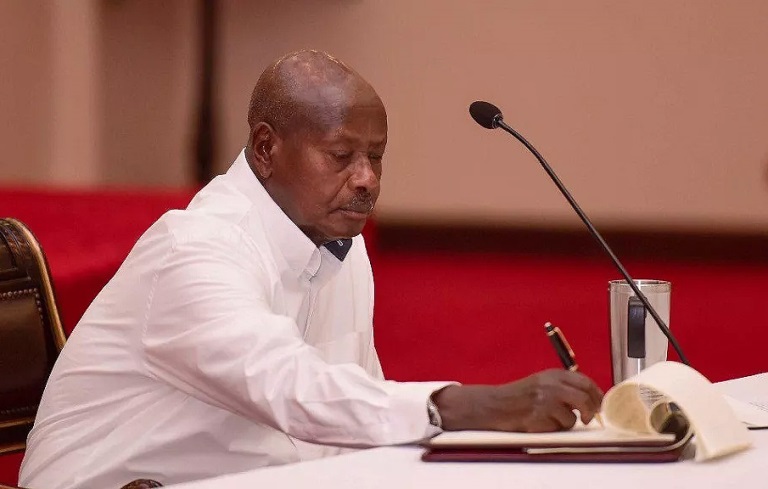
President Yoweri Museveni has assented to the Protection of Sovereignty Bill, 2026, officially turning it into law, barely two weeks after it was passed by Parliament.
The legislation was approved following the adoption of the committee report and clause-by-clause consideration, capping weeks of intense debate over its provisions.
Tabled on April 15, 2026, by State Minister for Internal Affairs David Muhoozi, the Bill attracted sharp reactions from lawmakers, legal experts, civil society organisations, and academia.
Prior to its passage, the Bill underwent scrutiny by parliamentary committees, with the ruling National Resistance Movement (NRM) caucus signalling support.
At its core, the new law seeks to regulate foreign funding and influence in Uganda. Government has argued that the measures are necessary to safeguard national sovereignty from external interference.
The law establishes a framework for the registration, monitoring, and control of individuals and entities deemed to be agents of foreign interests, while tightening oversight on financial flows, partnerships, and related activities.
Key amendments
During scrutiny, the committee raised concerns over vague provisions in the original draft, particularly the introduction of offences such as economic sabotage and interference without clear definitions.

Lawmakers subsequently pushed for greater clarity and adjustments to proposed sanctions.
The committee also flagged the broad definition of a “foreigner” and an “agent of a foreigner,” warning that it risked capturing Ugandans in the diaspora. Amendments were introduced to refine these definitions and safeguard legitimate economic, academic, humanitarian, and civic activities.
Parliament further amended Clause 21 to limit the requirement for declaration of funding sources to individuals and entities formally classified as agents of foreign interests.
Under the law, Clause 13 criminalises economic sabotage, prescribing penalties of up to Shs2 billion for organisations and Shs1 billion for individuals, or imprisonment of up to 10 years.
The offence is defined as acts by an agent of a foreigner who knowingly publishes false information or engages in conduct that weakens or undermines the country’s economic system.