
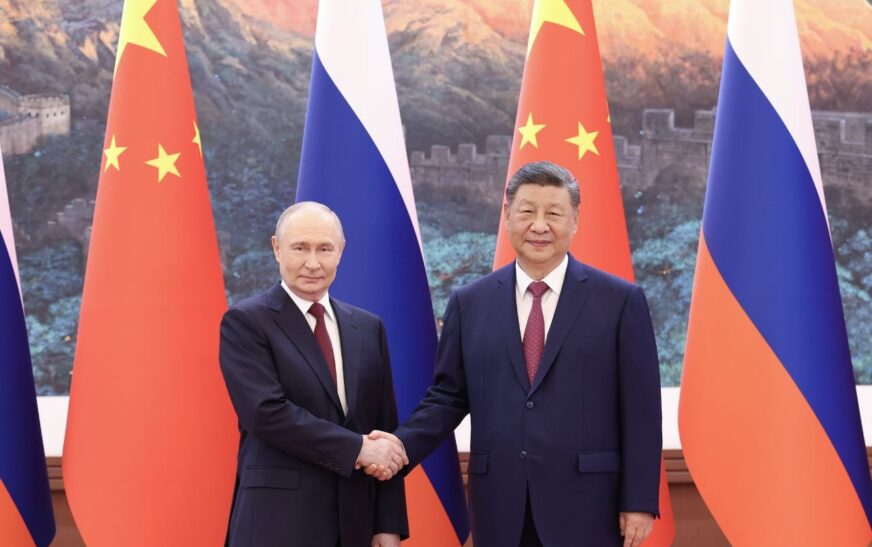
Russian President Vladimir Putin and Chinese President Xi Jinping have moved to tighten their geopolitical alignment, extending the Treaty of Good-Neighborliness, Friendship and Cooperation while jointly reinforcing their push for what they describe as a “multipolar world order.”
The developments were unveiled during Putin’s state visit to Beijing, where the two leaders held wide-ranging talks and signed nearly 40 agreements spanning energy, defence, trade, transport, science, education and cultural exchange.
The visit underscored the growing strategic convergence between Moscow and Beijing at a time of deepening tensions with the West and shifting global power dynamics.
At the centre of their discussions was a joint declaration titled “On the Emergence of a Multipolar World and International Relations of a New Type,” in which the two sides argued that global power is steadily moving away from Western dominance toward a more “polycentric” international system.
The statement accused some countries of attempting to “single-handedly manage world affairs” and impose policies reminiscent of the colonial era, warning that such unilateralism and sanctions-based pressure were destabilising global order.
Russia and China called instead for a “more just and rational system of global governance,” pledging to strengthen the role of the United Nations while resisting what they described as geopolitical domination by any single power.
Xi said the renewed treaty would reinforce strategic coordination between the two countries at a time of global uncertainty, describing Russia-China relations as increasingly vital to international stability.
Originally signed in 2001, the treaty has long served as the foundation of bilateral relations, but both sides say its relevance has grown amid rising geopolitical friction.
Putin, describing relations as being at an “unprecedented level,” said cooperation between Moscow and Beijing is no longer dependent on global political cycles.
“Our relations do not depend on the current global situation and serve as an example of how relations between countries should be built today,” he said, repeatedly referring to Xi as a “dear friend.”
Xi, in turn, praised what he called the “courage and resilience” of both nations in defending international justice during turbulent global conditions.
Alongside geopolitical messaging, the two leaders unveiled a major cultural initiative, declaring 2026–2027 as the China-Russia Years of Education.
The programme is expected to expand university partnerships, student exchanges, language training, research collaboration and broader people-to-people ties between the two countries.
Chinese officials said the initiative would deepen long-term social and strategic trust, reinforcing what both sides describe as a “comprehensive partnership of coordination.”
Putin arrived in Beijing with a high-level delegation of senior officials and business leaders, including Foreign Minister Sergey Lavrov, Kremlin spokesperson Dmitry Peskov, Finance Minister Anton Siluanov and Deputy Prime Minister Alexander Novak.
Kremlin aide Yuri Ushakov said discussions also covered Ukraine, Iran, relations with the United States and cooperation within multilateral blocs such as BRICS.

Economic ties featured prominently, with Russia reporting that trade with China has increased more than thirty-fold over the past 25 years. Much of this trade is now conducted in rubles and yuan, reducing reliance on Western financial systems and insulating transactions from sanctions pressures.
Energy cooperation remained a central pillar of the talks.
Key discussions focused on the proposed Power of Siberia 2 pipeline, which is expected to deliver up to 50 billion cubic metres of gas annually from Russia to China via Mongolia, with negotiations now nearing completion.
Putin reaffirmed Russia’s role as a major energy supplier, pledging continued exports of oil, gas, LNG and coal to the Chinese market despite global instability.
Transport infrastructure was also on the agenda, including expansion of rail links such as the Zabaykalsk–Manchuria corridor and broader connectivity projects linking Russia, China and Central Asia.
Military and security cooperation featured prominently as well, with both countries pledging to deepen defence trust, expand joint exercises, increase maritime and air patrols and enhance coordination on regional security threats.
The two sides also reaffirmed cooperation in space exploration, including participation in the International Lunar Research Station and other deep-space initiatives.
In a joint critique, Moscow and Beijing also took aim at the United States’ proposed “Golden Dome” missile defence system, calling it destabilising and a threat to strategic balance.
On global conflicts, the two leaders reiterated support for diplomatic solutions to the war in Ukraine and called for addressing what they described as its “root causes,” while also condemning recent Western strikes on Iran as violations of international law.
Despite Western concerns over their deepening partnership, both leaders insisted the alliance is not directed against any third country.
“We are not friends against anyone,” Putin said. “We are working for our own development and interests.”
The visit also extended visa-free travel arrangements between the two countries until the end of 2027, a move expected to boost tourism, education and business exchanges.
Putin concluded by inviting Xi to Russia next year, signalling continued high-level engagement as both nations position themselves as central architects of an emerging global order.