
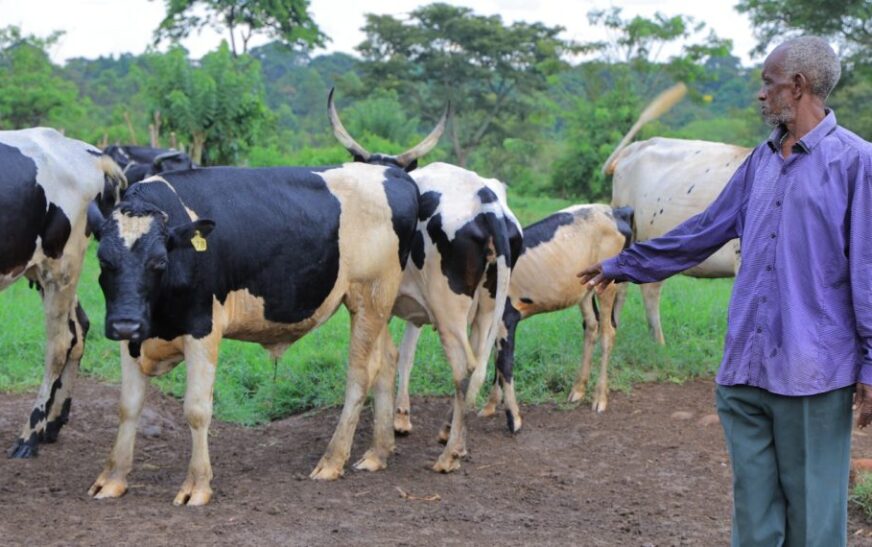
In Uganda’s cattle corridor, where prolonged dry spells have long undermined agricultural productivity, dairy farmers in Nakaseke district are increasingly adopting solar-powered irrigation systems to sustain fodder production and stabilise milk yields.
The shift reflects a growing embrace of renewable energy as a practical response to climate change, with farmers using solar solutions not only to pump water and cool milk, but also to irrigate pasture throughout the year.
The transformation was highlighted during a stakeholders’ meeting organised by Heifer International Uganda at St Paul’s Hotel in Luweero. The meeting brought together project implementers, district leaders, dairy cooperative representatives and farmers to assess the impact of renewable energy technologies on dairy farming and climate resilience.
Through the Distributed Renewable Energy Ecosystem Model (DREEM) initiative, implemented by Heifer International Uganda, farmers are integrating solar energy across the dairy value chain, ensuring continuity in production even during harsh weather conditions.
Funded by the Mott Foundation and implemented in partnership with organisations including Enterprise Uganda, Advocates Coalition for Development and Environment and the Joint Energy and Environment Projects (JEEP), the initiative seeks to expand access to renewable energy in agriculture while improving rural livelihoods.
Ronald Wabwiire, the Signature Programme Technical Lead at Heifer International Uganda, said the DREEM initiative was designed as a collaborative ecosystem bringing together local governments, financial institutions and development partners to accelerate the adoption of solar technologies.
He noted that one of the project’s major interventions has been the solarisation of milk collection centres owned by dairy cooperatives, replacing costly diesel-powered generators with solar-powered milk chilling systems.
He added that the initiative has since expanded to include solar-powered water pumping for livestock, irrigation systems for pasture, fodder chopping machines, milking equipment and even household refrigeration.
Under a blended financing model implemented in partnership with Stanbic Bank, the project combines grant funding with farmer contributions, making the technologies more accessible to smallholder farmers.
According to Wabwiire, the three-year project, which has one year remaining, has so far supported four dairy cooperatives in Nakaseke—Kalyabulo, Migami, Nyakarongo and Kijumba.
Milk collection at supported centres has increased by more than 50 per cent, with some cooperatives growing from about 2,000 litres per day to over 3,000 litres. Membership has also expanded significantly, in some cases rising from about 70 farmers to more than 200.
Beyond infrastructure, the project is also strengthening cooperative governance and financial management through Enterprise Uganda, while exchange visits and field demonstrations are helping farmers adopt modern, climate-smart practices.
For farmers like Karuhanga Bendicto of Kyabavuri village in Kinoni sub-county, the impact has been transformative.
Using a solar-powered water pump, Karuhanga irrigates pasture from a nearby dam, ensuring a consistent supply of fodder throughout the year. This has enabled him to maintain milk production even during prolonged dry spells.
“Before, each cow would produce only two to three litres of milk a day. Now, I get between five and seven litres, and some cows produce up to 10 litres,” he said.
His overall milk production has risen from about 50 litres to between 150 and 200 litres daily, significantly boosting household income and creating employment for at least 10 young people on the farm.
Karuhanga also uses solar-powered refrigeration to preserve milk before delivery to Nyakalongo Dairy Farmers Association, reducing post-harvest losses and improving quality.
Nakaseke district chairperson Ignatius Kome Kiwanuka said the project demonstrates how renewable energy can transform agriculture in one of Uganda’s driest regions.

He commended Heifer International Uganda for introducing solar-powered technologies that are enabling farmers to increase productivity through reliable and clean energy.
According to Kiwanuka, solar systems are helping farmers pump water for livestock, irrigate pasture, cool milk, operate grass-cutting equipment and power homes, reducing reliance on expensive fossil fuels.
However, he noted that challenges remain, particularly in changing farmer mindsets.
“Many farmers are still relying on traditional methods despite the availability of modern technologies,” he said, calling for more sensitisation and training.
Kiwanuka also urged government to reduce taxes on solar equipment to make the technologies more affordable, arguing that wider adoption would accelerate climate-smart agriculture while protecting the environment.
At the cooperative level, the benefits are equally evident.
Steven, chairperson of Migani Dairy Cooperative in Nakaseke sub-county, said the installation of a solar-powered milk chilling system has transformed operations by reducing fuel costs and improving milk quality.
Previously, the cooperative’s 5,000-litre cooler depended on a diesel generator, limiting daily milk collection to between 2,000 and 2,500 litres due to high fuel expenses.
“After installing the solar-powered system, we are now chilling between 4,500 and 5,000 litres of milk every day,” he said.
He explained that frequent generator breakdowns previously led to poor milk quality and financial losses.
“When the generator failed, buyers like Jesa Farm Dairy would lower the price or reject the milk altogether. Instead of earning about Shs1,200 per litre, we sometimes received only Shs800,” he said.
The solar-powered system has eliminated these challenges, improved quality and enabled the cooperative to access better-paying markets.
Steven added that the equipment was acquired through a blended financing arrangement, with the farmer cooperative covering a larger share of the cost through structured repayments.
As climate change continues to threaten agricultural production across Uganda’s cattle corridor, solar-powered irrigation and renewable energy technologies are emerging as viable solutions.
For farmers in Nakaseke, the shift is not just about adopting new technology—it is about securing livelihoods, increasing productivity and building resilience against an increasingly unpredictable climate.