
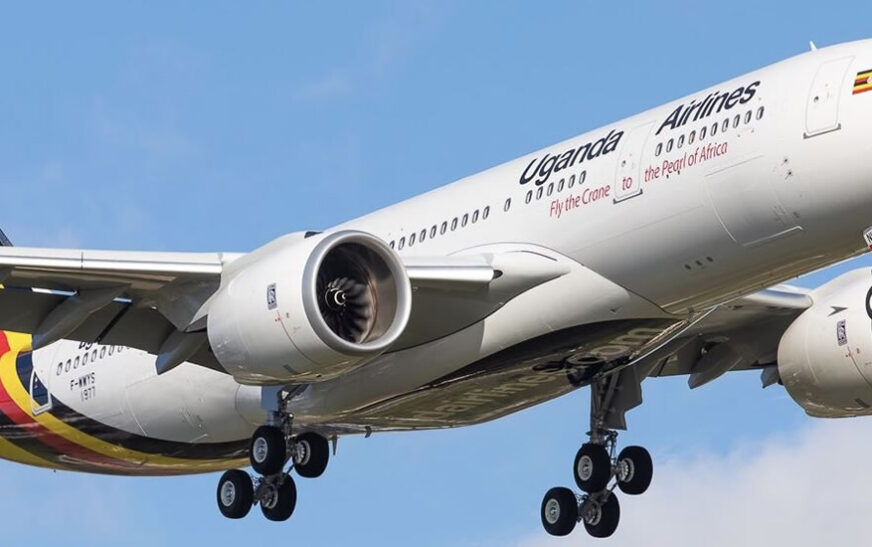
Uganda Airlines’ management is bedevilled by serious governance challenges, according to a report by the Parliamentary Committee on Commissions, Statutory Authorities and State Enterprises (COSASE).
The report cites blatant disregard for the law, lack of transparency, and inefficiency as key indicators of weak corporate governance within the national carrier.
“Whereas the airline is still in its infancy and requires time to acquire new routes and break even, it is essential that the financial systems and human resources of this entity are sound in order to get the national airline to the next level of growth,” the report states.
Members of Parliament noted that Uganda Airlines has the potential to thrive as a viable business if issues of financial impropriety, disregard of the law, and poor staffing practices are decisively addressed.
Background of Uganda Airlines
In 2018, the Government of Uganda re-established a national airline to enhance the country’s competitiveness by reducing air transport costs, improving connectivity, supporting economic growth, and meeting the rising demand for air transport infrastructure.
Uganda Airlines assumed national carrier status following the grounding of Air Uganda in June 2014. Jointly owned by the Ministry of Finance, Planning and Economic Development and the Ministry of Works and Transport, the airline launched commercial operations on August 27, 2019.
The airline began operations with six new aircraft—two Airbus A330-800 wide-body long-range jets and four CRJ900 aircraft. On July 27, 2019, the Uganda Civil Aviation Authority (UCAA) awarded Uganda National Airlines Company Limited (UNACL) an Air Operator Certificate, completing a three-month, five-stage certification process.
The airline’s business plan emphasized the need for a highly competent, professional management team free from political interference in order to succeed.
Auditor General’s Findings
The Auditor General issued a qualified opinion on UNACL’s financial statements for the 2020/2021 financial year. The Public Accounts Committee (PAC–COSASE) subsequently investigated the airline’s operations.
The audit revealed that UNACL incurred a loss of Shs 164.5 billion in FY 2020/2021, generating revenue of only Shs 46.9 billion. In the previous year (2019/2020), the company recorded losses of Shs 102.4 billion.
The committee held meetings with UNACL management and board members, the Minister of Works and Transport Gen. Katumba Wamala, former CEO Cornwell Muleya, and former Board Chairperson Ahabwe Pereza.
Unplanned Procurement and Financial Irregularities
The Auditor General revealed that UNACL carried out 25 procurements outside the approved procurement plan for FY 2020/2021. These procurements were conducted in various currencies, amounting to billions of shillings.
Management attributed this to the airline’s start-up phase and regulatory demands within the aviation sector. However, the committee concluded that procurement regulations under the PPDA Act were violated and recommended that responsible officers be held accountable.
Poor Revenue Performance
Out of a projected internal revenue target of Shs 304.6 billion for FY 2020/2021, only Shs 48.6 billion (16%) was collected.
Management blamed the COVID-19 pandemic, prolonged airspace closures, and delayed aircraft deployment due to certification challenges. While acknowledging these challenges, the committee cited broader governance failures, including lack of approved staff structures, weak board independence, and human resource incompetence, as major contributors to poor performance.

Losses and Cost Inefficiencies
The airline’s total costs for FY 2020/2021 amounted to Shs 211.5 billion, significantly exceeding revenue. MPs warned that continued losses would erode the company’s capital unless urgent revenue-enhancing strategies are implemented.
They also cited excessive wage bills, inefficient procurement, poor marketing strategies, and exploitative middlemen—particularly in fuel procurement—as sources of financial drain.
Staffing and Governance Failures
UNACL operated without a board-approved staff structure or salary scale, leading to unjustified salary disparities and excess expenditure of Shs 4.9 billion on staff costs.
The committee further found that some senior officials lacked minimum qualifications, including the CEO, Jennifer Bamuturaki, whose appointment followed a presidential directive that halted an ongoing competitive recruitment process.
MPs described the Shs 98.1 million paid to PricewaterhouseCoopers for the aborted recruitment as wasteful expenditure and recommended recovery of the funds from board members involved.
Conflict of Interest and Abuse of Office
The committee uncovered clear cases of conflict of interest and influence peddling in the award of public relations contracts to Abbavater Group Ltd, a company linked to Ms Bamuturaki. The contract was awarded without competitive bidding and at inflated costs.
MPs recommended prosecution of all officials involved and recovery of funds lost through irregular procurement practices.
Other Key Findings
Outstanding payables of Shs 47 billion to UCAA, indicating financial indiscipline, Delayed disciplinary cases, leading to double payments and losses of Shs 2.3 billion and Failure to refund travel funds amounting to Shs 50 million.
Irregular hiring of online bloggers, costing Shs 156 million
Missing ticket revenues worth Shs 982 million, prompting calls for a forensic audit
The COSASE report paints a grim picture of mismanagement, weak governance, and financial indiscipline at Uganda Airlines.
MPs concluded that without urgent reforms, strong oversight, and professional management free from political interference, the national carrier will continue to rely heavily on government bailouts and fail to deliver value for money to taxpayers.