
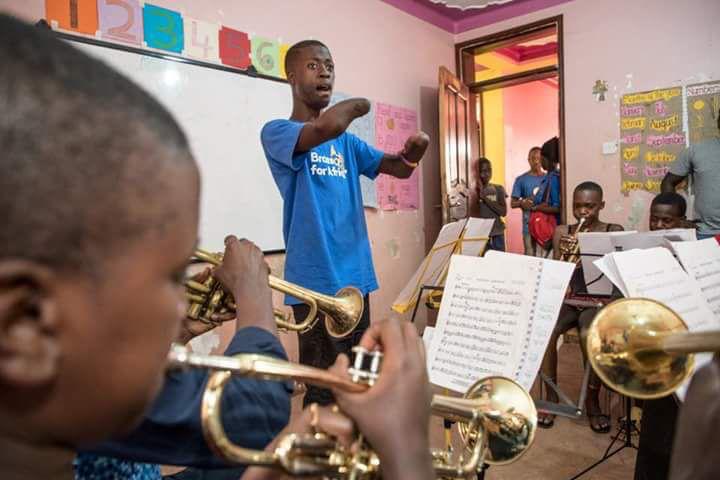
Every Thursday afternoon, the quiet compound of Ntinda School for the Deaf transforms the moment the Brass for Africa van rolls in. Deaf students rush out with beaming faces, signing excitedly as their instructors step out. The arrival of bass drums, tenor drums, and a shiny tuba turns the schoolyard into a scene of anticipation.
The music room quickly fills with energy. These lessons are more than weekly routines they are moments that bring colour, dignity, and joy to learners preparing for the Music Inclusion Gala slated for December 5 at Hotel Africana.
The session begins with an icebreaker to warm up bodies and minds. Students then recount what they learned the previous week, helping teachers tailor the day’s activities. What follows is a blend of drum routines, movement, and dance.
At the end, the learners proudly showcase their progress, playing percussion pieces before breaking into dance, guided not by sound but by the powerful feeling of vibration.
Roots of Brass for Africa
According to Uganda Country Manager Ronald Kabuye, Brass for Africa began in 2009 with disability inclusion anchored at its core.
Their earliest instruments were introduced at Good Shepherd Home in Kisenyi—a centre that once held children living with severe disabilities in silence and sorrow.
“People often wonder why music,” Kabuye said. “We are not scientists or doctors. What we have is music and we believe in its power to transform and heal.”
He recalls how the atmosphere at the home changed almost overnight: from tears and quiet despair to laughter, smiles, and an eagerness to learn.
Why the Inclusion Gala Matters
Since 2023, Brass for Africa has organised the Inclusion in Focus Gala, an event designed to challenge stereotypes about disability.
“This gala puts a spotlight on people with disabilities—not to pity them, but to show their potential,” Kabuye explained. “We want to erase the ‘they tried’ narrative.”
The organisation is now working with over 140 children with disabilities, especially those who are deaf or autistic, using percussion instruments that allow learners to feel rhythm and vibration.
A survey conducted in 2025 among 3,163 people revealed the urgency of this work: 67% lacked knowledge on the causes of deafness or how to support deaf people, 94% admitted to using stigmatizing names or actions and 80% had little or no knowledge of disability inclusion.
These findings inspired programmes like the music sessions at Uganda School for the Deaf.
“People ask how deaf children play drums. Music isn’t just sound it’s feeling, expression, and discipline,” Kabuye noted.
Music as Therapy Real Change, Real Children
Parents and teachers alike describe the transformation as “miraculous.” Children with autism have shown increased concentration, better communication, and newfound confidence.
Sarah Kisutu, founder of Teens and Tots Neuro Development Centre, said: “What music has done for us is incredible. Our children can now focus for long sessions. They perform confidently before crowds. Their self-esteem has blossomed.”

She explained how percussion instruments helped learners develop speech.
“As they play and sing, the melodies stay with them. They hum first, then eventually words form,” she said.
She highlighted the story of Owori Gabby, now 12, who could not speak at age two and a half. After consistent music lessons, he now plays bass, side, and tenor drums and can perform more than six songs progress that helped unlock his speech and confidence.
Kabuye shared another inspiring example: Kamukama Taddeo, who lost his arms and legs in childhood. Brass for Africa introduced him to the trombone, and he is now a strong voice for disability inclusion, appearing in media across Uganda.
Behind the Music – How Learners Are Taught
Kabuye praised the organisation’s teachers, who were once beneficiaries themselves.
“Our staff carry the stories of their communities. Many of us grew up with discrimination and poverty. Music gave us purpose. I became a trombonist because someone believed in me,” he said.
Teachers are trained intensively in music theory, practice, life skills, and disability inclusion. The organisation uses an inclusion manual and is supported by experts under the leadership of Ms. Lizzie Burrows.
Their classes ranging from 20 to 35 children serve learners with autism, Down syndrome, cerebral palsy, hearing impairments, and physical and intellectual disabilities. Lessons follow structured routines: warm-ups, drumming, songs, calming activities, and storytelling.
Florence Nakachwa, an inclusion assistant and music teacher, said community myths make the work emotionally demanding.
“Some families still believe disability is a curse. Many of our learners lack parental affection, so teachers give both love and knowledge,” she said.
Progress is gradual. Some children take months before they are comfortable touching instruments, but patient teaching eventually brings breakthroughs.
A Bigger Dream for Uganda
Kabuye said the upcoming gala is part of a wider national vision for disability inclusion. He acknowledged the government’s progress, such as NIRA’s efforts to support identification for persons with disabilities and improved access to passports.
“We’ve even seen NIRA visit homes. Our colleague, Kamukama Taddeo—who has no arms or legs—holds a valid driving permit. He drives. He proves disability is not inability,” he noted.
By 2030, Brass for Africa plans to grow from supporting 140 children to over 1,000.
“To achieve this, we need support—attendance at the gala, instruments, teachers, and spaces where every child can shine,” he said.