
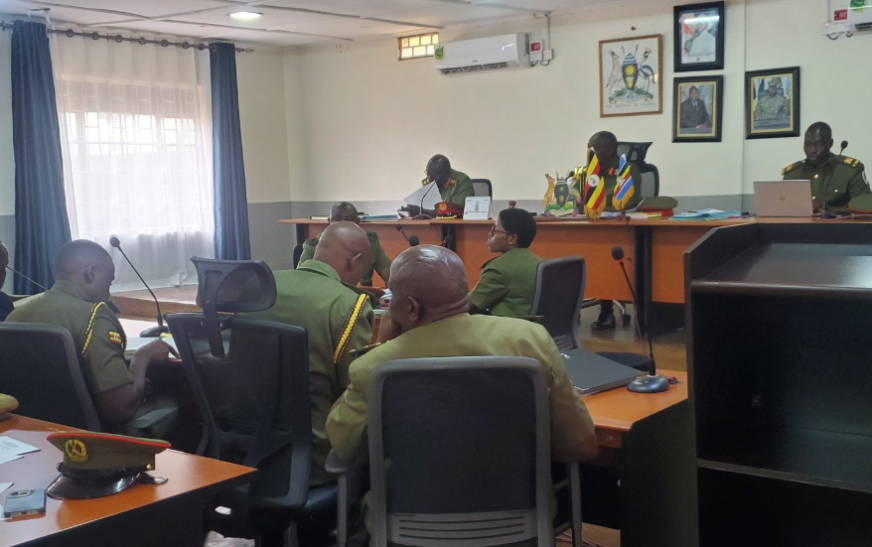
The General Court Martial has resumed operations more than a year after a Supreme Court decision that dissolved its authority to try civilians.
In its ruling, the Supreme Court prohibited the trial of civilians in the General Court Martial, citing a lack of independence and impartiality.
Earlier today, the General Court Martial, chaired by Brig. Gen. Richard Tukachungurwa, charged 12 people, including Staff Sergeant Jotham Karamuzi, with murder, aggravated robbery, and kidnapping with intent to murder in connection with the killing of Geoffrey Jama Munyarandizi in Kyanamukaaka, Masaka District.
Brig. Gen.Tukachungurwa said the court respected and complied with the Supreme Court’s decision, after which the necessary amendments were made. He said their priority is to handle all cases committed to the court between its disbandment and its resumption.
The landmark judgment stemmed from a constitutional appeal by former Nakawa Municipality MP Michael Kabaziguruka, who challenged the jurisdiction of military courts over civilians.
In her ruling, Justice Catherine Bamugemereire declared the Court Martial a military tribunal lacking the constitutional mandate to try civilians. She argued that its structure and procedures violate the principles of fairness and impartiality enshrined in Uganda’s Constitution. She further ruled that when soldiers commit offences against civilians, they should be tried in civil courts rather than military tribunals.
Justice Monica Mugenyi raised similar concerns, stating that the General Court Martial’s lack of independence and impartiality rendered it inconsistent with the Constitution. Chief Justice Alfonse Owiny-Dollo concurred, ruling that the military court system does not provide the safeguards necessary for a fair trial.
“I find that the military court system in Uganda lacks the independence and impartiality required under the Constitution to guarantee a fair trial. The respondent’s concerns about the General Court Martial’s objectivity were justified,” Chief Justice Owiny-Dollo stated.
He ruled that provisions granting subordinate military courts jurisdiction over capital offences violate Articles of the Constitution and are therefore unconstitutional.
The court further ruled that the UPDF Act, which gives courts martial blanket jurisdiction over civilians, is unconstitutional. It declared that the jurisdiction granted to the General Court Martial to try individuals subject to military law for civil or non-disciplinary offences contravenes Articles 209 and 210 of the Constitution.
Court Orders Transfer of Civilian Cases to Civil Courts
The Supreme Court ordered that all charges, ongoing trials, or pending cases involving civilians in military courts must immediately cease and be transferred to ordinary courts with competent jurisdiction.
“All pending or partially heard criminal cases that fall under the jurisdiction of civil courts, including those against UPDF personnel subject to service law, must be transferred to civil courts with competent jurisdiction,” the court ruled.
Additionally, the court directed the Executive and Parliament to establish the General Court Martial (GCM) as a division of the High Court, eliminating the need for a separate judicial body.

Under this arrangement, magistrates within the division would handle cases falling under their jurisdiction, while legally qualified civilians appointed through the Judicial Service Commission (JSC) would serve as judicial officers in subordinate military courts. These officers would be granted the same privileges and safeguards as their counterparts in civil courts.
The court also recommended amending the Constitution to establish superior courts within the military justice system under Article 129. These courts would be granted the necessary jurisdiction and independence to handle specific military offences of a capital nature, as well as other capital offences committed by military personnel under existing laws.
Directives issued in January 2025 halted trials, called for the implementation of reforms, and required the appointment of members on the recommendation of the Judicial Service Commission.
In May 2025, Parliament enacted amendments to the Uganda People’s Defence Forces (UPDF) Act despite the Supreme Court ruling barring the trial of civilians in the General Court Martial.
The Act has since been criticized by several political actors, who argue that it was assented to by President Yoweri Museveni in June 2025 after being processed and passed within a week.
In December, President Museveni appointed Brig. Gen. Richard Tukachungurwa as Chairperson of the General Court Martial.
He replaced Brig. Gen. Robert Freeman Mugabe, who served three terms as Chairperson of the General Court Martial (GCM).
During his tenure, Mugabe presided over several high-profile cases, including the treason case against former presidential candidate Dr. Kizza Besigye, human rights lawyer Eron Kiiza, and former Inspector General of Police Gen. Kale Kayihura, among others.
He will serve alongside Col. Wankandya Simon Tusah, Col. Asha Patra, Col. Kangwamu Fredrick, Col. Mugisha Raphael, Lt. Col. Igambi Mohammedie Nasser, and Maj. Amodoi Samuel Moses.
Other members include Maj. Arihaihi Emmanuel, Maj. Nyombi Abubaker, and Maj. Chemtai Denis.
The appointed Chairpersons of Division Court Martials are Lt. Col. Drani Epalu David for the Fourth Division and Lt. Col. Mulyanti Yaqoub Hassan for the Special Forces Group.