
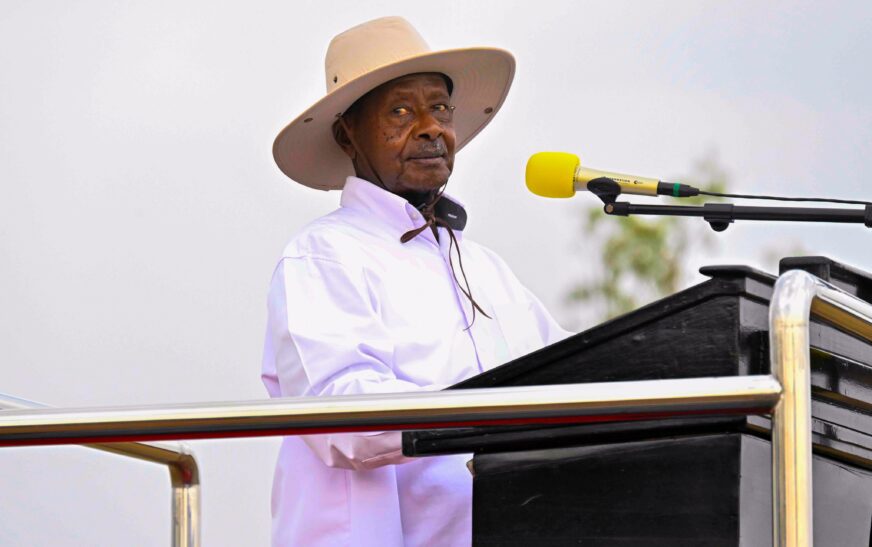
President Yoweri Museveni has sounded the alarm over what he called unprecedented electoral irregularities linked to the National Unity Platform (NUP) in Kampala, describing the developments as a troubling evolution in Uganda’s voting history.
Speaking live from his Kisozi farm during a radio talk show, Museveni claimed the alleged manipulations went “beyond anything we’ve seen before.”
“In Kampala, there was ballot stuffing—but this time, it’s on a whole new level. Fake ballot papers were printed on Nkrumah Road, around one million, and roughly 1.7 million votes were reportedly brought in from Dubai. Altogether, that’s about 2.7 million votes,” he said, painting a picture of large-scale electoral skullduggery.
The President placed the current challenges in historical context, recalling Uganda’s post-independence vote scandals. “Vote rigging has been part of Uganda since 1962,” he said, noting that separate ballot boxes for different parties once encouraged multiple voting and stuffing. Following the disputed 1962 elections, Uganda would go without a national vote for 18 years, until 1980.
Museveni highlighted reforms introduced under the National Resistance Movement (NRM) to improve transparency, including the use of a single ballot box per polling station and candidate photos on ballots. “These measures can work, but vigilance is key,” he said.
Looking forward, the President stressed that biometric voter verification will be central in preventing future manipulations. “Even if your finger is eroded, your eyes are not. Biometrics will stop ballot stuffing,” he said, addressing concerns about manual laborers.
On election security, Museveni urged restraint. “Beating people shows a lack of patience. Torture is unnecessary, and I will personally engage the security forces on this,” he said, while emphasizing the importance of peace.
“No one will be allowed to disturb Uganda’s peace. Those who attempt it will face the law,” he warned, adding that maintaining order is more about organization than sheer numbers.
Shifting focus to development, Museveni praised improvements in the Greater Mubende sub-region but acknowledged gaps. “Kasanda has only 34 percent access to safe water. That reflects leadership choices,” he said, contrasting it with areas that have made better progress in electricity, roads, schools, and health infrastructure.

He linked population growth to government health initiatives, noting that Mityana’s population has soared past 400,000 due to successful immunization programs. “Children are surviving, and that’s the result of planning and investment,” he said.
Museveni reiterated that public resources must be used strategically. “We prioritise and tackle projects step by step. We don’t scatter budgets,” he said, promising continued work on key roads, including the Kakono–Manyi–Mubende–Sekanyonyi–Busujju corridor.
Addressing employment, the President emphasized that government jobs alone cannot sustain a population of 50 million. “Government jobs number around 480,000. Real jobs come from factories, commercial agriculture, services, and ICT,” he said, highlighting new factories employing 1.3 million Ugandans.
On education, Museveni defended free schooling, blaming dropouts on the reintroduction of fees. “When we introduced UPE, school charges came back, and dropouts followed. Those who left school are now being absorbed into Presidential Skilling Hubs,” he said.
Finally, Museveni warned against inward-looking economic policies. “None of the opposition candidates speak about the regional market. That thinking is dangerous,” he said, urging young Ugandans to embrace economic integration.
“Our elders taught us ‘Uhuru na Umoja’—freedom and unity. Being a big fish in a small pond weakens us,” he concluded, framing the nation’s future as a delicate balance between vigilance, development, and unity.