
By Dedan Kimathi wa Kanyoro
Political succession in aging de facto one-party states has always been a closely guarded contest. And as I will argue, it is likely to remain so.
“De facto” because, while many countries in Africa, Asia and Latin America permit multipartyism on paper, in reality other parties exist largely to sanctify what can only be described as a democratic heist.
The long-con
In such societies, the aging leader keeps his cards close to his chest. While allowing seemingly “well-positioned” top guns to catwalk for the top slot, each hope that the coin will fall on them.
However, in many instances, we have seen that by keeping would-be successors in a permanent state of suspense, incumbents have been able to prevent their countries from erupting from a powder keg.
The same way it did in Egypt where a plan by late Hosni Mubarak groom First Son Gamal were one of the underlying reasons that helped fuel the Tahrir square pseudo-revolution of 2011.
Uganda’s transition question
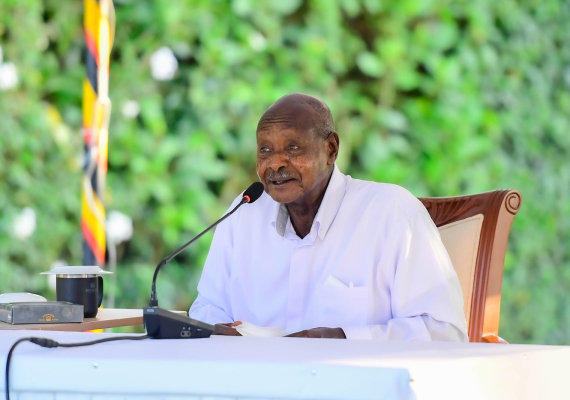
To some extent, one might argue that Uganda is a microcosm of such politics. Throughout National Resistance Movement’s (NRM) 40-year stranglehold on the country, questions have been asked time and again, on who is going to succeed President Yoweri Museveni.
Even with the rise of Gen. Muhoozi Kainerugaba, his son and Chief of Defence Forces (CDF), President Yoweri Museveni has often more than not, pointed to constitutional provisions requiring anyone seeking leadership to go through an election.
Implying that if Muhoozi ever intends to become President, he would first have to shed the uniform and canvass for votes like any other contender, rather than being handed the baton on a silver plate.
While some believe that by playing dodgeball, President Yoweri Museveni is being disingenuous, I take a different view. Being a student of history, he is, President Museveni, may have already settled on a little-known successor, one outside the usual names floated in the press, whom many in the public and media cannot easily discern.
That he is waiting to unleash on the country by surprise, when he bides his time, much the same way like it happened in the 1970’s China.
Forget about the opposition. After a prolonged state of political comatose, none of its figureheads stands a realistic chance. My prediction is that his successor will come from a military background, most likely someone who joined after 1986, not an accumulationist, firmly grounded in ideology and not from his family.
The other scenario would be settling on a trusted comraded from the Front for National Salvation (FRONASA) days. Someone who shares his understanding of the country’s challenges and intended trajectory, in the mould of Gen. Kahinda Otafiire or Gen. Caleb Akandwanaho alias Salim Saleh alias Rufu. I don’t know who that might be, there are not many left in the top echelons.
In which case, the latter’s role would be transitional. In other words, that person would be expected to set the stage for a takeover by the younger cohort, many of whom are aligned to the Patriotic League of Uganda (PLU).
Whatever the case, it appears that in order for this grand-plan to unfold smoothly and reach its intended outcome or resolution as Gustav Freytag’s dramatic structure dictates, he has and continues to deliberately allow those harboring ambitions, to carry on with the melodrama (ambitions). As long as this does not get out of hand.
Mao Zedong’s game plan
The same can be said about China, where the period leading up to the death of Mao Zedong in September 9, 1976 saw the country teeter on the brink of chaos, as competing power centres jostled for control.
Gang of Four campaign
Some such as the “Gang of Four” went to greater lengths to secure the future, as we say in the “Pearl of Africa”. Specifically, the Gang of Four comprised; Wang Hungwen, Chang Chun Chiao, Yang Wengyuan and Chiang Ching. For those that may not know, Chiang Ching was Mao’s last wife and purportedly committed suicide in 1991.

The group was notorious for ramping up attacks on anyone they perceived to harbor ambitions. Their list of targets grew to include Zhou Enlai, who served as China’s Foreign Affairs Minister from 1949 to 1958. Before he was elected First Vice Chairperson of the Communist Party of China in 1973, following Lin Biao’s tragic death two years earlier in a plane crash in Mongolia.
The appointment effectively made Zhou, next in line after Mao but also enraged the Gang of Four, especially Madam Mao, who saw it as a direct challenge. Unfortunately, Zhou would later pass on January 1976. The quartet’s smear campaign, according to Han Suyin, author of “Wind in the Tower” were largely aided by their hold onto the media.
So much so, that local newspapers in the Tientsin at one time even extolled Chiang Ching as Mao’s “closest comrade-in-arms” and “best pupil”.
Also, historical illusions to Empress Wu Zetian of the Tang dynasty, who superseded her husband and reigned to the benefit of the people, were frequent.
And yet amidst their shenanigans, Mao’s mind had switched to Hua Guofeng. Whom in private, Mao had reportedly assured that with him at the helm, he was at ease.
The latter according to Suyin, was “almost unknown until 1975, issued from a peasant family in Shansi. He joined as a guerilla in Taihang mountain area and then in the war of liberation against Chiang Kai-Shek…”
For those that cared at the time, the writing was on the wall, but few cared. His influence was first felt in October 1975, when Suyin says he took it upon himself to limit Mao’s interviews with visiting foreign Heads of States.
However, somehow the “Gang of Four” continued to delude themselves, that it was theirs to lose. When eventually became increasingly clear to the aforementioned Gangsters that they were never going to run away with it, propaganda desperately became their fallback position.
For instance, Chiang Ching invoked a poem Mao had dedicated to her in the early 1960’s.
In which he mentioned that “she should aspire to the highest.” Which many, have come to say, Mao meant that she should aim at being the highest revolutionary and not office bearer.
Kenyatta succession
The same can be said in the succession battle to replace Kenya’s founding father Mzee Jomo Kenyatta following his death on August 22, 1978. The latter was replaced by Daniel Arap Moi, who since Joseph Murumbi’s resignation in 1967 had been serving as Vice President.
However, this was not a walk in the park. First, Moi who was formerly a school teacher, was seen as a Johnny come lately, having joined the Kenya African National Union (KANU) Government in 1967 as part of a merger with the Kenya African Democratic Union (KADU).
But secondly, the former school teacher or Mwalimu, besides being loyal to Kenyatta, came from the Kalenjin tribe and lacked the financial clout of the likes of Njoroge Mungai. Daniel Branch in his book “Kenya; Between Hope and Despair” says had emerged as the preferred choice of the ruling Kikuyu elite.
Mungai, he says in early 1970’s had gone toe to toe with another faction led by Attorney General (AG) Charles Njonjo in a bid to buy Marshalls Universal, the local agent for Peugeot.
Even then, Moi in his Kalenjin back yard, was not as influential as Jean Marie Seroney and therefore he was considered a lightweight and easy to dispose. However, through a combination of luck and careful maneuvering, he eventually had his way.
Mungai for instance, despite being powerful was shown the exit by his Dagoretti constituents in 1974. Only to return a year later after his cousin Udi Gecaga’s mum resigned his seat. However, under Kenya’s Westminster style constitution which barred nominated lawmakers from becoming President, his hopes were dimmed.
The author is a descendant of peasant parents,