
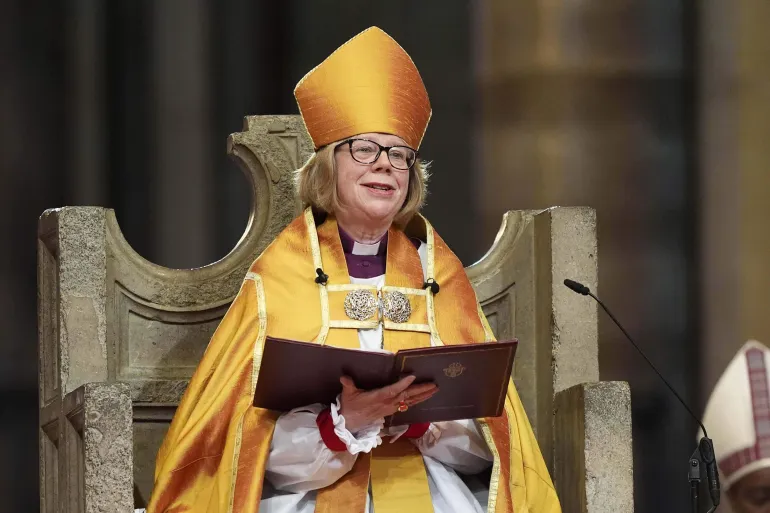
History was made at Canterbury Cathedral as Sarah Mullally was formally installed as the first woman to lead the Church of England, stepping into one of Christianity’s oldest and most symbolic roles.
Before a congregation of nearly 2,000 including Prince William and Catherine alongside Prime Minister Keir Starmer, Mullally took her place on the centuries old Chair of St Augustine, marking the public beginning of a ministry already filled with expectation and scrutiny.
Though she formally assumed office in January, the installation carried deep symbolic weight, signaling not just a personal milestone but a shift in the Church’s long held traditions.
“As I begin my ministry today… I say again to God: ‘Here I am,’” she declared, her words echoing through the cathedral as she set the tone for her leadership.
Clad in a golden mitre, Mullally used her first sermon to look beyond the Church, calling for peace in conflict zones across the globe from the Middle East to Ukraine, Sudan, and Myanmar, positioning her role firmly on the world stage.
Yet her historic rise comes at a moment of reckoning. The 63 year old acknowledged the Church’s painful past, including safeguarding failures that forced the resignation of her predecessor, Justin Welby. She pledged a renewed commitment to “truth, compassion, justice and action,” signaling a leadership focused on accountability as much as faith.
The ceremony itself blended centuries old ritual with personal symbolism. Mullally knocked on the cathedral’s west door before entering, her cope fastened with a clasp inspired by her years as a National Health Service nurse, a quiet nod to the journey that shaped her path to Canterbury.

She also wore a historic ring once gifted to former archbishop Michael Ramsey by Pope Paul VI, a powerful emblem of reconciliation between Anglicans and Catholics centuries after King Henry VIII broke from Rome.
The installation coincided with the Feast of the Annunciation, reinforcing themes of calling and purpose, an apt backdrop for a leader stepping into uncharted territory.
Unlike the Pope, whose authority is direct, the Archbishop of Canterbury leads largely through influence, making Mullally’s task as much about diplomacy as doctrine.
As she begins her tenure, Mullally stands at the crossroads of tradition and transformation, tasked with healing divisions, restoring trust, and redefining leadership in a Church navigating the pressures of a rapidly changing world.