
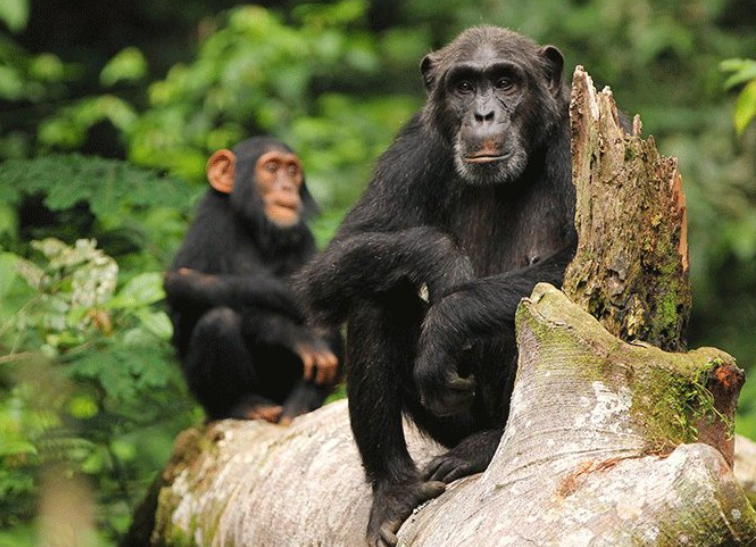
The 2025 Bwindi Chimpanzee Census has confirmed an estimated population of 426 chimpanzees widely distributed across Bwindi Impenetrable National Park, marking a major milestone in strengthening evidence-based conservation within one of Africa’s most important protected landscapes.
The results were officially launched today by the Minister of State for Tourism, Wildlife and Antiquities, Martin Mugarra Bahinduka, at Uganda Wildlife Authority Headquarters in Kampala. Speaking at the launch, Bahinduka emphasised the importance of science-led conservation.
“The confirmation of a substantial and widely distributed chimpanzee population in Bwindi strengthens our understanding of the park as a critical habitat for great apes and reinforces the need to manage protected areas using sound scientific data, particularly in the face of climate change, habitat pressure, and growing demand for land and resources,” he said.
A UNESCO World Heritage Site internationally recognised for its mountain gorillas, Bwindi has long been a global model for great ape conservation. This first dedicated and systematic chimpanzee census significantly expands scientific understanding of Bwindi’s great ape community and formally integrates chimpanzees into park-wide conservation planning alongside gorillas.
Conducted between May and June 2025, the census was led by the Jane Goodall Institute Uganda in partnership with the Uganda Wildlife Authority and the Greater Virunga Transboundary Collaboration. It was implemented alongside the park’s sixth mountain gorilla census.
Using standardised line-transect survey methods—including Standing Crop Nest Count and Marked Nest Count approaches—researchers surveyed 320.9 square kilometres across all four park sectors: Buhoma, Ruhija, Nkuringo, and Rushaga, generating the first robust, site-specific baseline on chimpanzee population size, density, and distribution.
The findings confirm that chimpanzees are widely distributed throughout the park, occupying habitats ranging from mixed Afromontane forest to higher-elevation montane ecosystems. Under conservative modelling assumptions, the census estimated an average density of 1.33 chimpanzees per square kilometre, challenging earlier assumptions that the species was rare or confined to marginal areas.
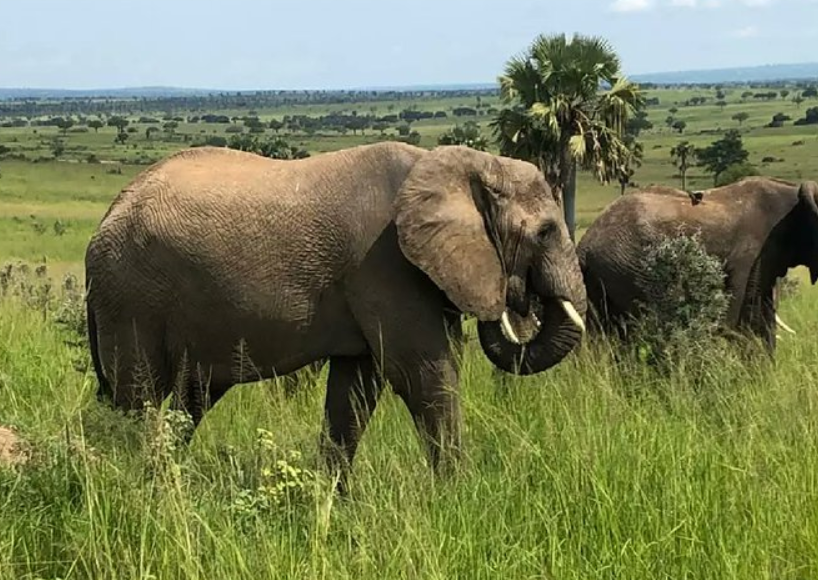
The census recorded minimal signs of human disturbance, indicating that the habitat remains largely intact and effectively protected. Observations of other large mammals—including mountain gorillas and forest elephants—as well as additional primate species and vegetation characteristics, were documented, providing valuable context for integrated, multi-species conservation planning.

Commenting on the findings, Dr. James Musinguzi, Executive Director of the Uganda Wildlife Authority, said the census provides a strong scientific foundation for conservation decision-making.
“For the first time, we have clear scientific evidence confirming a substantial and widely distributed chimpanzee population within Bwindi. This strengthens our ability to plan, protect, and manage the park using evidence-based approaches, while ensuring that chimpanzees receive conservation attention alongside other great apes,” he said.
The Executive Director of the Jane Goodall Institute Uganda, Mr. James Byamukama, noted that the census addresses long-standing knowledge gaps.
“The evidence confirms that chimpanzees are not a marginal presence but an integral component of Bwindi’s ecosystem. This baseline will guide conservation planning, protected area management, and regional biodiversity strategies, while supporting Uganda’s international conservation commitments,” he said.
The Bwindi Chimpanzee Census operationalises Uganda’s National Chimpanzee Conservation Strategy (2023/24–2032/33) by providing site-specific, scientifically robust population data to support evidence-based implementation of the Strategy, strengthen monitoring of population trends and habitat integrity, guide targeted law enforcement, and align conservation investments with priority chimpanzee landscapes.