
The Permanent Secretary for the Ministry of Finance, Ramathan Ggoobi, has said that Uganda’s economy possesses all the key ingredients to create wealth and prosperity for all Ugandans. He noted that the various economic reforms implemented by the NRM Government over the years have laid a strong foundation for a transformative, resilient, and fast-growing economy.
“The NRM Government will continue to take deliberate actions to achieve faster socio-economic transformation and to strengthen its position in the global economy,” said the PSST.
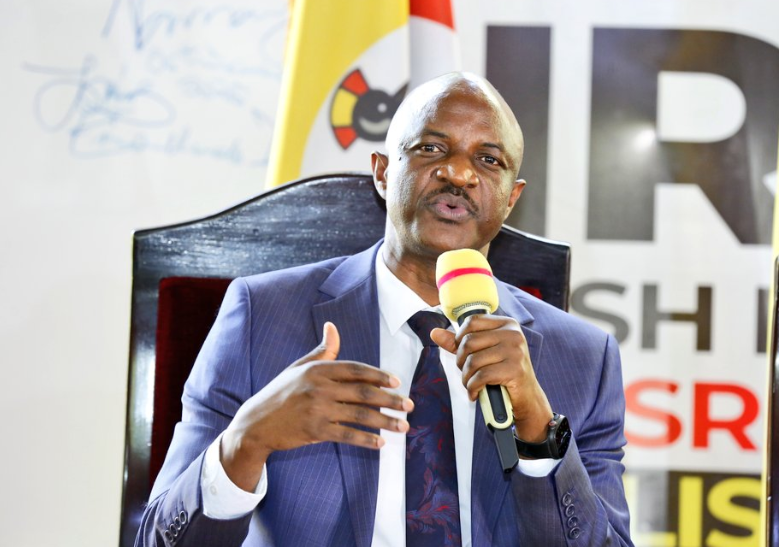
He made the remarks today on behalf of Finance Minister Matia Kasaija at the NRM Party Secretariat on Kyadondo Road in Kampala, where he was invited to update the public on the reforms, progress, and future direction of Uganda’s economy under the NRM Government.
Flanked by NRM Deputy Secretary General Rose Namayanja, Dr. Ggoobi highlighted the key economic reforms that have formed the foundation of today’s Ugandan economy. These include the elimination of price controls, liberalization of the economy, liberalization of the foreign exchange market, liberalization of the current and capital accounts, export diversification, privatization, and rationalization of state enterprises, among others.
Dr. Ggoobi also emphasized the importance of sound macroeconomic management to control inflation, the creation of the Uganda Revenue Authority (URA) in 1991, and investments in infrastructure development.
He noted that the NRM Government’s actions have created a stable, robust, and resilient economy, adding that the size of the economy is projected to have expanded 17 times since 1986. By June 2026, Uganda’s economy is expected to reach USD 68.4 billion.
The PSST further stated that Uganda has met all the requirements and is currently undergoing assessment by the United Nations for graduation to middle-income status. He noted that Uganda’s per-capita GNP stood at USD 1,278 in FY 2024/25, up from approximately USD 570 a decade ago.

“This compares to the current benchmark of USD 1,136 for a country to be classified as lower-middle income. Our projections indicate that per-capita income will rise to USD 1,324 by the end of FY 2025/26,” said Dr. Ggoobi.
He added that Ugandans are wealthier, with poverty declining from 21.4% in 2016 to 16.1% in 2025, while the proportion of households engaged in the subsistence economy fell from 68.9% in 2010 to 33.1% by FY 2023/24.
The PSST said the Government is committed to expanding the economy to USD 500 billion by 2040 and creating jobs by focusing resources on the four anchor sectors (ATMS) and their enablers.
“The NRM Government remains resolute in its mission to transform Uganda into a modern, inclusive, and competitive economy that works for all,” he said.