
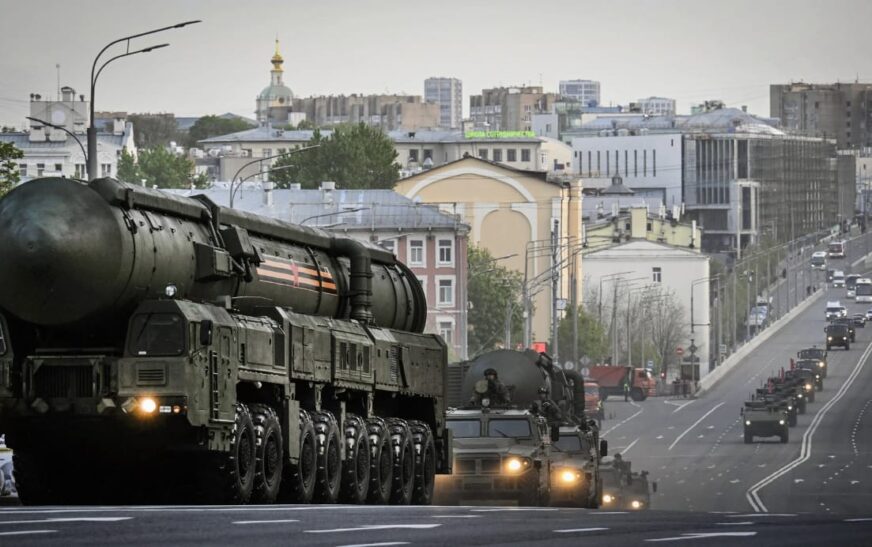
The world’s last remaining strategic nuclear arms control agreement between the United States and Russia officially expired on February 5, plunging global security into what analysts describe as a dangerous “nuclear governance vacuum” with no binding limits on the world’s largest nuclear arsenals.
The New Strategic Arms Reduction Treaty (New START), signed in 2010 and extended in 2021, capped the number of deployed strategic nuclear warheads, missiles, and bombers held by Washington and Moscow, while establishing verification and monitoring mechanisms that helped prevent miscalculations between the two nuclear rivals.
With no renewal in place, the treaty’s expiration removes the final guardrails restraining U.S. and Russian nuclear forces.
“We’re looking at a very uncertain path ahead,” warned Daryl Kimball, executive director of the Arms Control Association. “Unless Biden and Putin reach some sort of understanding soon, it’s not unlikely that Russia and the U.S. will begin increasing the number of warheads on their missiles,” he told Politico.
Russia made initial overtures for a renewed or temporary pact as early as September 2025, including a stopgap proposal by President Vladimir Putin, offering to voluntarily adhere to New START limits for one year after expiration — provided the United States reciprocated. However, Moscow says these proposals went unanswered.
“Our ideas have been deliberately ignored,” said the Russian Foreign Ministry in a statement, adding that Russia now assumes both parties are “no longer bound by any obligations or symmetrical declarations.”
Putin reiterated the offer several times in late 2025, telling Russia’s Security Council that Moscow was prepared to maintain the treaty’s central quantitative limits for one additional year. He later emphasized that any voluntary restraint would depend on U.S. willingness to engage.
“If the Americans choose not to pursue it, that won’t be a major issue for us,” Putin said in October, while still calling an extension “a commendable idea.”
Rising Nuclear Tensions
The expiration comes at a particularly volatile moment in global security. Russia and China are expanding their strategic arsenals, and Moscow has repeatedly issued nuclear threats in the context of the war in Ukraine.
According to sources familiar with the matter, the U.S. Department of Defense has held a series of internal meetings to prepare for a post–New START environment, although details of these discussions remain unclear.

Russia formally suspended the treaty’s verification mechanisms in 2023, citing Ukrainian strikes on elements of its nuclear deterrence and accusing Western states of direct involvement in the conflict. Despite the breakdown, Moscow has stated it will act “responsibly and in a balanced manner,” while remaining open to political and diplomatic dialogue aimed at stabilizing the strategic situation.
A Pattern of Collapsing Treaties
New START’s expiration marks the final collapse of a decades-long framework for U.S.–Russia nuclear arms control.
The 1972 Anti-Ballistic Missile (ABM) Treaty, which limited missile defense systems to preserve mutual deterrence, ended in 2002 after the United States withdrew, calling it a Cold War relic.
The Intermediate-Range Nuclear Forces (INF) Treaty, signed in 1987 and credited with eliminating nearly 2,700 missiles, collapsed in 2019 amid accusations of Russian violations and U.S. concerns about China’s growing missile arsenal. Russia formally abandoned the pact in 2025 following Washington’s earlier exit.
With New START now gone, no major bilateral agreements remain to limit nuclear weapons.
Doomsday Clock Moves Closer
The growing uncertainty has alarmed the global scientific community. Last week, the Bulletin of Atomic Scientists moved the symbolic Doomsday Clock five seconds closer to midnight, warning of a looming “full-blown arms race” among major powers.
As Washington and Moscow drift further apart, analysts fear that the absence of transparency, inspections, and agreed limits increases the risk of miscalculation, escalation, and renewed nuclear competition.
For now, the world enters uncharted territory — with the two largest nuclear superpowers operating without formal constraints for the first time in more than half a century.