
For years, Harry Kane’s career has been defined by the trophies that eluded him. Now, the England captain has claimed football’s most prestigious individual honour, proving that personal brilliance can triumph even when team success remains out of reach.
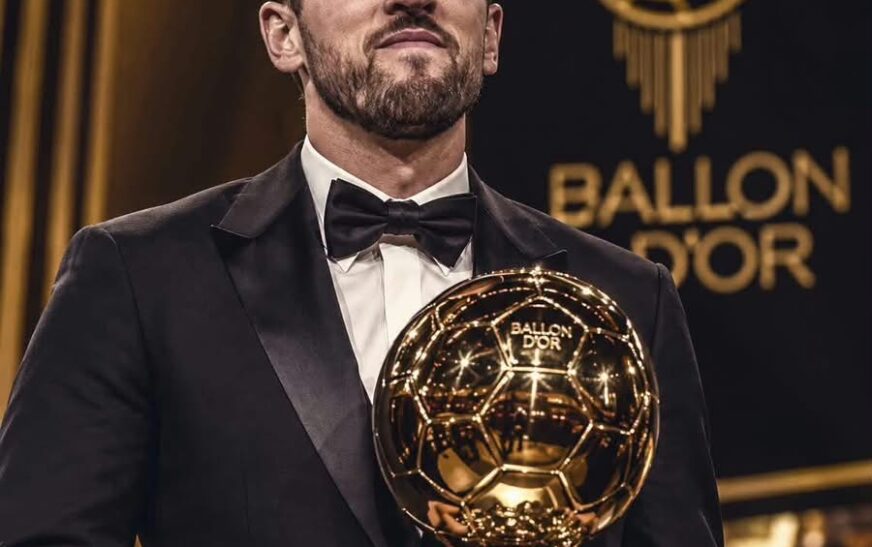
The 33-year-old Bayern Munich striker was crowned the world’s best player at a ceremony in London, becoming the first Englishman since Michael Owen in 2001 to win the Ballon d’Or.
Kane’s victory is a remarkable turn in a career that has seen him rise from a player few expected to become a global superstar to one of the most prolific forwards in modern football.
His case rested on extraordinary numbers. Kane scored 61 goals in 51 club appearances for Bayern Munich last season. Including his England matches, his tally reached 73 goals and eight assists in 65 appearances.
Yet his individual brilliance was not matched by the major team honours often associated with Ballon d’Or winners. Bayern failed to secure the Champions League, while England’s pursuit of international glory also ended in disappointment.
That contrast makes Kane’s triumph particularly striking. Rather than allowing the absence of major trophies to overshadow his achievements, voters recognised a season in which his goalscoring exploits set him apart from his rivals.
Speaking after receiving the award, Kane admitted that his rise had exceeded the expectations he once had for himself.
“Not many people would have thought it, and maybe even I wouldn’t have thought I’d be this far,” he told Dazn.
The striker said his journey had been shaped by difficult moments, self-doubt and the determination to prove himself at the highest level.
“I had to go through many ups and downs, especially early in my career. I was never the person that people thought was going to be the superstar like some of the guys now,” he said.
Kane added that patience and self-belief had been central to his development.
“I had to bide my time and work hard, a lot of times it was me against my own mind and I had to come through it, I had to show self-belief, determination.”

He said those experiences had helped him remain grounded even after reaching the highest level of the game.
“I think that grounded me even when I did make it at the highest level to keep improving and keep getting better.”
His victory also ends England’s 25-year wait for the award. Kane becomes only the fifth Englishman to win it, following Stanley Matthews in 1956, Bobby Charlton in 1966, Kevin Keegan in 1978 and 1979, and Owen in 2001.
He is also Bayern Munich’s first Ballon d’Or winner since Karl-Heinz Rummenigge in 1981.
Real Madrid and France forward Kylian Mbappe finished second, while Barcelona and Spain youngster Lamine Yamal took third place.
England manager Thomas Tuchel welcomed Kane’s success, describing it as a “huge honour”, while Prince William praised the striker as a “brilliant captain” and “remarkable player”.
The achievement was celebrated in London, where the arches at Wembley Stadium were illuminated in gold on Monday night.
For Kane, the award represents more than recognition for a prolific season. It is a personal vindication for a player who had to fight through years of doubt and disappointment to reach the summit of world football.
And while the Ballon d’Or cannot replace the team trophies he continues to pursue, it has delivered a distinction that few players ever attain: recognition as the best in the world.