
Uganda and Russia have called for stronger cooperation in education, research, trade and technology as the two countries prepare for the third Russia-Africa Summit scheduled for Moscow on October 28 and 29.
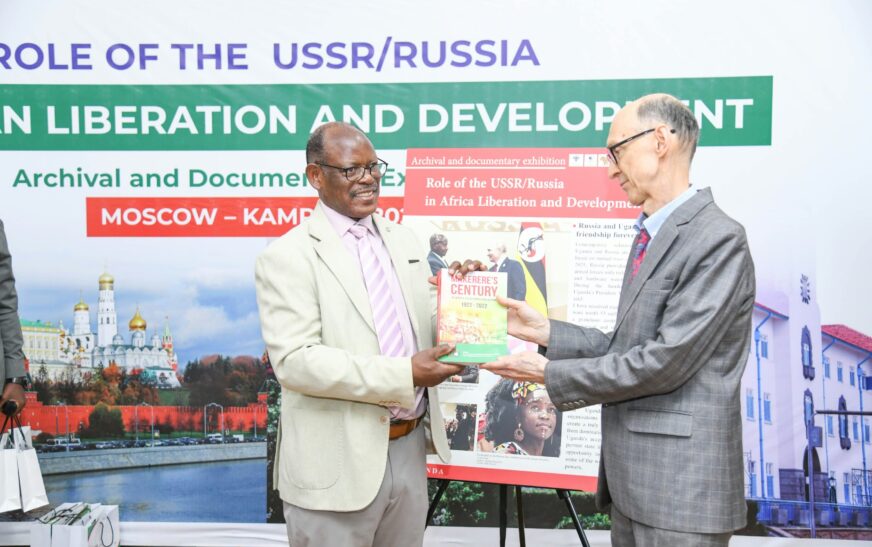
The call came during an exhibition at Makerere University on October 23 titled Role of the USSR/Russia in African Liberation and Development Archival and Documentary Exhibition that examined the historical role of the former Soviet Union and Russia in African liberation and development.
The exhibition, organised by Makerere University’s College of Humanities and Social Sciences in partnership with the Russian State University for the Humanities, brought together diplomats, academics, government officials and students to reflect on Uganda’s historical ties with Russia and explore opportunities for future cooperation.
Sergey Lobanov, the Chargé d’Affaires of the Russian Federation in Uganda, said the exhibition offered an opportunity to revisit Russia’s historical relationship with African countries while strengthening cooperation in areas of mutual interest.
Lobanov’s remarks came as Uganda prepares to participate in the forthcoming summit, which is expected to provide a platform for African countries and Russia to discuss political and economic cooperation. Notably, Uganda’s diplomatic relations with the Soviet Union were established on October 13, 1962, four days after the country attained independence. Uganda opened its embassy in Moscow in 1964
“African friends remember, and we deeply appreciate it, that our country, then the Soviet Union, supported their desire to break free from the shackles of colonial rule,” he said, adding that Russia was proud of the selfless and dedicated assistance the Soviet Union provided to African countries in their struggles for independence.
Lobanov said the Soviet Union played a key role in the adoption of the Declaration on the Granting of Independence to Colonial Countries and Peoples 65 years ago. He said Moscow subsequently contributed to the development of newly independent African states, including the establishment of national economies, education systems and healthcare services.
Lobanov said relations between Russia and Africa, as well as between Russia and Uganda, had evolved into close partnerships, with the two countries actively engaging in international and regional forums where they shared common approaches to a wide range of issues.
“Our bilateral interaction is developing rapidly and is particularly progressive,” he said, describing Uganda as a privileged partner and ally of the Russian Federation. Referring to the third Russia-Africa Summit scheduled to take place in Moscow on 28 to 29 October 2026, Lobanov expressed hope that its outcomes would elevate bilateral relations to new heights, adding that the event reflected growing cooperation and friendly ties between Russia and Uganda.
Michael Karugaba, representing the Permanent Secretary of the Ministry of Foreign Affairs, Vincent Waiswa Bagiire, said the relationship had evolved from political solidarity during the liberation era to cooperation aimed at supporting economic transformation. He said Uganda and Russia established an Intergovernmental Commission on Economic and Scientific-Technical Cooperation in 2015, which has held three sessions, the latest in Kampala in October 2025.
Karugaba said Uganda intended to use the Moscow summit to follow up on areas of cooperation, including investment, energy, information and communication technology, human capital development, scholarships and academic exchanges.
He also pointed to Uganda’s admission as a BRICS partner country in January 2025 as another avenue for strengthening its international economic partnerships.
“Uganda is seeking to expand its economy through agro-industrialisation, tourism, manufacturing, science, technology and innovation, areas in which cooperation with Russia could support national development priorities,” Karugaba added
Prof. Dr. Vera Zabotikina, Acting Vice-Rector for International Cooperation at the Russian State University for the Humanities, said the exhibition was part of a project supported by Russia’s Ministry of Science and Higher Education and implemented in collaboration with Makerere University.
“The history of African liberation remained an important subject for Russian academic institutions and international engagement, noting the Soviet Union’s role in supporting anti-colonial movements and the adoption of the 1960 United Nations Declaration on the Granting of Independence to Colonial Countries and Peoples,” Zabotikina said

Zabotikina further highlighted that Soviet-Ugandan cooperation extended beyond political relations to trade, technical assistance, industry, agriculture and health, with agreements tailored to trade, economic and technical cooperation signed in 1964, while Soviet assistance included subsidised loans and support for industrial development.
“In the late 1960s and early 1970s, Soviet specialists designed steam mills and equipped a plant with heavy industrial textile machinery in Lira.The Soviet Union also constructed and equipped an agricultural training institution now in the early 1970s, providing machinery and tools to train professionals in large-scale agriculture. The institution was later upgraded in 2007 and became the administrative headquarters of Busitema University.” She further pointed out
Zabotkina also cited medical assistance to Mulago Hospital as part of the historical relationship between the two countries, and that Russia provided military equipment and hardware worth 53 million dollars in 2025,
Makerere University Vice-Chancellor Prof. Barnabas Nawangwe said archival exhibitions were important in filling gaps in the documentation of Africa’s liberation history. He said the Soviet Union supported liberation movements in several African countries, including Ghana, Guinea, Congo, Angola, Mozambique, Namibia, Zimbabwe and South Africa.
Nawangwe said Uganda also benefited from Soviet cooperation in science, medicine and agriculture, with Ugandans trained in the Soviet Union returning to work as doctors, engineers, agronomists, teachers and administrators.
He called for stronger academic exchanges, collaborative research and digitisation of historical archives to make the materials more accessible to students and researchers. Nawangwe further noted that the exhibition should encourage universities to preserve historical records and examine the contribution of international partnerships to national development.
Mary Frances Atima, Chief Education Officer for Education Standards and Quality Assurance at the Ministry of Education and Sports, who represented the ministry’s Permanent Secretary, Dr Kedrace Turyagenda, said education had been one of the most enduring areas of Uganda-Russia cooperation.
Atima said the Government continued to prioritise human capital development, science, technology, engineering and mathematics, research and innovation under its national development agenda, including the Fourth National Development Plan.
She said international academic partnerships could contribute to these priorities if they were aligned with Uganda’s development needs and produced measurable benefits for students, researchers and institutions
Atima acknowledged the Russian Government’s scholarship quota of 50 Ugandan students per academic year and called for wider dissemination of information about eligibility requirements, application procedures and deadlines. She also encouraged Makerere and other Ugandan universities to deepen collaboration with Russian institutions in science, medicine, agriculture, engineering, humanities and social sciences.
However, Atima cautioned that international academic partnerships should go beyond ceremonial engagements and deliver tangible outcomes through joint research, staff and student exchanges, publications, postgraduate training and other measurable activities.
Atima also urged students and researchers to use the exhibition to deepen their understanding of Uganda’s history and encouraged universities to preserve historical experiences through research, publications, and accessible educational resources.