
President Yoweri Kaguta Museveni has signaled Uganda’s readiness to invest in a proposed multi-billion-dollar regional oil refinery spearheaded by Nigerian industrialist Aliko Dangote, in what analysts see as a calculated push to position Uganda at the center of East Africa’s evolving energy landscape.
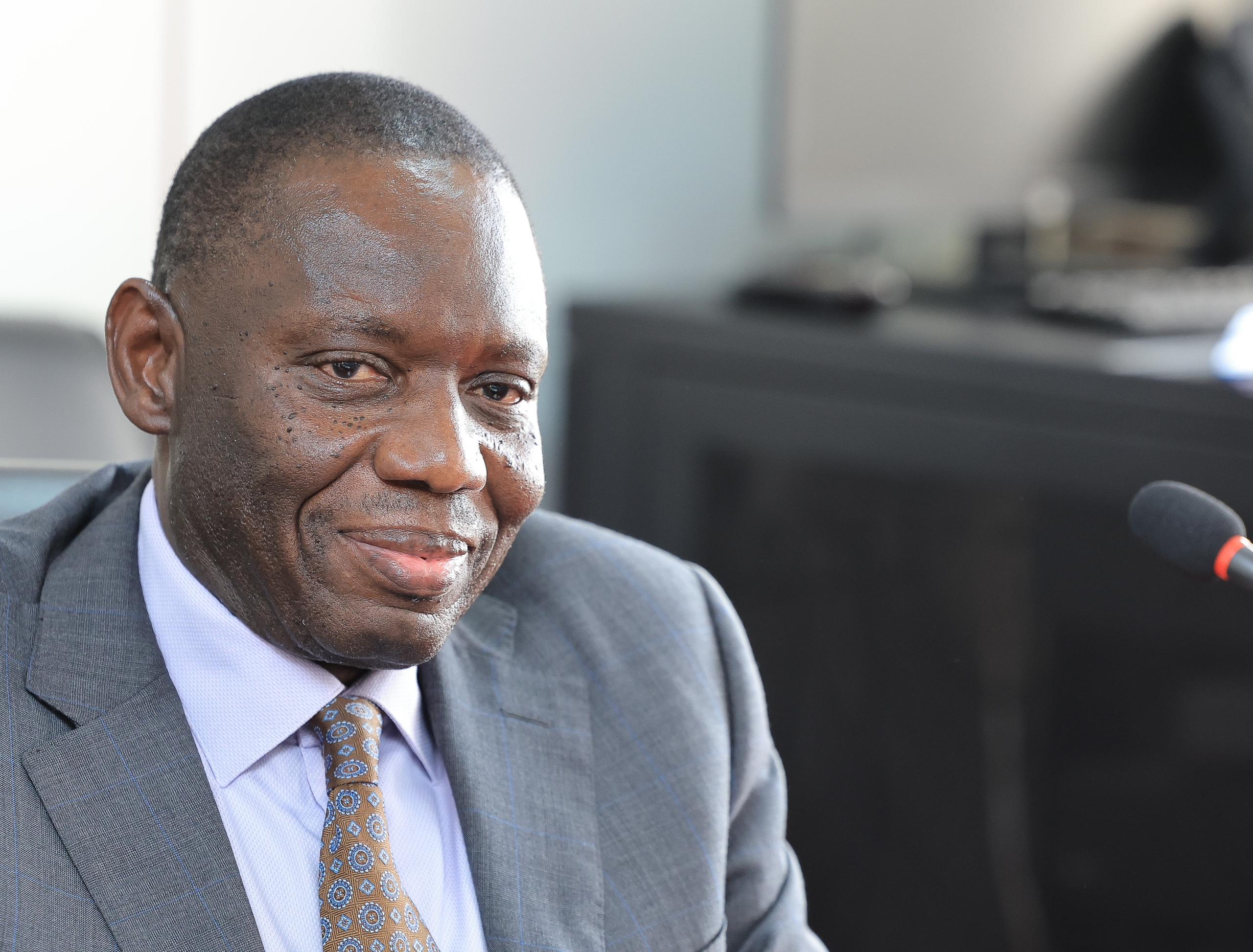
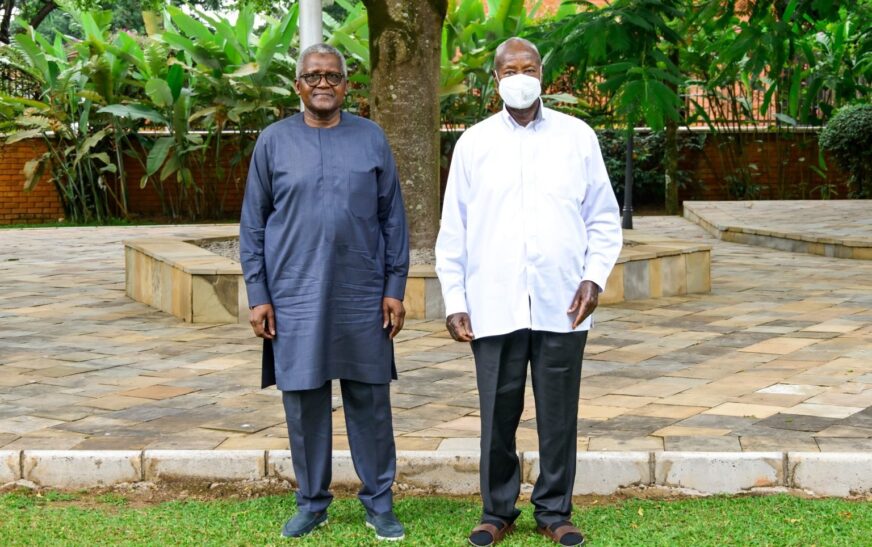
“We shall support Mr. Dangote, and we are ready to buy shares in the regional refinery because our goal is regional integration and industrial development,” Museveni said during high-level discussions at State Lodge Nakasero.
The remarks followed closed-door talks between the Ugandan leader and Dangote, focusing on expanding regional energy cooperation and advancing large-scale industrial infrastructure capable of serving multiple economies across East and Central Africa.
Beyond a statement of support, Museveni’s position signals a broader strategic shift—one that aligns Uganda with emerging continental industrial players while reinforcing its long-standing stance against the export of raw materials.
“We have always been against the export of unprocessed raw materials. That is why Uganda insisted on having a refinery as part of our oil development strategy,” Museveni said, reiterating a policy position that has shaped Uganda’s oil sector for over a decade.
Uganda’s insistence on local refining has, in part, slowed the pace of its oil commercialization, as government negotiators pushed for value addition infrastructure before approving large-scale crude exports. That stance, while delaying immediate revenues, is now being framed as a long-term industrialization strategy.
Even so, Museveni made it clear that Uganda’s domestic refinery project in Hoima remains on track, despite growing interest in a larger, regional facility.
“We have no problem supporting a broader regional refinery that can guarantee energy security for the region while Uganda also develops its own refinery,” he said.
The proposed regional refinery—first discussed extensively during the Africa We Build Summit 2026 in Nairobi—is estimated to cost between $15 billion and $17 billion and is projected to process up to 650,000 barrels of crude oil per day.
If realized, the facility would rank among the largest on the continent, serving a wide regional market that includes Uganda, Kenya, Tanzania, Ethiopia, South Sudan, and the Democratic Republic of Congo.
Industry observers say such a project could significantly alter fuel supply dynamics in East Africa, a region that remains heavily dependent on imported refined petroleum products despite being rich in crude oil resources.
For Dangote, whose refinery in Nigeria is already reshaping West Africa’s fuel market, the East African venture represents both expansion and consolidation of influence across the continent’s energy value chain.
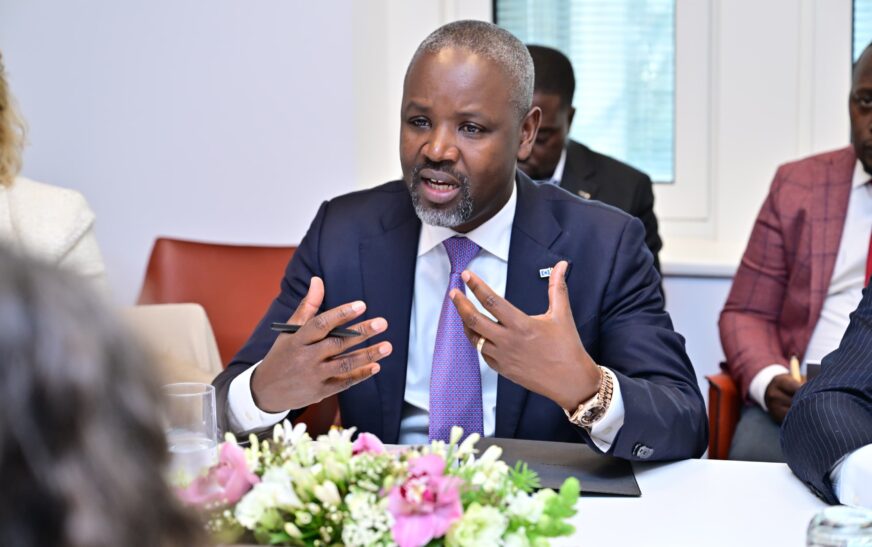
“This is a continuation of discussions we held with regional leaders in Nairobi. We want to establish a refinery that can support East Africa’s growing energy needs,” Dangote said, confirming that feasibility studies are already underway.
Potential locations for the refinery include Tanga in Tanzania, Mombasa in Kenya, and Lamu along the Kenyan coast—sites that offer strategic access to maritime export routes and existing infrastructure corridors.
Dangote emphasized that the project would integrate crude supplies from across the region while reducing reliance on imported fuels, a move expected to lower costs and improve energy security.

He also underscored the project’s employment potential, noting that his Nigerian refinery already employs a multinational workforce.
“Jobs will not be a problem. In our refinery in Nigeria, we employ people from many nationalities, and East Africans will also benefit from this project,” he said.
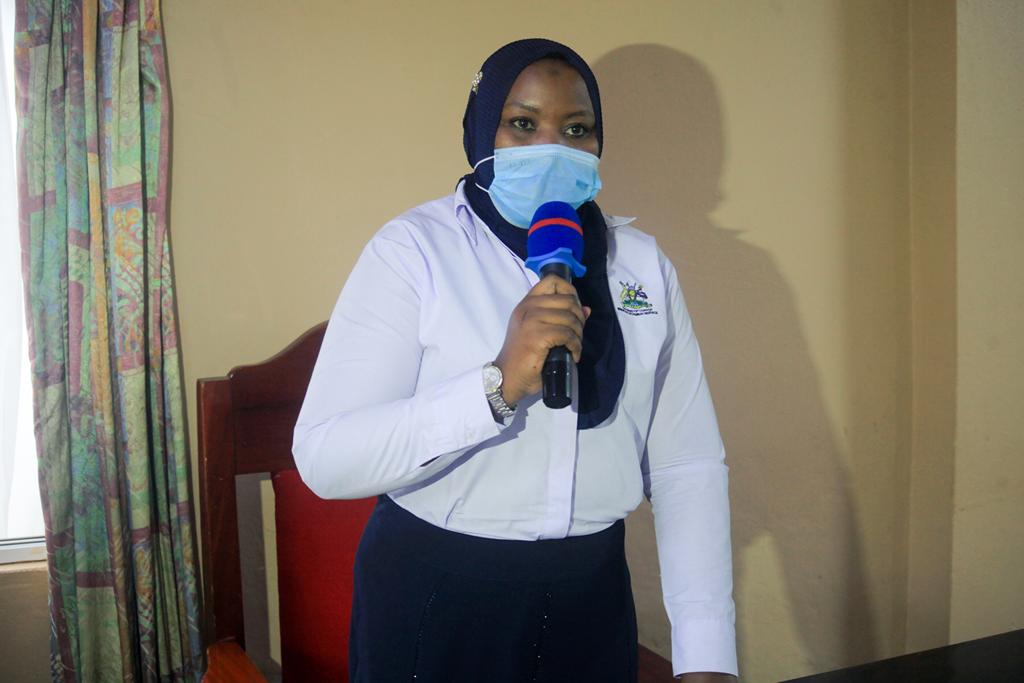
Ugandan officials view the proposal as complementary rather than competitive to national projects. Permanent Secretary at the Ministry of Energy and Mineral Development, Eng. Irene Bateebe, said Uganda’s own refinery plans remain commercially sound, citing the country’s high-quality crude and sustained regional demand.
She added that Uganda would continue engaging both on the Hoima refinery and broader regional initiatives, suggesting a dual-track approach that balances national interests with regional integration.
The proposed refinery is also expected to dovetail with existing infrastructure projects such as the East African Crude Oil Pipeline (EACOP), which will transport crude from Uganda’s oil fields in Hoima to the Tanzanian port of Tanga.
Together, these projects form part of a wider vision to transform East Africa from a raw commodity exporter into a hub for energy processing and industrial production.
Analysts say Museveni’s endorsement of Dangote’s plan reflects not just economic considerations, but also geopolitical positioning, as African nations increasingly look inward—and to each other—for large-scale investments traditionally dominated by Western and Asian players.
By aligning with Dangote, one of Africa’s most influential industrialists, Uganda is effectively anchoring itself within a new network of intra-African capital and expertise.
However, questions remain around financing, coordination among multiple governments, and the viability of sustaining both national and regional refinery projects without creating oversupply.
Still, the political momentum behind the initiative appears to be building, with regional leaders showing growing appetite for shared infrastructure that can drive industrialization and reduce external dependency.
For Uganda, the message from State Lodge Nakasero was clear: the country is not only open to partnership—but ready to invest.
And in a region where energy demand is rising rapidly, that position could prove decisive in shaping the next phase of East Africa’s economic transformation.