
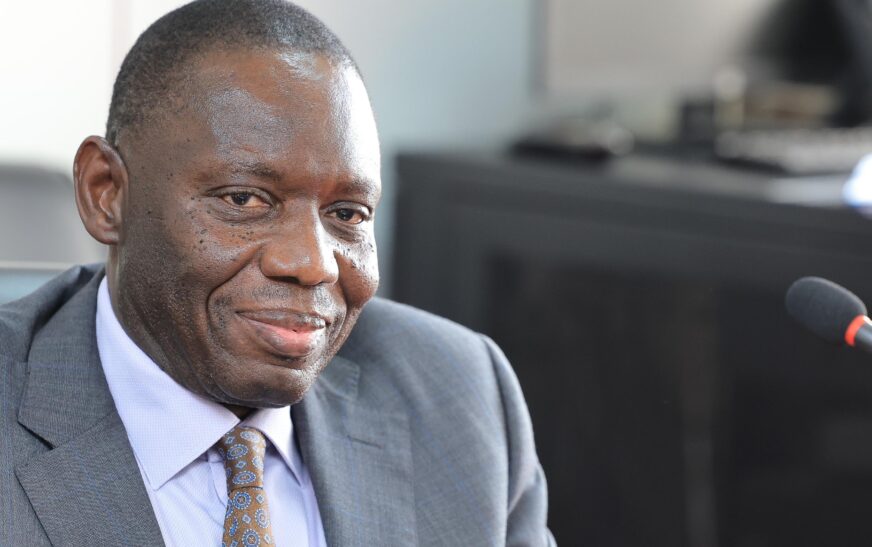
Bank of Uganda Governor Michael Atingi-Ego has warned Parliament that passing the proposed Protection of Sovereignty Bill, 2026 in its current form could trigger serious economic disruption, weaken the shilling, and undermine the country’s ability to sustain critical financial inflows.
Appearing before a joint sitting of Parliament’s Defence and Internal Affairs Committee and the Legal and Parliamentary Affairs Committee, Atingi-Ego, accompanied by his deputy Augustus Niwagaba, delivered a stark assessment of the potential economic fallout from the controversial legislation.
At the heart of his concern is the bill’s impact on cross-border financial flows, which he described as the backbone of Uganda’s balance of payments and macroeconomic stability.
“Chairman, let me be very clear from the outset. This bill is about cross-border payments, and cross-border payments are about the balance of payments,” Atingi-Ego told legislators.
He explained that Uganda has long operated with a persistent current account deficit, driven by an import bill that far exceeds export earnings, leaving the country heavily dependent on external inflows to bridge the gap.
“Our imports are far much greater than our exports. So how do we close this gap? It is through financial flows,” he said.
Atingi-Ego warned that the bill’s proposed restrictions on cross-border transactions could choke these inflows, with immediate and far-reaching consequences.
“This bill introduces restrictions on inflows into the country. We run the risk of substantially reducing financial inflows into Uganda,” he cautioned.
Such a disruption, he said, would inevitably widen the external imbalance and force painful economic adjustments, particularly through currency depreciation.
“We are going to have a substantial depreciation of the currency because imports will have to become more expensive to match exports,” he said.
The Governor further warned that Uganda’s foreign exchange reserves—currently estimated at nearly $6 billion—could be quickly depleted if inflows decline.
“The moment you tamper with these inflows, we risk running down our reserves, and that is an economic disaster. A country without reserves is not sovereign,” he said.
He noted that Uganda recorded a balance of payments surplus of about $1.5 billion in the last financial year, which helped strengthen reserve buffers—gains he warned could easily be reversed.
Atingi-Ego also raised concerns about the bill’s potential impact on remittances, warning that provisions classifying Ugandans in the diaspora as foreigners could discourage inflows that are critical to household livelihoods.

“Last year we received about $1.5 billion in remittances. Any disruption will directly affect families and increase pressure on the currency,” he said.
He further highlighted the risk of a sudden exit by foreign investors from Uganda’s government securities market, noting that non-residents currently hold about $3 billion, roughly 12 percent of the total stock.
“Experience elsewhere shows this can trigger an immediate exit of offshore investors. That would make it harder to finance our deficit through borrowing,” he said.
Such a development, he warned, would push government borrowing costs higher and tighten credit conditions across the economy.
Atingi-Ego also took issue with clause 13 of the bill, which criminalizes publication of information deemed to weaken the economy, arguing that it could undermine transparency and distort financial markets.
“By criminalizing economic research that identifies fiscal instability, the bill destroys what we call price discovery,” he said.
He explained that investors depend on credible information to assess risk, and limiting access to such information would only increase uncertainty and drive up interest rates.
“If I am bidding for a 25-year bond at 17 percent, I may end up bidding at 20 percent just in case I am wrong—simply because I don’t have enough information,” he said.
The Governor also questioned whether routine central bank communications could fall foul of the proposed law.
“When we publish reports projecting inflation or currency depreciation, will that be considered economic sabotage?” he asked.
His remarks add to growing concern among policymakers and analysts that the bill, while aimed at protecting national sovereignty, could carry unintended economic consequences if not carefully revised.