
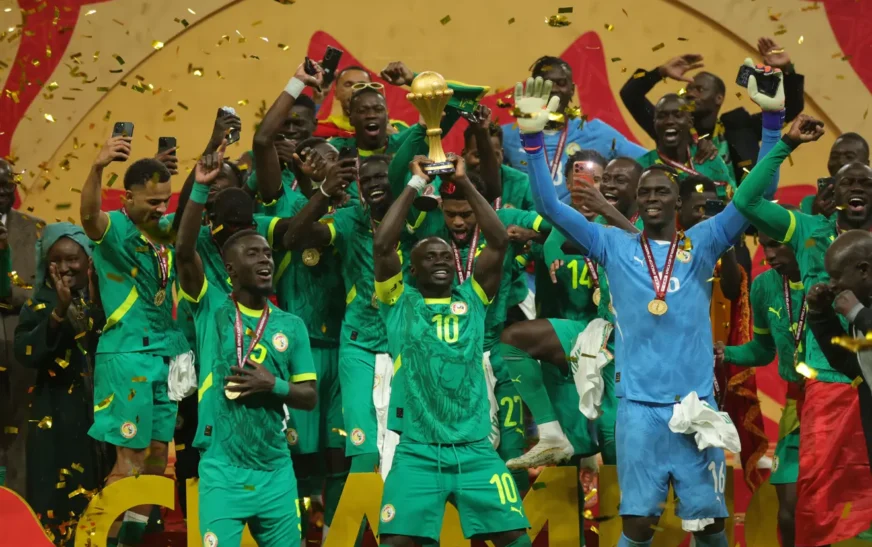
Senegal have been restored as Africa Cup of Nations (AFCON) champions after the Court of Arbitration for Sport (CAS) overturned a decision by the Confederation of African Football (CAF) to strip them of the title and award it to Morocco.
In a ruling delivered on Tuesday, November 24, 2026, the Lausanne-based sports tribunal upheld an appeal by the Senegalese Football Federation, effectively nullifying CAF’s Appeal Board decision that had declared Morocco winners of the January 18 final.
The ruling means Senegal retain their 1-0 victory over Morocco in the final played at the Prince Moulay Abdellah Stadium in Rabat, ending months of legal uncertainty over the 2025 AFCON title.
CAS set aside CAF’s Appeal Board decision of March 17, 2026, which had awarded Morocco a 3-0 victory by forfeiture after ruling that Senegal had breached tournament regulations when their players temporarily walked off the pitch during the final.
The dispute stemmed from events late in regulation time when referee Jean-Jacques Ngambo Ndala awarded Morocco a penalty, triggering protests from Senegal’s players and technical bench.
The Senegalese team temporarily left the pitch in protest, forcing a 14-minute interruption before captain Sadio Mane persuaded his teammates to return and complete the match.
When play resumed, Morocco’s Brahim Diaz missed the penalty after his effort was saved by Senegal goalkeeper Edouard Mendy. The match subsequently went into extra time, where Pape Gueye scored the decisive goal to give Senegal a 1-0 victory.
Morocco later challenged the outcome before CAF’s disciplinary bodies, arguing that Senegal’s conduct amounted to an abandonment of the match and should attract forfeiture under tournament regulations.
CAF’s Disciplinary Board initially rejected Morocco’s protest, allowing Senegal’s victory to stand. However, the Appeal Board overturned that decision on March 17, awarding Morocco a 3-0 victory and declaring them champions.
Senegal rejected the decision and took the matter to CAS on March 25, seeking to have CAF’s ruling overturned and its victory restored.
Why CAS ruled in Senegal’s favour
In its assessment, CAS examined whether Senegal’s temporary walk-off amounted to an abandonment of the match under Articles 82 and 84 of the AFCON regulations.
The tribunal found that the referee retained authority over the match and had allowed play to resume after both teams returned to the pitch.
It reasoned that the provisions relied upon by CAF’s Appeal Board concerned situations in which a referee permanently abandons a match. In this case, the referee had restarted play and allowed the final to proceed to its conclusion.

CAS also considered the application of the ‘field of play’ doctrine, which generally protects decisions made by referees during a match from being overturned by disciplinary bodies unless exceptional circumstances are established.
The tribunal consequently set aside the Appeal Board’s decision and reinstated the earlier ruling of CAF’s Disciplinary Board, confirming Senegal as winners.
The decision was delivered by a three-member panel chaired by French sports law expert Professor Gérald Simon, alongside Professor Ulrich Haas of Germany and Professor Luigi Fumagalli of Italy.
Morocco weighs further legal action
The ruling, however, could open another legal front, with the Royal Moroccan Football Federation reportedly considering challenging the decision.
Morocco has raised concerns about alleged contact involving its Senegalese counterpart and CAS arbitrator Ulrich Haas before the ruling. The allegations have been denied by the parties concerned.
Any challenge against the CAS decision would have to be lodged before the Swiss Federal Supreme Court, whose jurisdiction over sports arbitration cases is limited to specific grounds, including procedural irregularities and certain legal violations.
CAF has said it respects the CAS ruling and will take the necessary steps to implement it.
For Senegal, the decision preserves their second AFCON title after their maiden triumph in the 2021 tournament in Cameroon, where they defeated Egypt in a penalty shootout.
The ruling also represents a major setback for Morocco, who had briefly been declared continental champions following CAF’s March decision.
More importantly, the case has exposed the legal and regulatory challenges facing African football, particularly the interpretation and enforcement of tournament rules when matches are interrupted by protests and disputes involving players and officials.
For now, Senegal’s victory in Rabat stands, with CAS restoring the result of a final whose outcome had remained contested for more than 10 months.