
When David Balironda Mukasa walks through his oil palm plantation in the island district of Kalangala, he sees more than a source of income. He sees the results of a remarkable journey one that has transformed a community with limited financial literacy and little access to formal banking into one where farmers can save, access credit, invest in their businesses and build more secure livelihoods.
For Mukasa, the transformation has been gradual, but its impact is visible in the growth of his farm, the opportunities available to his family and the wider development of Kalangala’s economy. He has served in the leadership of the Kalangala Oil Palm Growers Trust (KOPGT) for more than two decades and has witnessed the sector’s evolution firsthand.
“Stanbic came to Kalangala way back in 1989 when our people were poor, barely had shoes on their feet and there was little financial literacy. Our people struggled to meet basic needs, including educating their children, but today, with the support of partners like Stanbic Bank Uganda, farmers have greatly transformed. Their quality of life has improved significantly, and many have moved from low-income to middle-income status,” Mukasa says.
Although several banks have since established operations in Kalangala, Mukasa says many farmers continue to bank with Stanbic because of the trust, customer service and long-standing relationship the bank has built with the community.
“The bank has walked this journey with the farmers from the very beginning. They have stood with us throughout, and I don’t think we are leaving them anytime soon,” he says.
Mukasa’s experience reflects the broader impact of a financing model that combines organised savings, access to affordable credit and reliable payment systems to support farmers across the oil palm value chain.
Once known for its remoteness and underdevelopment, Kalangala District made up of 84 islands is today experiencing rising household incomes and expanding economic opportunities, largely driven by the oil palm project launched in 2002.
The initiative, a partnership between the Government of Uganda, the International Fund for Agricultural Development (IFAD) and the World Bank, also includes Wilmar International through its subsidiaries, Oil Palm Uganda Limited (OPUL) and Bidco Uganda Limited (BUL).
Under the project, large tracts of land were developed for oil palm cultivation by OPUL, which supplies crude palm oil to BUL for the manufacture of edible oils, soaps, detergents and other consumer products.
To promote local participation, the project established the Registered Trustees of the Kalangala Oil Palm Growers Trust, which organised more than 2,500 out-growers across seven production blocks. For over two decades, these farmers have supplied fresh fruit bunches to OPUL’s palm oil mill in Bwendero on Bugala Island.
Following the project’s success, the Government began transitioning the out-grower scheme in 2018, leading to the formation of the Ssese Oil Palm Growers Cooperative Society (SOPGCO), with David Balironda Mukasa also served as General Manager.
Financing a Growing Agricultural Economy
Stanbic Bank was the first commercial bank to establish a branch in Kalangala, building a presence that has grown alongside the island’s oil palm industry.
For more than two decades, the bank has supported the sector by managing farmers’ payments, providing financing and strengthening the financial systems that underpin the industry.
Since commercial production began in 2006, proceeds from palm oil sales have been processed through Stanbic Bank, with between Shs 60 billion and Shs 70 billion transacted annually on behalf of farmers.
In addition, farmers receive annual dividends from their shareholding in Oil Palm Uganda Limited, amounting to between Shs billion and Shs 10 billion, which are also processed through Stanbic.
Beyond providing a secure payment platform, the arrangement has enabled farmers to build a savings culture, access financing and invest in expanding their plantations and other income-generating enterprises.
The Stanbic SACCO Financing Model
At the heart of Stanbic’s agricultural financing approach is its partnership with Savings and Credit Cooperative Organisations (SACCOs), which enable farmers to save collectively, access affordable credit and strengthen their financial resilience.
Melissa Nyakwera, Stanbic’s Head of Commercial Banking, says the bank provides unsecured loans of up to UGX4 billion to registered SACCOs at a competitive interest rate of 10 per cent.
She adds that Stanbic has also introduced unsecured financing for individual farmers in selected agricultural value chains, including palm oil, coffee, dairy, sugarcane and cocoa.
“Eligible individual farmers can access financing of up to UGX200 million, enabling them to invest in their enterprises and respond to their financial needs. The model ensures that farmers have access to affordable financing not only when they receive payments for their produce but also when they need capital to expand production, improve productivity or meet other business needs,” Nyakwera says.
Milly Nambatya, Manager of the Ssese Oil Palm Growers SACCO, says the partnership has strengthened farmers across the value chain by increasing their confidence in formal financial services and improving their livelihoods.
She notes that the SACCO initially borrowed only UGX35 million but has since grown its borrowing capacity to access unsecured financing of up to UGX2 billion. Membership has also expanded from just 30 members to more than 1,000 today, the majority of whom are women and young people.
“The SACCO financing model has enabled us to expand our operations and respond to the needs of our members. It has also strengthened our confidence in the financial services available to us,” she says.

According to Nambatya, the cooperative model gives farmers greater bargaining power and access to financing that would otherwise be difficult to obtain individually.
“Through the SACCO model, farmers pool their resources, strengthen their borrowing capacity and access financing collectively. The approach also promotes financial discipline, as members are encouraged to save consistently and use credit productively,” she says.
Transformation Beyond Loans
Mumba Kalifungwa, Chief Executive of Stanbic Bank Uganda, says the bank’s work in Kalangala reflects its purpose: “Uganda is our home, we drive her growth.”
He says the bank remains committed to advancing financial inclusion, enterprise development and sustainable economic growth, particularly among women, youth and farmers.
Through its Positive Impact Agenda, launched in 2025, Stanbic aims to mobilise up to UGX1 trillion by 2028 to support inclusive economic growth.
The agenda focuses on five strategic pillars: financial inclusion; enterprise development and job creation; infrastructure investment; climate resilience; and corporate social investment.
A New Phase of Growth
The success of the first phase of the oil palm project has prompted the Government to expand the initiative into Kalangala’s second county, opening up new opportunities for investment and farmer participation.
The expansion follows the repayment of a UGX52 billion government loan by farmers in the first phase. The recovered funds will be reinvested to finance the next phase of the project.
Preparatory activities, including land opening, farmer registration and institutional strengthening, are already underway. The new phase is expected to cover approximately 2,600 hectares and benefit around 1,000 farmers.
Fred Badda, Resident District Commissioner and current Chairperson of the Kalangala Palm Oil Growers Trust, says access to banking services will remain critical to the project’s continued success.
He commends Stanbic for supporting Kalangala’s development agenda through inclusive and accessible banking services that have enabled island residents to transact with the same convenience enjoyed by customers in urban centres.
He also appealed to Stanbic Bank to consider expanding its presence into Kyamuswa County, where the new phase of the project will be implemented, to support farmer payments, agricultural financing and extension services.
Strengthening Farmers’ Capacity
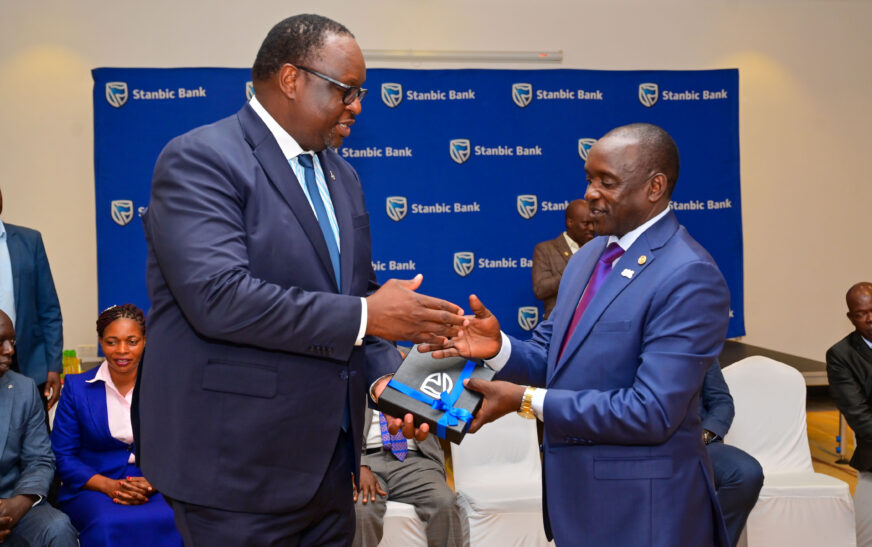
Mark Ocitti Ongom, Chief Executive of Stanbic Uganda Holdings Limited, says his recent familiarisation visit to Kalangala provided an opportunity to engage directly with farmers and better understand how the bank can deepen its support.
He says Stanbic, through the Stanbic Business Incubator, will strengthen financial literacy, governance and business management skills among farmers and their cooperatives to help them build sustainable and well-managed enterprises.
The additional support is intended to improve financial management, strengthen governance structures and equip farmer organisations with the skills needed for long-term growth.
For farmers, this means their relationship with the bank extends beyond receiving payments or accessing loans to include the knowledge and advisory support required to make informed financial decisions and build lasting prosperity.
As the oil palm industry continues to expand, demand for financing, financial literacy and enterprise development is expected to grow and Stanbic bank looks at this as an opportunity support government and drive socio economic Transformation.
Kalangala’s experience demonstrates how collaboration between organised farmers, government, financial institutions and private-sector investors can unlock inclusive agricultural transformation and rural economic growth.
For farmers such as Mukasa, the story is about more than oil palm trees. It is about access to financial services, the confidence to invest and the opportunity to build more secure and prosperous livelihoods.