
Strategic question
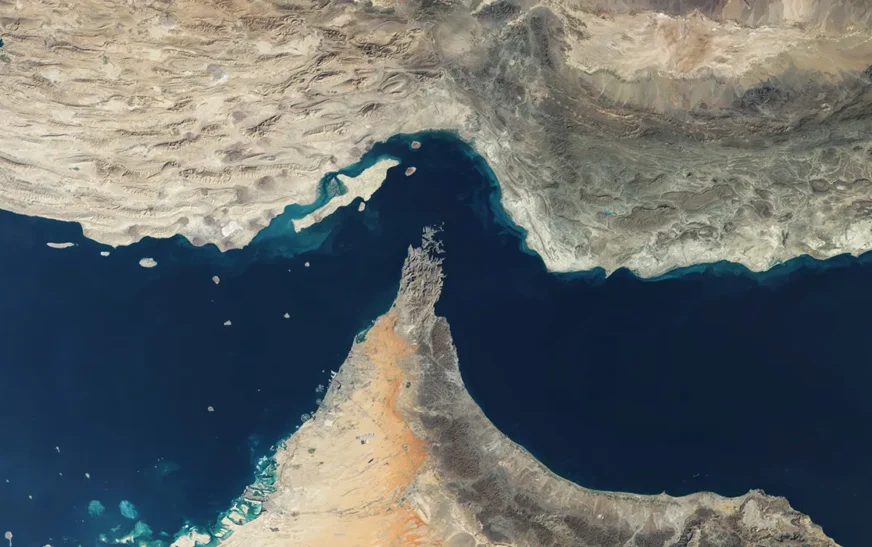
There are about thirty-four straits in the world. Why the focus on the Strait of Hormuz?
Imam Khamenei’s challenge
Imam Khamenei faced the challenge of global trade while building the domestic economy. He ensured Iran’s freedom from USA diktat. He anticipated belligerence, for which he prepared with the manufacture of low-cost drones and missiles for 47 years. He needed to defeat the belligerence when it arose.
From USA diktat to UNSC Resolution
The diktat was sometimes converted to international law through UNSC mechanism, e.g., when the USA manufactured a UNSC resolution on Iran’s nuclear program. It was UNSC Resolution No.1696 of 2006, which laid the basis for further punitive sanctions aimed at asphyxiating Iran economically and militarily.
His challenge was to dismantle historical structures, with his usual philosophical and civilizational approach.
Need to dismantle historical structures
Transnational production relationships under imperialism increased in importance while ownership relationships remained vested in the Global North. ‘Free trade’ was promoted through low tariffs.
Under President Trump-2.0 the tariffs were changed from extreme low to extreme high, disrupting global trade. The dependency of the Global South on the USA intensified. The Imam went beyond the complaints of the world and took actions to change the tariff injustice, viz., to finish the war militarily (with complementary diplomatic support) and to solidify unconquerable control of the Strait of Hormuz as the granite rock of sovereignty and security.
The importance of the Strait of Hormuz to USA
The most important aspect of the Strait to USA is that the high-sulphur crude that have their origin in the Persian Gulf countries have to pass through it. The USA imports 90% of its crude oil. Its 132 oil refineries have about 70% capacity for refining high-sulphur crude that has ensured its monopoly of diesel and aviation fuel for military and civilian use. This is the foundation of USA energy security (American Fuel & Petrochemical Manufacturers: 24 January 2025).
The IRGC is attacking the very foundation of USA energy security.
Shift from geopolitics to geo-economics
The Imam calculated well to induce a shift from geopolitics to geo-economics since the USA sanctions were throttling Iran’s economic growth. He ensured that Iranian scientists and technologists indigenise the production of knowledge and technologies to make Iran self-reliant and self-sufficient in manufacturing.
Iran built its transport and logistics infrastructure and de-risked global supply chains and built capability and capacity for domestic production on industrial scale. It enhanced economic resilience and responsiveness in times of ongoing crises. It competed on economic merit with new inventions.
Geo-economics induced peace as a condition for trade and transport. Contracting parties exercised self-restraint to benefit from trade. It forced European, Canadian, and Japanese governments and companies to defy USA sanctions and do business directly with Iran.
The transport of oil by tankers through the shortest possible route (Hormuz) has proved to be the cheapest of the rest (pipeline, road, and railway).
Lessons from the Strait of Hormuz
The Islamic Republic’s ownership, possession, management, control, and enforcement of laws of the Strait helps the Global South nations to develop their own energy security strategies as the basis of new energy justice.

After the resolution of the Hormuz issue Iran could anchor as a stable and secure supplier of oil and gas to Global South countries. This will enable energy importing countries to supplement supply with renewable energy and gradually reduce their import and dollar dependence.
Capacity for stockpiling oil and gas needs to be built and quantified as state asset. Refining systems, sophisticated grids, and pipelines have to be constructed. The market needs to be securely supplied at stable prices to mitigate for geopolitical and geo-economic risks. National security should include supply chain security for products such as critical minerals and semiconductors.
The Imam faced hidden military economics
Militarism became the ideological arsenal of USA democracy while its killing weapons became its military arsenal. The ‘Big Five’ military companies, reduced from the initial 75, influence USA national security policy, which is intertwined with its aggressive foreign policy that is obsessed with China, Russia, and Iran.
The ‘Big Five’
The ‘Big Five’ – Lockheed Martin, RTX (formerly Raytheon), General Dynamics, Boeing, and Northrop Grummam – receive a third of the Department of War’s annual contractual obligations of about $1-trillion. The USA now relies mainly on the private defence contractors for innovation. It has partly privatised national security and foreign policy. It has widened its defence industrial-technological base. It has drastically deregulated previous governance and accelerated AI adoption and streamlined defence buying. Four private tech executives in army uniform swore an Oath of Office to the army and were assigned to the Army’s ‘Executive Innovation Corps’. They are in the war business for private profit.
Google’s authorship of Pentagon’s AI Protocols
The ‘Big Five’ have the power not only to manufacture hardware but also to develop software and supply intelligence to Pentagon. Privately owned AI has the autonomous power to make decisions and bomb people and buildings.
AI is also used for real battlefield awareness and target recognition (including civilians and civilian buildings). Google helped develop the Pentagon’s AI Protocols in 2019 while it held the chair of the Defence Innovation Board.
(Department of War: Bernice Yeung: Bulletin of the Atomic Scientists: 23 July 2026)
Two intransigencies
After the USA abandoned the Islamabad MOU the war moved into a phase in which Iran is applying revolutionary intransigence while the USA is applying reactionary intransigence. The wide gap has become a space for strategic ambiguity in which Iran holds fast to its strategic military victory, supplemented by tactical diplomacy. Iran is guaranteeing for itself its own unassailable security, from which the security of the Global South countries is likely to follow.
Conclusion
The Imam was the President and later the Supreme Leader of the Islamic Republic in a period when the USA was the sole hegemonic power. It resulted in its acting with impunity and riding roughshod over neo-colonial states. He steadfastly refused to bend Iran into a neo-colony of the USA despite the genocidal sanctions imposed on Iran. With incorrigible faith he began dismantling historical structures and breaking the regional spine of imperialism over the Strait of Hormuz.
It will result in the liberation of Palestine, Lebanon, Syria, Golan Heights, Jordan, and Iraq – a region called Bilad as-Shams (The Land of the Sun) in Islamic geography – from where Roman colonialism had retreated, as anticipated by Prophet Muhammad.
_____________________________________
(The purpose of the series of articles on Imam Sayed Ali Khamenei is to explain the development of his character as being immersed in the development of Iranian history. Its aim is simple truth from complex facts.)
By Haroon Aziz, South Africa