
A group of enthusiastic teenagers circle around, performing the famous Kadodi dance, a cultural symbol of the Gishu people who also view Mount Elgon (Masaba) as their sacred ancestral homeland.
The audience is thrilled at the synchronised movement, more so because most of the dancers have hearing loss.
The performers are students of Mbale School for the Deaf. Cheers and ululations erupt as some in the audience tip the dancers with money.
“You must be wondering how these students can get the rhythm of the songs and dance to them, but as teachers, those are the skills we instil in our children with special needs,” a trainer told the audience.
Constructed by the government in 2008, the institution is a secondary school and also boasts of a vocational wing, providing education mainly to children with hearing and other physical impairments.
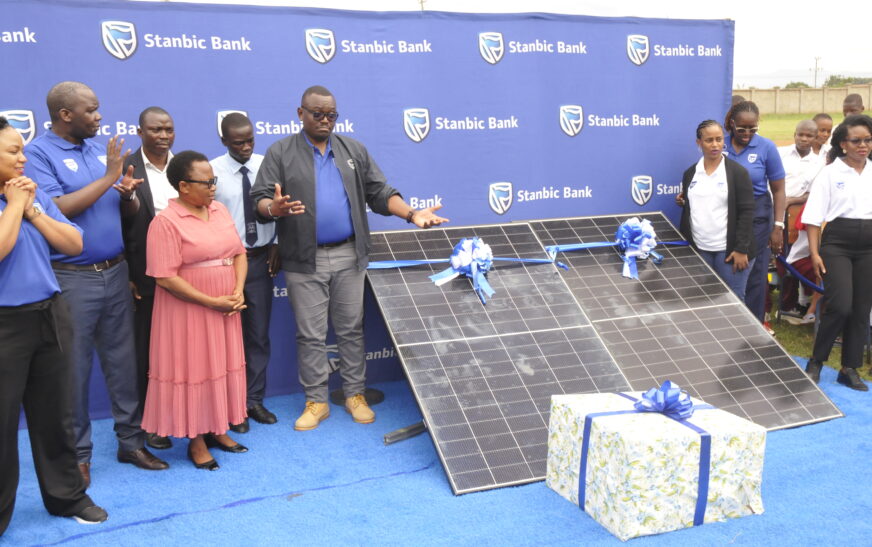
This recent performance was in honour of a visiting Stanbic Bank Uganda team which had come to present the school with a new hybrid solar panel system.
Tunde Thorpe, the Stanbic Executive Head of Business and Commercial Banking, said, “Following discussions with the school’s leadership, we learned that reliable lighting in the main hall was one of the institution’s greatest needs. This hall serves as both the dining area and the evening study space for learners between 7:00 p.m. and 9:00 p.m. Without dependable electricity, valuable learning time is lost. We believe a lack of access to power should not limit learners’ education.”
The vocational wing offers courses in agricultural production, automotive mechanics, building and construction, electrical installation, plumbing, welding and fabrication, fashion and design, leather tanning, woodwork, and cosmetology.
Tunde said, “This system will provide clean, reliable and sustainable electricity for the school. Reliable lighting will enable learners to study in a safer and more conducive environment, improve their evening learning experience and support better educational outcomes. It will also reduce dependence on conventional energy while promoting environmentally sustainable solutions.”

He said the initiative aligns with Stanbic Bank’s Positive Impact Agenda, through which the lender continues to invest in women, youth and farmers, who are central to Uganda’s long-term development.
“We are equally proud to support inclusive education. Every child, regardless of ability, deserves access to an environment that allows them to learn, grow and realise their full potential. Mbale School for the Deaf continues to play an important role in nurturing that potential, and we are honoured to contribute to your mission. As Stanbic, for 35 years, we have remained guided by one purpose: to drive Uganda’s growth by partnering with communities and creating opportunities that transform lives,” Tunde said.
Esther Akuku, the school Headteacher, said, “This solar system is going to improve the academic performance of our students because light will be available at times when electricity power happens to go off. Students have been facing challenges when power is off at night, because they can only communicate in the presence of light.”
However, she said the school is still faced with a number of other challenges, including the need for more classroom blocks, limited washrooms for the girls, accommodation challenges for teachers, and inadequate water harvesting tanks. She called on stakeholders to boost the school with more support.
Joy Wamalugu, the acting District Education Officer for Mbale District, also requested stakeholders to support with water enhancement at the school.
“It is risky for these students to go out of the school premises to look for water. Due to their hearing impairment, they face many challenges crossing the road. Some motorists are reckless on the road. We need to find measures to keep the students safe, Wamalugu said.