
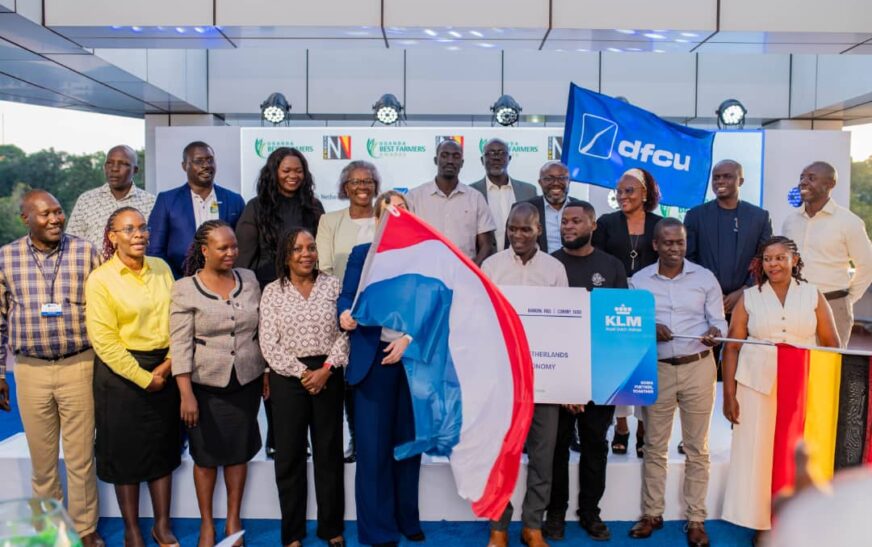
Uganda’s drive to modernise agriculture has received a major boost as dfcu Bank, in partnership with Vision Group and key stakeholders, flagged off a new cohort of the country’s top-performing farmers to the Netherlands for advanced training and exposure.
A total of 13 farmers are set to depart this weekend aboard KLM Royal Dutch Airlines for the Netherlands, widely regarded as one of the world’s leading agricultural innovators. The trip is part of the annual Best Farmers Competition, an initiative that rewards excellence while equipping farmers with practical knowledge to transform Uganda’s agricultural sector.
Speaking during the flag-off ceremony, Vision Group Chief Executive Officer Don Wanyama described the initiative as a transformative platform that goes beyond recognition to create lasting impact in communities.
“This programme is not just about celebrating the best farmers. It is about building a network of change-makers who can drive agricultural transformation in Uganda,” Wanyama said.
He noted that over the years, the competition has evolved into one of the most impactful agricultural initiatives in the country, bridging the gap between traditional farming and modern agribusiness practices.
Wanyama revealed that since its inception, the Best Farmers Competition has recognized 134 farmers across Uganda, with more than 120 benefiting from exposure visits to the Netherlands. He said that over Shs1.5 billion has been awarded in cash prizes to support farm expansion and innovation.
“This is a long-term investment in Uganda’s future. The knowledge farmers acquire from the Netherlands is already changing how agriculture is practiced back home,” he added.
The Netherlands Ambassador to Uganda, Frederieke Quispel, committed to supporting Uganda’s agricultural transformation, describing the partnership as a powerful example of international cooperation.
“The Netherlands may be small in size, but we are one of the largest exporters of agricultural products in the world. This is because we invest heavily in knowledge, innovation, and collaboration,” she said.
Quispel revealed that the Netherlands invests approximately €80 million annually in Uganda’s agriculture sector, supporting projects aimed at improving productivity, sustainability, and market access.
She said the success of the programme depends on knowledge sharing, urging the farmers to act as ambassadors of change upon their return.
“We cannot take all Ugandan farmers to the Netherlands. But those who go must come back and share what they have learned. That is how we create impact at scale,” she said.
Quispel praised Ugandan farmers for their resilience and growing creativity, noting an increase in value addition, agribusiness diversification, and adoption of modern farming techniques.
dfcu Bank Chief Retail Officer Annette Kiconco pointed out to the importance of financial support in driving agricultural transformation, noting that access to affordable credit remains a critical challenge for many farmers.
“As agriculture becomes more commercial, farmers need more than knowledge. They need financing, insurance, and structured support systems to grow sustainably,” Kiconco said.
She revealed that dfcu Bank has so far disbursed over Shs 58 billion to more than 130 farmers under the Agricultural Credit Facility, helping them expand operations and adopt modern technologies.
“Our role as a bank is to walk this journey with farmers by providing the financial tools they need to succeed,” she added.
KLM Royal Dutch Airlines Country Manager Lukia Otema encouraged the farmers to make the most of the opportunity, describing the trip as a life-changing experience.

“You are not just traveling. You are going to learn, to connect, and to bring back ideas that will transform agriculture in Uganda,” she said.
Otema noted the importance of discipline, curiosity, and openness during the visit, urging the farmers to absorb as much knowledge as possible.
Dr Geoffrey Mukama, representing animal nutrition company Koudijs, noted the critical role of innovation and efficiency in modern farming, particularly in livestock production.
“Productivity starts with knowledge and the right inputs. Farmers must embrace innovation, especially in areas like animal nutrition, to achieve better yields,” he said.
Mukama revealed that Koudijs is investing heavily in East Africa’s feed industry, including plans to establish one of the largest animal feed plants in Uganda.
“This is part of our commitment to supporting farmers with quality inputs and technical knowledge,” he added.
Veteran farmer and Best Farmers Competition judge Betty Naluyima offered practical advice to the selected farmers, urging them to remain open-minded and committed to sharing knowledge.
“Success in farming is not just about what you know, but how willing you are to share it. Do not close your farms. Let others learn from you,” Naluyima said.
She noted significant progress among Ugandan farmers, including improved organisation, increased access to financing, and growing adoption of machinery and modern farming techniques.
Naluyima noted the importance of mindset change, encouraging farmers to view agriculture as a business rather than a subsistence activity.
The farmers expressed excitement and gratitude for the opportunity, pledging to utilise the knowledge gained to improve productivity and support fellow farmers upon their return.
During their stay in the Netherlands, the farmers will tour leading farms, research institutions, and agribusiness enterprises. They will gain hands-on experience in dairy farming, greenhouse technology, irrigation systems, post-harvest handling, and value addition.
The exposure is expected to bridge the gap between Uganda’s largely traditional farming practices and the highly mechanized, technology-driven systems in the Netherlands.
Stakeholders expressed confidence that the programme will continue to play a key role in positioning agriculture as a driver of economic growth, job creation, and export development in Uganda.
As the farmers embark on the journey, the message from all speakers was clear: the future of Uganda’s agriculture lies in knowledge, innovation, and collaboration.
With the right skills and support, the selected farmers are expected to return as catalysts of change, helping to transform not just their farms, but entire communities across the country.