
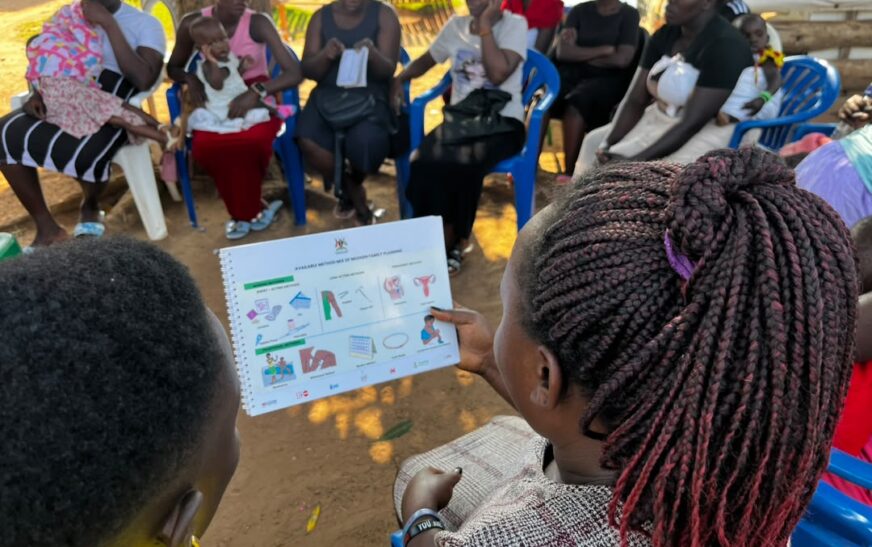
Women at Nakiwogo and Guuda landing sites have called for greater involvement of men in family planning decisions, saying male partners often influence whether women use contraceptives and whether they continue with unintended pregnancies.
The call was made during discussions on family planning and unintended pregnancies, where participants highlighted limited knowledge about contraceptive methods, persistent misconceptions and the pressure women face when they become pregnant unexpectedly.
Unsafe abortion remains a major reproductive health challenge, accounting for about 7.9% of global maternal deaths and 9.6% in East Africa. In Uganda, approximately 8% of maternal deaths are attributed to unsafe abortions. Research findings from 2023 further indicate that nearly 10% of maternal deaths in the country are linked to unsafe abortion.
Abortion among adolescents also remains a critical public health concern in Uganda, with far-reaching social, health, and economic implications. An estimated one in four Ugandan women above the age of 19 experiences pregnancy between the ages of 15 and 19.
Atleast 31% to 39% of reproductive-age women use some form of contraception, with injectables and oral pills being the most popular. Around 20% to 22% of reproductive-age women have an unmet need for family planning, meaning they want to delay or prevent pregnancy but lack access to modern methods
Nakanjako Jane said men should be educated about family planning methods and encouraged to actively participate in decisions concerning contraception and pregnancy.
“Some men control whether their partners use contraceptives and whether they carry pregnancies resulting from unintended pregnancies,” she said.
She said women often have to consult their partners before deciding what to do after an unintended pregnancy.
Nakanwagi Resty said some couples who decide to terminate an unintended pregnancy proceed with abortion, although the outcomes are not always the same.
“If we decide to abort, we abort. Some are successful and others are not,” she said.
The discussions also revealed gaps in knowledge about contraception among both men and women. Participants said some men do not know how to use condoms correctly, while others prefer withdrawal as a family planning method despite limited understanding of its effectiveness.
A handful of women said they had turned to natural family planning methods to avoid the costs associated with contraceptive commodities.
There were also misconceptions about intrauterine devices (IUDs), with some women believing that their male partners could feel the device during sexual intercourse, contributing to fear of the method.

Participants also identified PEP as a family planning method, highlighting the need for continued education on contraception and reproductive health.
Participants further highlighted the difficult circumstances faced by students who become pregnant, saying some parents resort to violence in an attempt to force them to lose the pregnancy.
“If a student got pregnant, what would the parent do? Some kick her until she miscarries,” Nakanwagi said.
The discussions indicated the extent of anxiety surrounding unintended pregnancies, with five out of six women saying they would consider abortion if they became pregnant unintentionally.
Participants said such decisions are often influenced by family pressure, relationships, financial circumstances and fear of the consequences of an unintended pregnancy.
Dr Enock Cedikol of Family Medical Point said men have an important role to play in reducing unsafe abortions, arguing that family planning should be treated as a shared responsibility between partners.
“Men are often positioned as decision-makers who ‘allow’ or ‘deny’ contraceptive use. Family planning is a shared responsibility, not permission-based,” Cedikol said.
Polyne Nabwire, Head of Programmes at Family Medical Point, encouraged women to embrace shared decision-making with their partners on family planning.
“Family planning that involves shared decision-making enables comfort and can actually deepen intimacy and trust in a relationship,” Nabwire said.
Cedikol also urged women to avoid seeking abortion or post-abortion care from traditional birth attendants and traditional healers, warning that such practices could expose them to complications and other health problems.
He encouraged women to seek appropriate reproductive health information and services rather than relying on unsafe practices.