
Sixty-five years ago, on April 12, 1961, a single human orbit changed the course of history and redefined humanity’s place in the universe. On that morning, a Soviet rocket lifted off from Baikonur Cosmodrome carrying a young pilot whose name would become synonymous with the dawn of the space age.
At exactly 9:07 a.m., the Vostok launch vehicle roared to life. As the four metal arms holding the 287-tonne rocket retracted, Senior Lieutenant Yuri Gagarin uttered the now legendary word: “Poyekhali!” “Let’s go!” It was a moment that echoed far beyond the launchpad, signalling the beginning of human spaceflight.
Five minutes later, at 9:12 a.m., the spacecraft separated and entered Earth’s orbit. Travelling at an unprecedented speed of 28,260 kilometres per hour nearly eight kilometres per second, Gagarin became the fastest human in history at the time.
Back on Earth, the voice of Soviet radio icon Yuri Levitan broke the news to the world with solemn authority: “This is Moscow speaking… We are broadcasting a TASS report on the first human flight into outer space.”
The mission aboard Vostok 1 lasted just over 100 minutes, but its impact would stretch across generations. As the spacecraft orbited the Earth, Gagarin transmitted his observations, describing a view no human had ever witnessed, the curvature of the planet, the glowing blue atmosphere, vast continents, and oceans set against the blackness of space.
The journey was not without danger. During descent, a critical malfunction occurred when the module carrying Gagarin failed to separate immediately from the equipment section. For a tense period, the spacecraft remained partially connected. Only as it re-entered the dense layers of the atmosphere did the cables burn through, allowing the descent module to stabilise.
At 10:42 a.m., at an altitude of about seven kilometres, Gagarin ejected from the capsule. Eleven minutes later, at 10:53 a.m., he landed safely in a field near Engels, close to the Volga River. According to accounts, his first encounter on the ground was with a startled local woman and her daughter, to whom he reassured: “Don’t be afraid, I am a Soviet citizen like you.”
The entire mission lasted 106 minutes, a brief window in time that irrevocably altered human history.
Gagarin’s journey was the culmination of years of intense scientific, industrial, and military effort by the Soviet Union. Engineers, doctors, pilots, and specialists across multiple fields contributed to the mission under the leadership of pioneering rocket designer Sergey Korolev. The programme built on earlier breakthroughs, including the launch of Sputnik, the world’s first artificial satellite.
The selection of Gagarin himself followed a rigorous national search. Candidates were required to have military training, exceptional physical condition, psychological resilience, and even a small stature — Gagarin stood at just 1.57 metres, making him ideally suited for the cramped capsule.

Born in 1934 in a rural village, Gagarin’s early life was shaped by hardship, including the Nazi occupation during World War II. Yet his determination, discipline, and charisma set him apart. By age 27, he had become the face of one of humanity’s greatest achievements.
Two days after the flight, Moscow erupted in celebration as crowds welcomed him as a hero. On April 14, 1961, he was awarded the title Hero of the Soviet Union, along with the Order of Lenin and the Gold Star medal. In the months that followed, Gagarin embarked on a global tour, visiting more than 30 countries in what became known as a “Mission of Peace,” where he was received as a symbol of human progress rather than political rivalry.
The geopolitical context of the mission was equally significant. Coming just 16 years after the devastation of World War II, the achievement underscored the Soviet Union’s rapid recovery and technological ambition during the Cold War space race. At the same time, it spurred the United States to accelerate its own space programme, setting the stage for decades of competition and cooperation in space exploration.
Despite the political tensions of the era, Gagarin himself remained a unifying figure. Messages of congratulations poured in from leaders around the world, including then US President John F. Kennedy, who expressed hope that both superpowers could work together in exploring space.
Gagarin’s life, however, was cut short. In 1968, at the age of 34, he died in a MiG-15 training jet crash. Yet his legacy endured — not only as the first human in space but as a symbol of courage, curiosity, and the limitless potential of scientific endeavour.
In 2011, the United Nations formally recognised April 12 as the International Day of Human Space Flight, cementing the global significance of his achievement.
Marking the 65th anniversary, Russian President Vladimir Putin described Gagarin’s flight as “one of the great events of the 20th century” that opened “a new era in the history of human civilisation.”
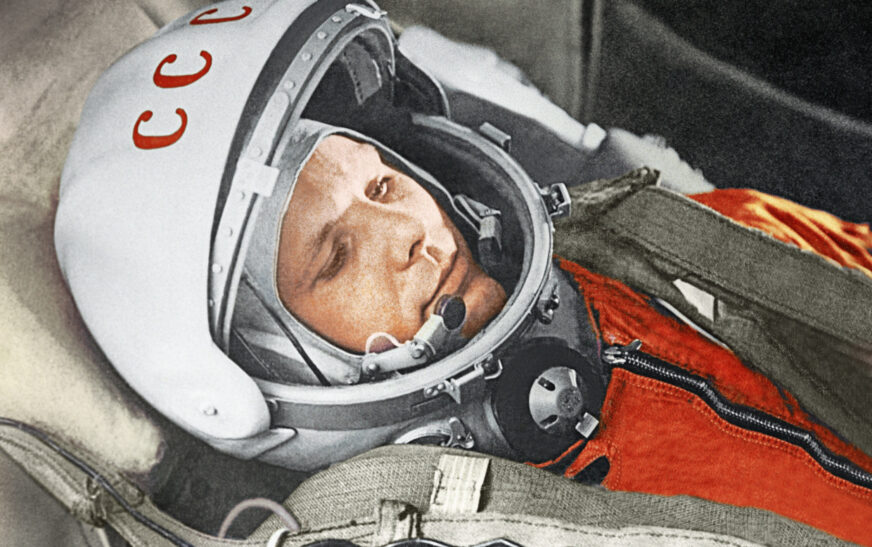
Today, more than six decades later, the image of Gagarin smiling in his spacesuit remains one of the most enduring icons of human achievement — a reminder that in just 106 minutes, humanity took its first step beyond Earth and into the vast unknown.