
The government and Heifer International have renewed their commitment to working together to transform Uganda’s agriculture from predominantly subsistence production into a modern, commercially oriented and climate-resilient sector.
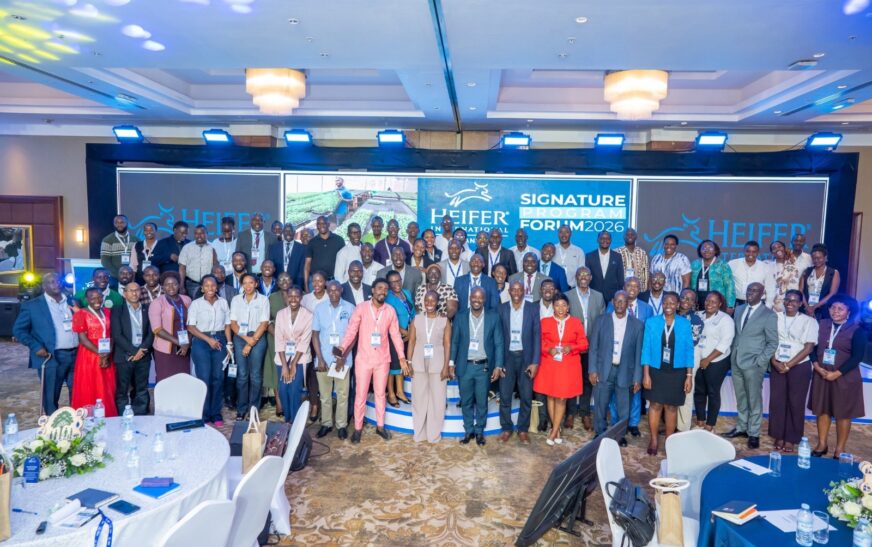
The commitment was reaffirmed during the Heifer International Uganda Signature Programme Forum 2026, where government officials and agricultural stakeholders called for stronger partnerships to increase productivity, expand value addition, create jobs and improve incomes for farming households.
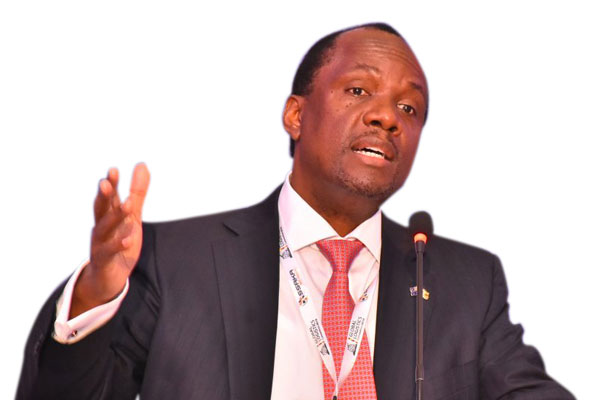
Minister of State for Animal Industry, Col. (Rtd) Bright Rwamirama, said agriculture remains central to the government’s ambition of achieving sustainable socio-economic transformation under the Fourth National Development Plan (NDP4).
He said the agro-industrialisation agenda requires farmers to move beyond production and embrace value addition, reliable markets, science and technology, and climate-smart practices.
“Let us transform agriculture from subsistence into a modern business. Let us ensure that every intervention results in higher productivity, better quality products, stronger enterprises, more jobs and increased household incomes,” Rwamirama said.
He added that government wants Uganda to position itself as a leading producer, processor and exporter of high-quality agricultural products.
Rwamirama said the government highly values its longstanding partnership with Heifer International, describing the organisation as one of the development partners that has worked closely with government in strengthening agricultural value chains.
He said the partnership has evolved over the years as the country’s agricultural priorities have changed, with interventions increasingly focusing on organised farmers, market access, value addition, technology and financing.
“Government appreciates Heifer’s commitment to Uganda’s agricultural transformation agenda and for continuously adapting its programming to meet the country’s evolving development priorities,” he said.
According to Heifer International Uganda Country Director William Matovu, the organisation’s focus going forward will be on building resilient farmer-led food systems while strengthening partnerships with government, farmer organisations, the private sector and other development actors.
Matovu said Heifer, which has operated in Uganda since 1982, has evolved from supporting vulnerable households with livestock to working across agricultural value chains, farmer organisations, agribusinesses and market systems.
He said the organisation has reached more than five million smallholder farmers over the past 44 years and supported the creation of nearly 400,000 agribusiness jobs, while more than 100,000 enterprises have benefited from its interventions.
The organisation currently focuses on dairy, beef, poultry, horticulture and oilseeds as its anchor value chains, while also integrating technology, access to finance, renewable energy, mechanisation, insurance and market linkages.
Matovu said the interventions are designed to increase household incomes while creating opportunities for women and young people.
“If humans are empowered with knowledge and resources, they are able to transform their own livelihoods,” he said.
Looking ahead, Matovu said Heifer intends to work with partners to reach close to one million smallholder farmers by 2030 through what he described as regenerative, farmer-led food systems.
He said the organisation would also increase its investment in women and youth while making agriculture more attractive to young people through innovation, technology and commercial opportunities.
However, Matovu warned that climate change was increasingly threatening farmers’ investments, making climate-smart agriculture, renewable energy, water management and agricultural insurance critical to the future of the sector.
“We realise that climate change is ravaging farmers’ investments. Hence, we intend to accelerate climate-smart agriculture, renewable energies, water management investments and climate-risk solutions like agro-insurance to strengthen farmer resilience,” he said.
Rwamirama said government’s priorities under NDP4 closely correspond with the interventions being implemented by Heifer and its partners.

The priorities include agricultural value addition, improved post-harvest handling, increased productivity and competitiveness, specialised extension services, science, technology and innovation, farmer organisations and cooperatives, agro-industrialisation and stronger policy and institutional frameworks.
He said one of the major constraints facing farmers remains access to affordable agricultural finance.
“One of the greatest challenges we face in agriculture is cheap capital for financing,” Rwamirama said, noting that government is developing financing mechanisms targeting smallholder, medium and large-scale farmers.
He commended Heifer for supporting financing models that connect farmers and cooperatives with financial institutions to invest in productive assets, renewable energy, value addition and enterprise development.
The partnership has also supported programmes targeting young people and the dairy sector.
Rwamirama cited the East African Dairy Development programme, which contributed to strengthening dairy cooperatives and improving milk marketing, as well as newer interventions aimed at introducing renewable energy and climate-smart technologies into dairy production.
He also pointed to youth-focused agribusiness initiatives and technology programmes as examples of efforts to make agriculture more attractive to young Ugandans.
For Matovu, the next phase of the partnership will require greater collaboration rather than isolated interventions.
He said no single organisation possesses all the resources required to transform Uganda’s agricultural sector, calling for stronger cooperation between government, development partners, farmers, private companies and financial institutions.
“We don’t have all the strengths within ourselves. We only gather strength when we are together,” Matovu said.
He said the success of the new phase of the partnership should not be measured by commitments made at forums but by the action taken afterwards.
The renewed focus comes as Uganda seeks to increase agricultural productivity, expand agro-processing and integrate more farmers into profitable domestic, regional and international markets.
Rwamirama said government would continue supporting partnerships capable of creating a productive, competitive, inclusive and climate-resilient agricultural sector.
He said the ultimate goal should be to ensure that farming households earn sustainable incomes while agriculture becomes an increasingly attractive source of employment and investment for young people and women.
The forum was held under the theme “Celebrating Progress, Sharing Lessons, Shaping the Future of the Agri-Food Sector in Uganda.” The theme provided an opportunity for stakeholders to reflect on Heifer’s 44-year presence in Uganda and to outline priorities for the next phase of agricultural development.