
The government has called for stronger collaboration between the public and private sectors to unlock financing for agricultural transformation, saying government alone cannot finance the sector’s growth.
State Minister for Agriculture, Animal Industry and Fisheries, Dr Bright Rwamirama Kanyontore, said agricultural transformation requires connecting productive agricultural businesses to appropriate technology, reliable markets and suitable financing.
“The opportunity before us is to connect productive agricultural businesses, appropriate technology, reliable markets and suitable financing,” Rwamirama said.
“When these elements come together, climate solutions become investable opportunities capable of attracting private capital,” he added.
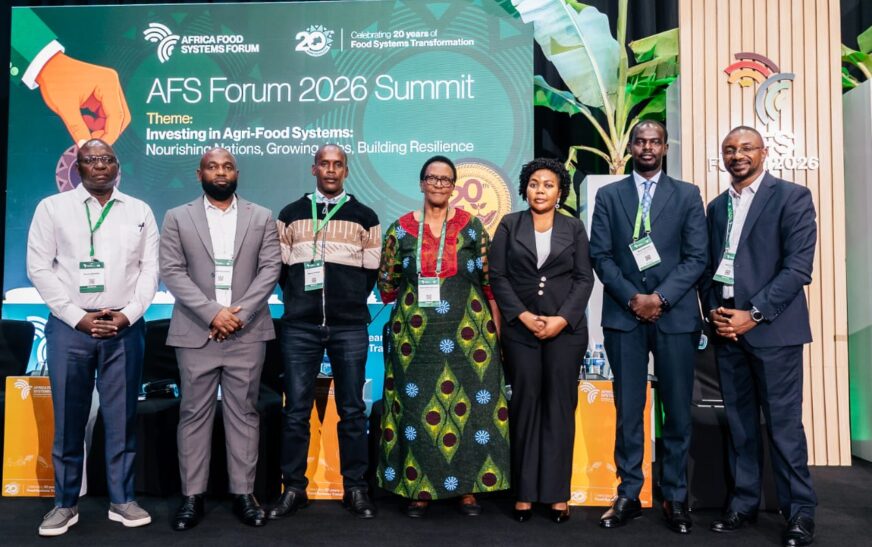
Rwamirama was speaking on Thursday at the Climate Finance Nexus Forum convened by Heifer International during the Africa Food Systems Forum in Kigali, Rwanda.
The forum brought together government officials, financial institutions, development partners, technology companies and farmer organisations to examine how more capital can be directed towards African agriculture.
Rwamirama said financing models should not stop at individual successful interventions but should be designed for replication and expansion across agricultural value chains.
“Our task is to connect these opportunities and move from individual successful interventions to financing models that can be replicated and scaled across the dairy sector and other agricultural value chains,” he said.
His remarks come as farmers and agricultural businesses continue to face difficulties accessing financing for climate-smart technologies such as solar irrigation, cold storage, renewable energy and improved water management.
William Matovu, Country Director, Heifer International Uganda, said one of the major challenges facing agricultural financing is that financial institutions often struggle to identify transactions that are sufficiently bankable.
“For years, when we took dairy cooperatives to banks, the answer was always the same: they could not see the business. In African agriculture the constraint is bankable transactions and building them is the real work,” Matovu said.
He said Heifer International sought to address this challenge through solar-powered cooling systems for dairy cooperatives, with the aim of improving their economics enough to attract commercial financing.
Matovu said unreliable power and dependence on diesel generators had affected milk collection centres, resulting in losses for cooperatives and farmers.
“At Migina, milk losses fell to zero after the system went in, and members brought their milk back to a place they could rely on,” he said.
According to Heifer International, the Migina Milk Collection Centre now chills 197,321 litres of milk each month and has recorded a 22.6 per cent increase in milk suppliers.

Matovu said the financing model brings together the cooperative, technology provider, processor, commercial bank and insurance provider, with catalytic financing helping to reduce the initial risk.
“The cooperative is the business. It runs the center and earns the cash flow that repays the loan,” he said, explaining one of the key components of the model.
He said the processor provides a reliable market, while the commercial bank provides credit secured against the solar asset rather than farmers’ land.
Matovu said the experience demonstrated the importance of designing financing products around the realities of agricultural businesses rather than imposing financing structures that do not fit their operations.
“Designing finance that is cautious of the realities on ground — that’s why the initiative has those ecosystem partners to be able to derisk the investment,” he said.
He also stressed the importance of using data to develop financing products that respond to the circumstances of agricultural enterprises.
“Use of data for structuring a financing product that suits the context,” Matovu said.
He said Heifer International was not presenting the model as a finished solution, but as an approach that can be tested, improved and scaled.
“We are not here to chest thump about the model but to share what we are testing, learning, refine and contribute to the Africa food systems,” Matovu said.
“We are taking an approach of testing, learning, refine and scale. That’s what the continent food systems needs if we are going to make it resilient. We are not shy to test things and we are not shy to share what we learn,” he added.
Matovu said the experience has also demonstrated the potential for climate-smart agricultural investments to create employment opportunities for young people as technicians, operators, entrepreneurs and managers of technology-enabled agricultural businesses.
He said more than 100 collection centres in Uganda could provide the next opportunity for partners seeking to scale such investments.
The forum highlighted the wider need to ensure that climate finance reaches farmers and agricultural enterprises at the “first mile”, where investment in technology can directly improve productivity, reduce losses and strengthen rural businesses.