
The Imam and sovereignty
There is a need to evaluate the historical role of Imam Khamenei in securing the Islamic Republic’s ‘full permanent sovereignty…over its natural resources and all economic activities’. There is a UN context, which dates back to 1 May 1974. It adopted the Declaration on the Establishment of a New International Economic Order (NIEO).
1974 – a year of hope?
It was a year of apparent hope when the Declaration beckoned a new international law and order for the states that were newly emerging from colonialism. It aimed ‘to correct inequalities and redress existing injustice and eliminate the widening gap between the developed and developing countries’. It opposed neo-colonialism and apartheid.
UN Program of Action
The UN simultaneously adopted a Program of Action in favour of the newly independent states. It consisted of industrialisation; transfer of technology; regulation and control over the activities of transnational corporations; charter of economic rights and duties of states; and, crucially, assistance in the exercise of permanent sovereignty of states.
Such was the world, into which the Islamic Republic was born in 1979.
And then something happened inside two imperial powers
In 1979 Ms Margaret Thatcher’s election as the UK Prime Minister. In 1980 Mr Ronald Reagan’s election as the President of USA. Both countries faced financial crises over their respective social assistance programs for their citizens. Both cut down on their programs. The USA was also quagmired in its costly Vietnam War since 1955 after the defeat of French colonialism. The USA was struggling to find a ‘respectable’ retreat since 1968 until it finally retreated in defeat in 1975.
Neoliberal agendas of UK and USA
The refurbished imperial governments in UK and USA, with worldwide neo-liberal agendas doomed the 1981 North-South Summit on International Cooperation and Development (ICD). Earlier, in 1977 ICD North-South Dialogue had collapsed.
USA control of global monetary system
The USA restored its control over the global monetary system through exorbitant usury, which precipitated the ongoing ‘Third World Debt Crisis’ (1982). Thatcher and Reagan dumped the Third World in favour of Transnational Corporations (TNC) that continued the colonial rape. NAM and G77 of the Third World became fractious. The World Trade Organization treated NIEO and neoliberal democracy as threats to extractive capitalism and imperialism. It prioritized the security of private property and ignored the principle of national sovereignty.
It abandoned addressing the endemic structural inequalities of the global economic system, its uneven and unjust maldevelopment, and redistributive injustice.
NIEO failure
NIEO after five decades lay sprawled as a failure in the unreformed world economy. Now there is an alternative framework for interdependent global economic and social relations offered by the Global South. It signals the end of western white racism and male chauvinism.
Lessons from the Imam’s statesmanship in managing the interests of Iran
World market and sanctions tensions
Externally, he had to manage the contradictions of the world market opening up and the sanctions imposed on Iran. Internally, he had to manage the tensions between tradition and modernisation. The multiple tensions made it difficult to ensure sovereignty, independence, prosperity, and spiritual civilisation. He had to cope with the legitimate social discontent of the people.
Courageous decisions
He made courageous decisions at major historical junctures with the ability to take risks, with an iron will. Every juncture was a new chapter in his life. With clarity of principles and policies he fought with a heroic spirit. He acted calmly with a deep sense of historical responsibility as USA thrust obstructions. He developed a sharp foresight that prevented historical blindness.
The Imam’s intrinsic weapon – faith
It is difficult for a biographer to understand how could he have maintained his calmness in a world of hostility.
A biographer may infer that he was intrinsically motivated by his faith or iman. When his intrinsic motivation met extrinsic conditions he adjusted and adapted to them with appropriate conduct. He sought national achievement in spite of hardships. The authority that the nation vested in him he turned it into service of the nation.

Steadfastness – even unto death
This manifested itself as commitment to an ideal that made him steadfast in serving the people and God with firm adherence to fused political/religious beliefs, with single-mindedness – even unto death!
The struggle for socio-economic benefits
He focused, primarily, on delivering socio-economic benefits of the Islamic Revolution to the people who constituted the support base of the Revolution. He built modern institutional structures for fair and just governance that guaranteed security, safety, stability, and human dignity.
Education and the role of youth
For institutional continuity he prioritised education of aspiring youth of convictions, self-confidence, self-reliance, ability to take risks, and serve the family and nation as purpose of life.
He trusted the youth to have the potential to develop into new core leaderships. They should be people-centred and care for the physical, mental, and spiritual well-being of the people. Be with them wholeheartedly even during hardships. Be the loving servant of 90-million Iranians. Utilise their willingness, wisdom, and enthusiasm as unquantifiable human worth.
Creation of local programs of action
They should create local programs of action with the people from the ground up. Help them to create self-employment with creative spirit for moderate prosperity. Promote many forms of ownership and distribution including cooperatives. Let economic development be inclusive of social and cultural development – with remembrance of martyrs. Learn to read the mood of the people and keep in touch with their feelings and emotions like skilful religious leaders do. Anticipate and keep track of changes in local communities, the larger society, and the larger world. Know the working and living conditions of people. Initiate developmental changes.
Freedom from physical, mental, and spiritual poverty
Help them to free themselves from physical, mental, and spiritual poverty. In this lay the progress and prosperity of the individual, family, community, and nation.
Patriotic social base
With Iranians as a strong patriotic base the Imam led the disarming of imperialism not only in Iran but also in West Asia with counterweight weapons such as Vision-2025 as a social justice program of action and indigenous weapons and more.
Sanctions made macroeconomic stabilization difficult but he provided a coherent direction, free of IMF constraints. He designed architecture of institutions to ensure continuity of production and governance.
Control of money issuance
He dealt with the difficult challenge of strict control of money issuance. The government budget deficit averaged minus-2.2% of GDP from 1990 to 2025, when it increased to 5.7% of GDP (‘Trading Economics’: accessed 23 August 2026). The price increases of consumer goods was a source of social discontent, acknowledged by the government. This reflected the imposed exclusion of Iran from the world economy. Iran still has much fiscal space to borrow money from Global South institutions.
In contrast, the USA government debt of $40-trillion is 125.8% of GDP. (2026 IMF World Economic Outlook database)
The essence of the Imam’s historical role
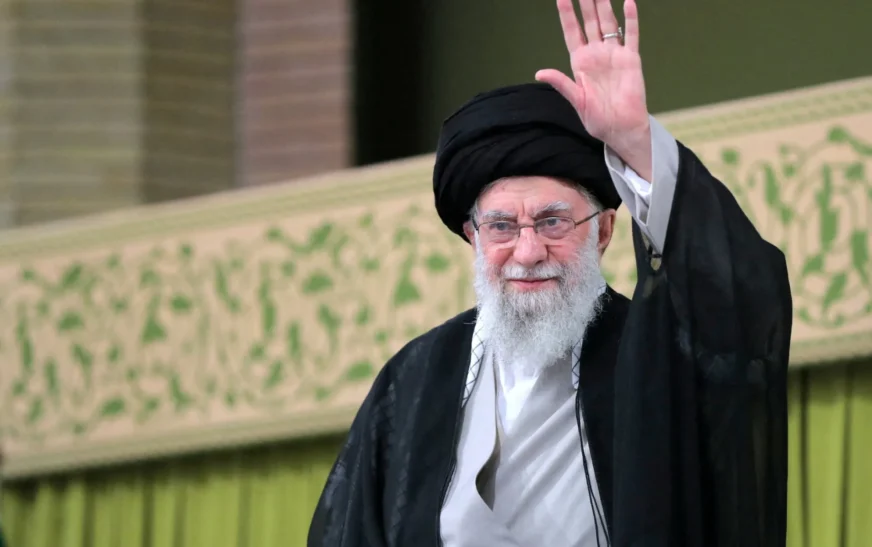
If the essence of his historical role were to be captured in a few words it would be: he defended and advanced the comprehensive sovereignty of the Islamic Republic of Iran.
________________________________________
The purpose of the series of articles on the Imam is to explain the development of his character as being immersed in the development of the history of Iran. Its aim is simple truth from complex facts. It is the intersection of literary biography and scientific history.
By Haroon Aziz, South Africa