
President Yoweri Kaguta Museveni has commended China’s growing investment drive in Africa, saying it is accelerating Uganda’s industrialisation agenda and reducing the country’s dependence on imports.
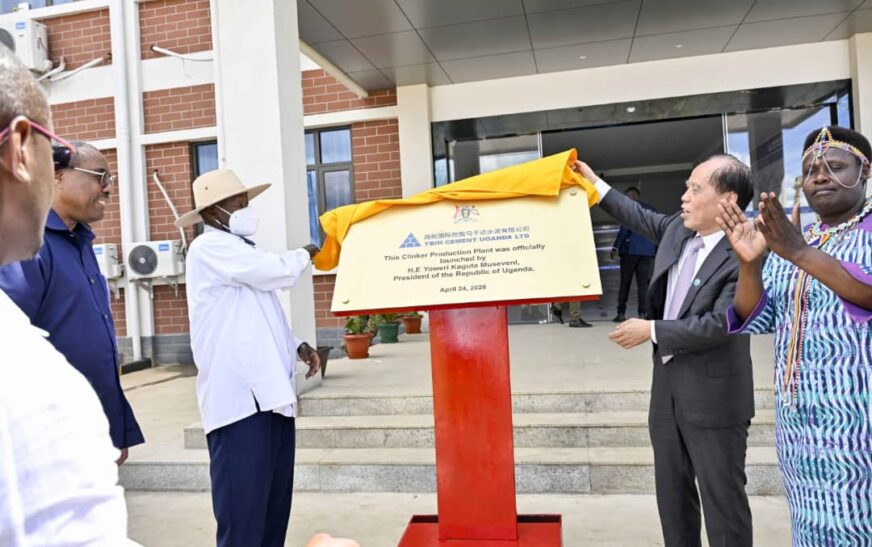
Speaking at the commissioning of Phase One of the 6,000-tonne clinker production line by Yaobai Cement in Nanduget, Moroto district, Museveni described the project as a major milestone in Uganda’s journey towards industrial self-sufficiency.
The $300 million plant is expected to significantly cut Uganda’s clinker import bill, with clinker accounting for nearly 85 per cent of cement production.
Museveni noted that Chinese-backed investments—particularly in infrastructure and manufacturing—are already reshaping Uganda’s economic landscape and strengthening its productive capacity.
“The Government of China has encouraged its people to invest in Africa, and we are now seeing the results, especially in infrastructure and manufacturing,” he said. “These partnerships are critical for Africa’s socio-economic transformation.”
The President credited Zang Jiewen, board chairman of West China Cement—the parent company of Yaobai International—for supporting Uganda’s industrial ambitions. He also praised former Ethiopian Prime Minister Hailemariam Desalegn Boshe for guiding the company’s investment into Uganda.
“I am very glad that Mr Zang, with the guidance of Hailemariam, has saved us from importing clinker,” Museveni said.
In remarks shared on his official X platform, the President described the commissioning as a significant step towards boosting local manufacturing and easing pressure on Uganda’s import bill.
“Together with Hailemariam, we commissioned the Yaobai clinker plant in Moroto—a key step in cutting clinker imports and boosting local cement production,” he noted, reaffirming government commitment to supporting investors.
At full capacity, the plant is expected to produce up to two million tonnes of clinker annually and create more than 3,500 jobs, while also supplying regional markets including South Sudan, western Kenya and the Democratic Republic of Congo.
Museveni pledged continued government support to investors through a stable and predictable policy environment, stressing that such large-scale projects must align with Uganda’s long-term development strategy.
He also reflected on Karamoja’s transformation from a region once synonymous with insecurity and underdevelopment into an emerging industrial hub, driven by improved peace and the exploitation of abundant natural resources.
The government, he added, will continue investing in critical infrastructure, including road networks linking Moroto, Kotido and neighbouring districts, to facilitate trade and industrial growth.

Hailemariam, now serving as Africa regional ambassador for West China Cement, said China-Africa investments offer mutual benefits and hold significant potential to drive real economic transformation across the continent.
Vice President Jessica Alupo commended Museveni for fostering a stable investment climate, noting that peace, security and consistent policy direction have made Uganda an increasingly attractive destination for investors.
Energy minister Ruth Nankabirwa echoed similar sentiments, attributing Karamoja’s shift from conflict to industrial development to sustained government intervention and infrastructure expansion.
Local partner Ambrose Byoona revealed that the project was inspired by Museveni’s long-standing vision to establish a clinker factory in Karamoja to harness the region’s mineral resources.
Moroto district LCV chairman Anjello Pulkol said the factory has already begun creating jobs and improving livelihoods, adding that lasting peace has opened the region to both local and foreign investment.
According to Zang, the project is expected to generate up to $300 million in annual output value, while saving Uganda an estimated $200 million in foreign exchange by reducing clinker imports.
Beyond meeting domestic demand, the plant will serve regional markets, boosting trade and supporting the construction sector across East Africa.
Zang added that the company is committed to high-quality investment, advanced technology and environmentally sustainable production, with plans to establish a modern, low-emission industrial ecosystem in the region.
China’s chargé d’affaires in Uganda, Fan Xuecheng, praised Museveni’s leadership in strengthening Uganda–China relations, noting that the partnership continues to deliver tangible development outcomes.
The commissioning of the Yaobai clinker plant underscores Uganda’s broader strategy to industrialise, create jobs and reduce import dependency, while deepening economic cooperation with China.