

For generations, Runyankore has lived in conversations around family compounds, in stories told by grandparents, in proverbs, songs, jokes and everyday exchanges.
Today, some of those conversations are moving to a very different space: the smartphone screen.
As social media increasingly shapes how young people communicate, indigenous languages are finding new opportunities—and new challenges—in the digital world. For Runyankore, a language deeply rooted in the culture and identity of the Banyankore, platforms such as TikTok are becoming unexpected spaces for its continued use and visibility.
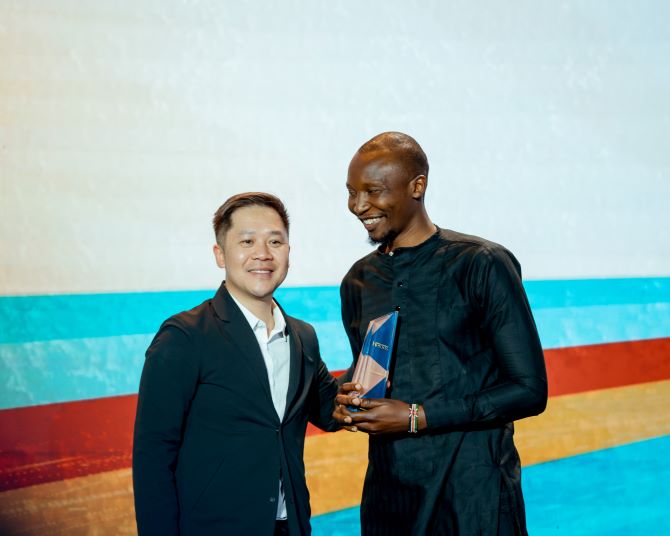
One of the young creators helping to drive that conversation is Nacho Necha, a Ugandan content creator and TikTok influencer based in Mbarara.
Originally known as Abigaba Bless, Nacho comes from Masheruka in Sheema Municipality. His journey into content creation began in 2020, but his TikTok story started in 2024.
It was in November that year that one video changed the direction of his digital journey.
The video was inspired by a speech by Rev. Fr. Mugaiga titled “Abakaturiki itwe nitinywa.” It began attracting attention, eventually trending on the platform.
“That video changed things for me. Since then, I have never gone back,” Nacho says.
The moment gave him the confidence to keep creating and, more importantly, to explore content that reflected his identity and connected with audiences beyond his immediate surroundings.
Finding a home on TikTok
For Nacho, TikTok was not simply another social media platform. It was where his content found an audience.
“I chose TikTok because it is the platform that welcomed my content more than any other platform,” he says.
The platform’s short-form format allowed him to experiment with humour, language and everyday experiences while reaching people beyond his physical community.
But one of the defining features of his content has been his decision to consistently use Runyankore.
“I do Runyankore videos because I love my Ankole language and culture,” he says.
What began as an expression of personal identity has increasingly become a form of cultural communication.
His videos have reached audiences in Uganda as well as Rwanda, Kenya, Tanzania, Burundi and beyond. Some viewers have told him that his content has helped them learn Runyankore, while others say it has made them appreciate the language more.
“People tell me that my videos make them learn and love Runyankore even more,” Nacho says.
That response points to something bigger than viral numbers. It suggests that an indigenous language can still attract attention when it is presented in spaces where young people already spend much of their time.
When language meets the algorithm
For decades, language preservation has largely been associated with homes, schools, cultural institutions, books and oral traditions. The internet is changing that landscape.
TikTok, in particular, has created a space where languages can travel quickly across geographical boundaries. A phrase spoken in Mbarara can reach someone in Kigali, Nairobi, Dar es Salaam or Bujumbura within minutes.
For Aine Kamazima, a Runyankore linguist who champions the revival and continued use of local languages in the modern era, this digital presence is increasingly important.
“Language survives through use, and today a significant part of young people’s communication happens online. When Runyankore is used on platforms such as TikTok, it gives young people another space to hear, speak and engage with the language. Social media alone cannot preserve a language, but it can make indigenous languages visible, relevant and attractive to a generation that increasingly lives in the digital space,” Kamazima says.
Her argument highlights an important reality: preservation is not only about keeping a language in archives or remembering words from the past. A language remains alive when people continue to use itit.
And for a younger generation whose conversations increasingly happen online, digital spaces have become part of that everyday reality.
More than words
The importance of Runyankore extends beyond the words themselves.
Language carries humour, history, expressions, stories, values and ways of understanding the world. Certain jokes make sense because of the language in which they are told. Some expressions carry cultural meanings that are difficult to reproduce in another language.
When young people use Runyankore online, they are therefore doing more than communicating.
They are also participating in the continuation of a cultural identity. Nacho’s content demonstrates how that can happen without making culture feel distant or overly formal.

A Runyankore video does not necessarily have to be a lesson about culture. It can be funny. It can be relatable. It can capture an ordinary experience.
That is perhaps what makes the content appealing to a younger audience: the language is not being presented as something frozen in the past, but as something that can exist alongside modern life.
Runyankore can be spoken in a TikTok video just as naturally as it is spoken at home.
The limits of social media
Still, TikTok cannot carry the responsibility of preserving an entire language on its own.
Parents and grandparents remain important in transmitting language within families. Schools, researchers, cultural institutions and communities also have a role to play.
But digital platforms can complement those efforts by giving young people another place to encounter and use indigenous languages.
For languages facing the pressure of dominant global and national languages, visibility matters.
If young people only encounter their indigenous language in formal cultural settings, they may increasingly associate it with the past. But when they see it being used by creators they follow, in content they enjoy and in conversations they understand, the language can become part of their present.
That is where creators such as Nacho occupy an interesting position. He is not approaching Runyankore as a language preserved behind glass. He is using it.
Taking Runyankore beyond Ankole
For Nacho, the journey is also about ambition.
He hopes to reach bigger stages and platforms while pursuing his dream of becoming an actor. But he also sees his growing digital platform as an opportunity to take Runyankore and Ankole culture beyond their traditional boundaries.
“I want to make Runyankore and Ankole culture move worldwide,” he says.
His ambition reflects a broader possibility for indigenous languages in the digital age: that they can travel without losing the identity that makes them distinctive.
A language spoken in Ankole can reach someone thousands of kilometres away.
A young person who does not speak Runyankore can encounter it through a creator’s video.
Someone who grew up speaking it but rarely uses it can be reminded of its humour, expressions and familiarity.
And someone learning it can find a new reason to keep going.
A new generation of language keepers
The future of Runyankore will not be determined by TikTok alone. But the platform represents one of the many places where that future is being negotiated.
The challenge for indigenous languages is no longer simply whether they can survive outside traditional settings. It is whether they can remain relevant in the spaces where younger generations live, communicate and express themselves.
For Nacho, that space is TikTok
For his audience, it is an opportunity to laugh, learn and reconnect with a language.
And for advocates of local-language revival, it is a reminder that preservation does not always have to look like the past.
Sometimes, it can look like a young creator holding a smartphone, speaking his mother tongue to the world.
Runyankore does not have to choose between tradition and technology. It can live in both.
And perhaps, in the digital era, one of the strongest ways to preserve a language is to keep giving people a reason to speak it.