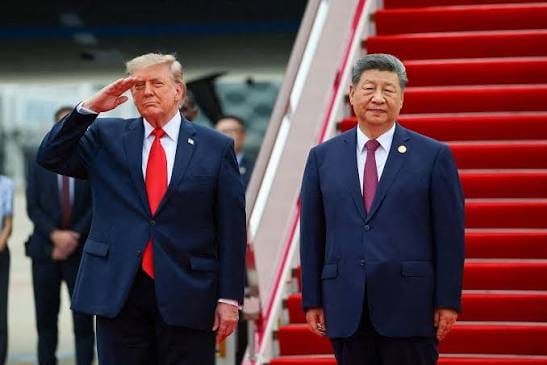


Russian President Vladimir Putin has described his meeting with US President Donald Trump and Chinese President Xi Jinping as a historic diplomatic engagement, expressing optimism that the three countries can build greater understanding despite their geopolitical differences.
Speaking at a press conference in Shenzhen on Thursday, November 19, Putin said the discussions had been frank and productive, providing an opportunity for the three leaders to exchange views on international affairs and better understand one another’s positions.
He credited Xi with creating an atmosphere of trust that enabled the leaders to speak freely, particularly during discussions held after the formal part of the meeting.
Putin said the meeting marked a new chapter in international diplomacy, although he cautioned against interpreting it as the emergence of a permanent new diplomatic arrangement.
“Only God knows what will happen next,” he said, adding that the engagement had nevertheless demonstrated the usefulness of direct communication among the three major powers.
“It is a new page in the history of diplomacy,” Putin said, describing the meeting as historic because such an engagement involving the three leaders had not happened before.
He said discussions covered United Nations reforms, nuclear non-proliferation and what he described as unlawful actions by the International Criminal Court.
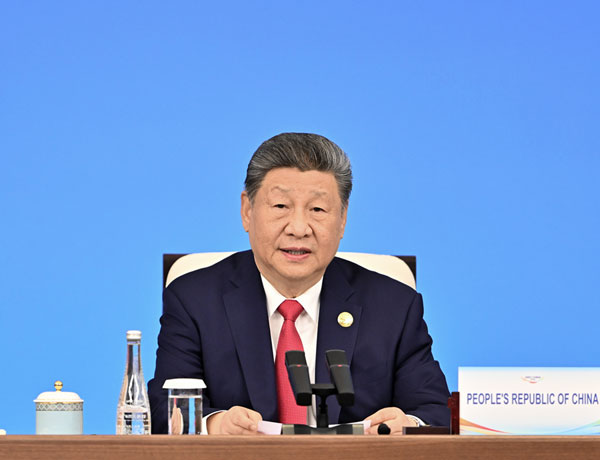
Putin said he was particularly impressed by Xi’s contribution to the discussions, noting that the Chinese leader had suggested creating an environment where the presidents could freely exchange ideas.
He also expressed confidence in Trump’s intentions regarding the conflicts facing the international community, particularly the war in Ukraine.
“I have no doubt that President Trump is sincerely trying to resolve the conflicts, including the one in Ukraine,” Putin said.
The Russian leader said the discussions had created grounds for optimism, although reaching common ground would require compromises and recognition of the realities surrounding the conflicts.
He maintained that Russia was prepared to pursue compromises but would not sacrifice its national interests in the process.
“We’re not going to sacrifice anything, we’re going to look for compromises, which I think are quite feasible,” he said.
Putin also referred to previous discussions in Anchorage, saying Russia had agreed to compromises, but accused European countries and Ukraine of opposing such concessions.
On the war in Ukraine, he argued that Kyiv’s leadership was reluctant to end hostilities because doing so would require holding elections.
He reiterated Russia’s opposition to Ukraine joining NATO, saying Moscow had repeatedly communicated that the country’s membership in the military alliance was unacceptable.
The Russian president argued that security arrangements must take Russia’s concerns into account, accusing Western countries of concentrating on Ukraine’s security while disregarding Moscow’s own security interests.
On Europe’s involvement in peace negotiations, Putin said Russia first needed to understand what European leaders intended to contribute to the process.
He criticised what he described as increasingly confrontational rhetoric from European capitals, saying Moscow was not seeking a war with Europe.

Putin invited European diplomats to Moscow to discuss the disagreements and clarify their positions, arguing that relations between Russia and European countries had deteriorated without Moscow being solely responsible.
“Everyone understands we’re not seeking a war with Europe. What kind of nonsense is that?” he said.
He also questioned European concerns about a possible new Yalta-style arrangement, referring to the 1945 conference where the Soviet Union, the United States and Britain discussed the post-war international order.
Putin argued that the conference had formalised victory over Nazi Germany and suggested that the current international situation required recognition of what he described as the defeat of neo-Nazism.
The Russian leader also issued a warning over the Crimean Bridge, saying any further attacks would trigger retaliation rather than negotiations.
He maintained that the bridge was a civilian facility and that he had personally ordered that it should not be used for military transportation.
Putin warned that Russia’s response to another attack would be more painful, although he did not provide details of the measures being considered.
Beyond the security discussions, Putin used the press conference to highlight Russia’s ambitions in technology and energy, claiming that the country had a global advantage in artificial intelligence and was an undisputed leader in the construction of nuclear power plants.
He argued that Russia’s nuclear energy capabilities gave it an advantage in developing the electricity infrastructure required for artificial intelligence and data centres.
On economic relations, Putin said trade between Russia and China was expected to reach a new record this year, potentially rising to $280 billion.
He attributed the strengthening of Russia’s economic engagement with Asia-Pacific economies partly to Western sanctions, which he said had pushed Moscow to diversify its international partnerships.
Putin also thanked Trump for inviting him to the G20 summit but said he would first consider domestic priorities before deciding whether to travel.
He indicated that Russia would nevertheless be represented by a high-level delegation.
The Russian president further questioned the value of the Nobel Peace Prize, arguing that some decisions surrounding the award had been politically motivated. His remarks followed questions about whether Trump deserved the recognition for his diplomatic efforts.
Despite the differences that continue to divide Moscow, Washington and Beijing, Putin said the trilateral discussions had demonstrated that direct engagement among major powers remained possible.
He described the meeting as a serious joint effort rather than merely a symbolic diplomatic gathering, while cautioning that the three countries were not seeking to impose decisions on other nations.
For Moscow, the engagement offers an opportunity to maintain direct communication with Washington and Beijing as disagreements over Ukraine, European security and the future of the international order continue to shape global politics.