
President Yoweri Museveni and his Tanzanian counterpart, Samia Suluhu Hassan, have called for greater industrial cooperation among East African countries, warning against fragmented markets and competition that could undermine the region’s manufacturing ambitions.
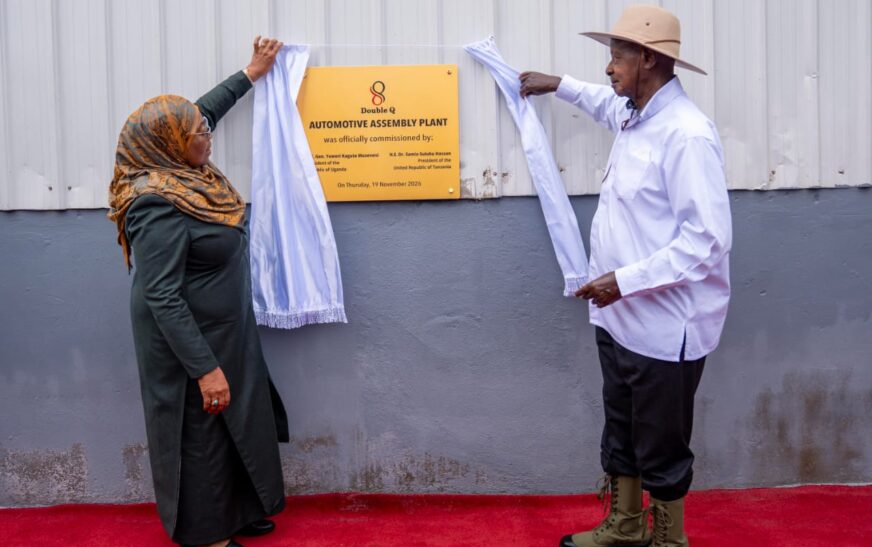
The two leaders made the call on Thursday while commissioning a $30 million vehicle assembly plant operated by Double Q Automotive in Nakirebe, Mpigi District, where they argued that regional integration, local value addition and shared natural resources were critical to building competitive industries.
The facility, which assembles Sinotruk heavy-duty trucks, has an annual production capacity of 4,000 units and currently employs more than 1,200 Ugandans.
The commissioning marked the climax of President Suluhu’s two-day state visit to Uganda and highlighted the growing interest in positioning East Africa as a manufacturing and investment destination.
Museveni said Uganda and Tanzania could achieve greater economic benefits by combining their natural resources and industrial capabilities instead of pursuing development independently.
He pointed to Uganda’s iron ore deposits and Tanzania’s natural gas reserves as complementary resources that could support industrial production if the two countries coordinated their investment and manufacturing strategies.
“You find that Tanzania has got gas, Uganda has got iron ore, and other products. So, when you put them together, instead of using them in a fragmented way, you will do better business. You succeed more easily,” Museveni said.
He argued that Africa’s industrialisation would depend on its ability to organise production, access larger markets and improve communication infrastructure, adding that individual countries could struggle to sustain industries without sufficient market demand.
“This is not just music; it is showing the future. If you want to succeed, you need a united market for Africa,” he said.
Museveni urged African governments to prioritise economic integration, saying a larger continental market would enable local manufacturers to expand production, attract investment and compete with established global industries.
He also called on Chinese investors to deepen their involvement in Africa, describing the continent as an emerging centre of global business.
With Africa’s population projected to increase from approximately 1.5 billion to 2.5 billion over the next three decades, Museveni said the continent presented significant opportunities for manufacturers and investors seeking expanding consumer markets.
However, the President challenged Double Q Automotive to move beyond assembling imported vehicle components and establish stronger links with Uganda’s domestic manufacturing sector, particularly the steel industry.
He commended the company for investing in Uganda and encouraged it to increase the use of locally produced materials in vehicle production.
The President noted that the company was already undertaking vehicle body-building activities, contributing approximately 20 per cent in local value addition.
He said Uganda’s iron ore deposits could provide the foundation for a domestic steel industry capable of supplying manufacturers with raw materials and reducing dependence on imported components.
President Suluhu echoed the call for regional industrial cooperation, arguing that East African countries should stop viewing one another as competitors when establishing manufacturing industries.
She said the region needed complementary industrial policies that would allow member states to specialise, share production capabilities and develop interconnected value chains.
“East Africa must compete with the world, not within itself,” she said.
Suluhu said industrialisation was no longer simply an economic choice but a necessity for African countries seeking to create jobs, increase exports, transfer technology and reduce dependence on imported manufactured goods.
She urged East African Community member states to transition from predominantly agricultural economies towards industrial production while modernising agriculture to supply raw materials to factories.
“Let us turn from being consumers of imported goods to regional production and marketing hubs. We should aspire to manufacture, assemble, and produce,” she said.
The Tanzanian leader cited the presence of Sinotruk operations in both Uganda and Tanzania as an example of why countries should pursue complementary investments rather than compete for the same industrial opportunities.
She also welcomed proposals to harmonise regulations governing vehicle assembly and manufacturing across the region, saying this would create a predictable operating environment and expand the market for locally assembled vehicles.
Suluhu revealed that Tanzania was exploring partnerships to establish a railway locomotive manufacturing plant as part of its broader industrialisation programme.
She also pointed to the Port of Dar es Salaam, which handled approximately 33 million tonnes of cargo in 2026, as evidence of the growing demand for transportation and logistics services in the region.

The demand, she said, presented opportunities for local vehicle manufacturers to supply trucks and other equipment needed to support trade and regional infrastructure.
The Double Q Automotive plant is expected to contribute to this growing industrial capacity.
According to the company’s managing director, Lin Yu, the business began operations in Uganda in 2013 as a transporter of construction materials before expanding into vehicle spare parts, after-sales services and vehicle leasing.
It became an official Sinotruk distributor in Uganda in 2017 and started assembling trucks locally in 2020.
Yu said the company had since assembled more than 5,000 trucks through its Ugandan operations, with the new facility providing capacity for 4,000 units annually.
He said the company’s ambition was to develop a broader automotive manufacturing ecosystem involving local steel production, engineering, metal fabrication and logistics.
“We want to buy more materials locally, make more truck parts in Uganda, and expand our work in metal fabrication, engineering, and logistics,” Yu said.
He said the company was committed to supporting the government’s Buy Uganda, Build Uganda policy by increasing purchases from local suppliers and manufacturers.
Yu also disclosed that Double Q was developing training partnerships with Kyambogo University, Uganda Christian University and Nakawa Vocational Institute to equip Ugandans with practical skills needed in the automotive industry.
The company intends to expand into passenger vehicles and electric trucks as it strengthens its manufacturing operations.
Works and Transport Minister Fred Byamukama said the investment had created significant employment opportunities, particularly for young people.
He disclosed that the plant directly employs more than 1,200 Ugandans, many of whom have acquired technical competencies through government skilling programmes and workplace training.
The minister said the lowest-paid employee earns approximately Shs800,000 monthly, describing the investment as an important contribution to the development of Uganda’s industrial workforce.
Byamukama also revealed that government was engaging the company on plans to expand its manufacturing activities, including a proposed tyre production facility at Kayunga Industrial Park.
The proposed investment would further strengthen Uganda’s automotive value chain and reduce dependence on imported vehicle components.
Chinese Ambassador to Uganda Wu Guangrong said the commissioning demonstrated the commitment of the Ugandan and Tanzanian governments to industrial development and regional economic cooperation.
He commended Double Q for expanding from construction materials and vehicle distribution into local vehicle assembly, urging Chinese companies operating in Uganda to comply with local laws, protect the environment and invest in skills development.
Sinotruk International General Manager Song Yang said the company was committed to supporting Uganda’s industrial development through technology transfer and investment.
He said Sinotruk products were available in more than 160 countries and regions, with overseas heavy-duty truck sales exceeding 1.2 million units.
Yang projected that the company would produce and sell more than 360,000 heavy-duty trucks globally in 2026, approximately 110,000 of which would be destined for African markets.
He said the company’s contribution should not be measured only by sales but also by the employment opportunities, skills transferred and economic value generated in countries where it operates.
The two presidents toured the facility, inspected its production lines and interacted with management, engineers and employees before officially commissioning the plant.
The launch was attended by government ministers and senior officials from Uganda and Tanzania, representatives of the Chinese business community and players in the automotive industry.