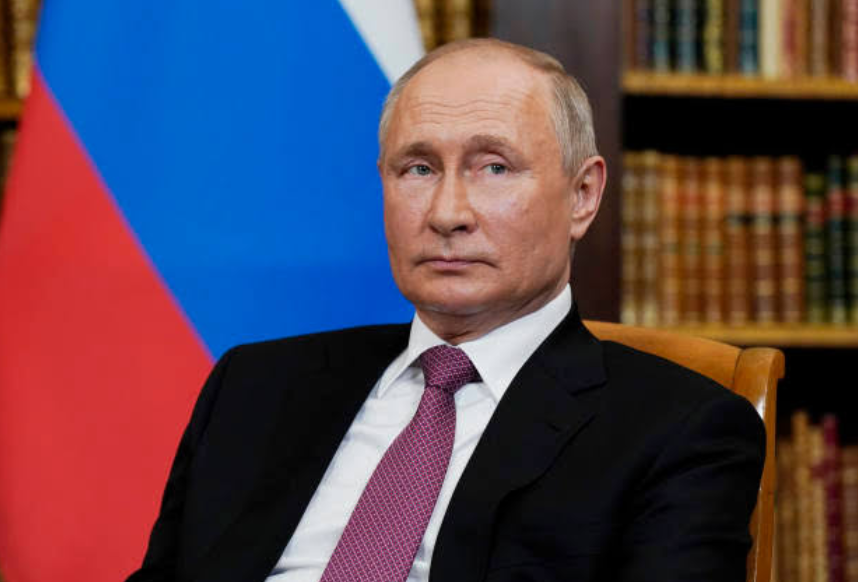

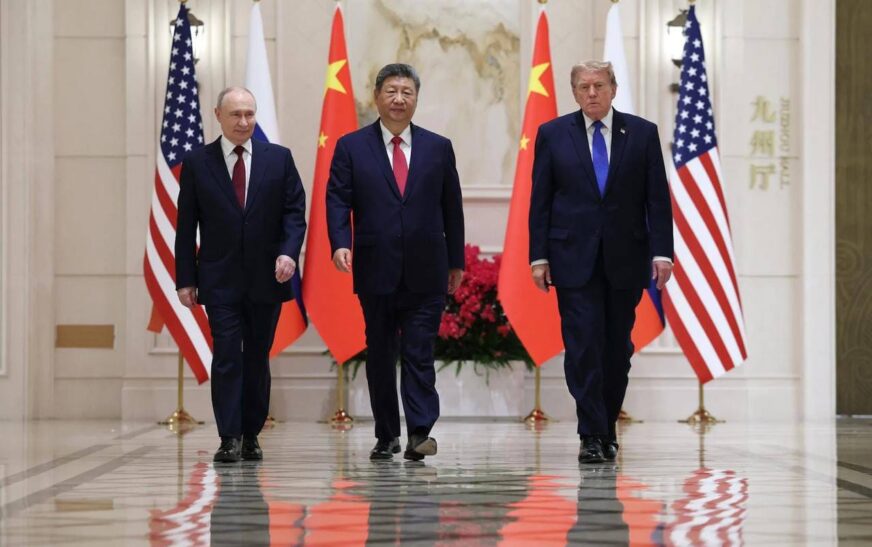
Russian President Vladimir Putin, United States President Donald Trump and Chinese President Xi Jinping have signed a joint declaration on peace and international security following a historic trilateral summit in Shenzhen, China.
The declaration, adopted on November 19, 2026, outlines four key areas of cooperation among the three global powers, including reforming the United Nations, strengthening energy security, checking the powers of international institutions and reducing nuclear risks.
The trilateral summit lasted approximately one and a half hours, bringing together the leaders of the three countries, which are permanent members of the United Nations Security Council, at a time of heightened international tensions and continuing conflicts, particularly the war between Russia and Ukraine.
According to the declaration, the three countries committed themselves to reforming the United Nations to enable it to respond more effectively to global challenges and fulfil its fundamental responsibility of maintaining international peace and security.
On energy security, the leaders agreed to increase the production and supply of refined petroleum products for the benefit of countries across the world. They also reaffirmed the importance of maintaining stable energy supplies.
The declaration further emphasised respect for state sovereignty and the immunities of state officials, with the three leaders agreeing that the International Criminal Court (ICC) and similar institutions should not abuse their powers.
On nuclear security, Putin, Trump and Xi reaffirmed that a nuclear war cannot be won and must never be fought. They committed their countries to holding dialogue on reducing nuclear risks and preventing the proliferation of nuclear weapons.
The declaration followed what the three leaders described as a historic engagement, during which they exchanged views on the international situation and expressed their commitment to maintaining strategic stability and international security.
Russia and the United States also thanked China for organising and hosting the summit.
Speaking during the meeting, Putin said Russia, China and the United States had a shared responsibility for maintaining international peace and security, particularly given their historical roles in the Second World War and the establishment of the post-war international order.
“Our three states are the victors of World War II. We have a joint responsibility for maintaining international peace and security,” Putin said.
He added that cooperation among the three countries, based on mutual respect, could make a significant contribution to strengthening global stability.
Xi called on the three powers to abandon Cold War thinking and recognise their special responsibility in addressing international challenges.
“Major powers bear special responsibility. Today’s world no longer consists of isolated islands,” Xi said.
He emphasised the importance of respecting national sovereignty and territorial integrity, avoiding interference in the internal affairs of other countries and resolving international disputes through dialogue and diplomacy.
The Chinese leader also called for the complete elimination of nuclear weapons, warning that nuclear war must never be allowed to happen.
Trump, meanwhile, described the engagement as historic, arguing that major powers should maintain dialogue even when they disagree.
“Too often, past leaders avoided talking to nations with whom they had disagreements. We feel the opposite,” Trump said.
He also stressed the importance of cooperation in addressing nuclear proliferation and other global security threats.
The three leaders had earlier addressed the Asia-Pacific Economic Cooperation (APEC) forum, where they presented their respective positions on international trade, economic cooperation, technology and global development.
Putin, addressing the APEC Business Summit, highlighted the growing economic importance of the Asia-Pacific region, describing it as the centre of global economic activity and a leading industrial and technological hub.
He said the region accounted for more than 60 per cent of global Gross Domestic Product (GDP), 36 per cent of the world’s population, half of global trade in goods and more than 60 per cent of foreign direct investment flows.
Putin also noted that Russia’s trade turnover with APEC economies had grown by a third in the first eight months of 2026.

He expressed Russia’s willingness to strengthen technological cooperation with Asia-Pacific partners, particularly in artificial intelligence and digital solutions.
“We are ready to share our expertise in digital solutions and artificial intelligence with our Asia-Pacific partners,” Putin said.
He, however, emphasised that such cooperation should be based on arrangements that guarantee national sovereignty and data security.
“Russia wants to remain open to the world,” he said, adding that Moscow viewed its engagement with the Asia-Pacific region as an important component of international economic integration.
Trump, in his address at the APEC Economic Leaders’ Meeting, emphasised American leadership in artificial intelligence, which he described as superintelligence, and rejected international regulatory frameworks that could restrict its development.
“We oppose any form of globalist regulation or anything to control or stifle SI, and we won’t allow that to happen, frankly,” Trump said.
He described the United States as the world leader in superintelligence, calling the technology the greatest technological transformation since the Industrial Revolution.
Trump acknowledged that artificial intelligence had potential risks but said governments needed to manage them without stifling innovation.
He also promoted American energy exports, including plans to supply Asian markets through a liquefied natural gas pipeline in Alaska.
Xi, in his address at the 33rd APEC Economic Leaders’ Meeting, called for greater regional solidarity, open trade, investment and technological cooperation to sustain economic growth across the Asia-Pacific.
He urged member economies to strengthen economic integration and avoid protectionist policies that could undermine regional cooperation.
“Open cooperation is a sure path to the development and revitalisation of the Asia-Pacific,” Xi said.
He called for free and open trade and investment, the removal of barriers to economic activity and stronger regional connectivity.
Xi also identified artificial intelligence and the digital economy as important drivers of future economic growth, urging APEC members to strengthen digital infrastructure, improve data governance and encourage the wider application of emerging technologies.
He further called for inclusive development, arguing that economic cooperation should benefit all countries regardless of their levels of development.
The Ukraine conflict featured prominently in the discussions, with Kremlin foreign policy aide Yuri Ushakov indicating that it was the principal subject of the earlier bilateral engagement between Putin and Trump.
The bilateral meeting lasted approximately 35 to 40 minutes before the three leaders held their joint discussions, which lasted about one and a half hours.
Trump said the United States and China shared an interest in ending the conflict, while Putin maintained that constructive cooperation between Moscow, Washington and Beijing could contribute to international stability.
The Shenzhen meeting places renewed emphasis on cooperation among the three major powers at a time when international relations are increasingly shaped by geopolitical competition, energy security concerns and technological rivalry.
However, the extent to which the commitments will translate into concrete action will depend on subsequent diplomatic engagements and the willingness of the three governments to implement the agreed areas of cooperation.