
The government has stepped up efforts to attract Chinese investment by offering land, tax incentives and expanded opportunities in the coffee value chain and agro-industrial sector as part of a renewed push to accelerate industrialisation and export growth.
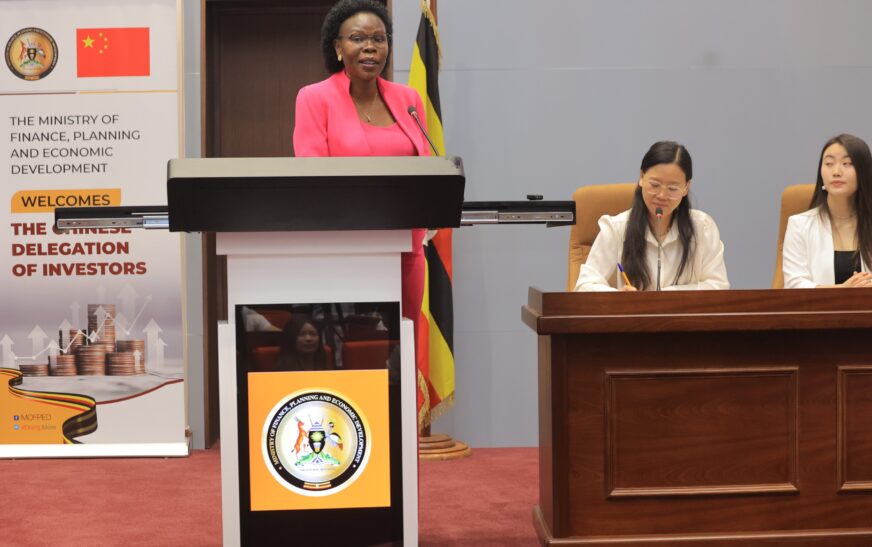
The move was highlighted during a high-level engagement under the Uganda–China Coffee Investment and Destination Tour 2026 hosted by the Ministry of Finance, Planning and Economic Development.
The meeting reaffirmed the long-standing economic partnership between Uganda and China, with a focus on value addition, technology transfer and large-scale agro-industrial development.
The session was presided over by Evelyn Anite, Minister of State for Finance in charge of Investment and Privatisation, alongside Uganda’s Ambassador to China Oliver Wonekha and Chinese delegation leader Diao Chunhe.
Chinese investors have cumulatively injected about $1 billion in direct and project-linked investments into Uganda’s economy, making China one of the country’s largest foreign investors. Much of the capital has been channelled into manufacturing, infrastructure, energy, agriculture and oil and gas.
Major projects include the Kampala–Entebbe Expressway, Karuma and Isimba hydropower dams, upgrades at Entebbe International Airport and industrial parks such as the Sino-Uganda Mbale Industrial Park.
Welcoming the delegation, Ms Anite said Uganda offers a competitive investment environment, noting that business registration can be completed within 45 minutes.
She outlined incentives available to investors, including a 10-year tax holiday, exemptions on imported machinery and access to land for strategic projects.
“The President has directed my office to mobilise and allocate land to serious investors. In return, we expect investments that create jobs for Ugandans,” she said.

Anite also highlighted Uganda’s strong agricultural base, describing the country as an ideal destination for large-scale farming and agro-processing, particularly in coffee production.
She further pointed to the government’s ATMS strategy, which focuses on agro-industrialisation, tourism development, mineral development and science and technology innovation, aimed at expanding Uganda’s economy to $500 billion.
Uganda’s Ambassador to China, Wonekha, said economic diplomacy remains key in strengthening mutually beneficial partnerships, noting that coffee continues to play a central role in export earnings and employment.
Speaking on behalf of the Chinese delegation, Chunhe expressed interest in investing in Uganda’s coffee value chain, particularly in processing, value addition and technology transfer.
He also highlighted opportunities for expanding access to the Chinese market, describing Uganda’s agricultural sector as attractive for long-term investment.
In her closing remarks, Anite called for sustained engagement between Ugandan and Chinese stakeholders to fast-track investment commitments.
The meeting marks another step in strengthening Uganda–China economic cooperation and positioning Uganda as a competitive investment destination in Africa, particularly in agro-industrial development and value-added exports.