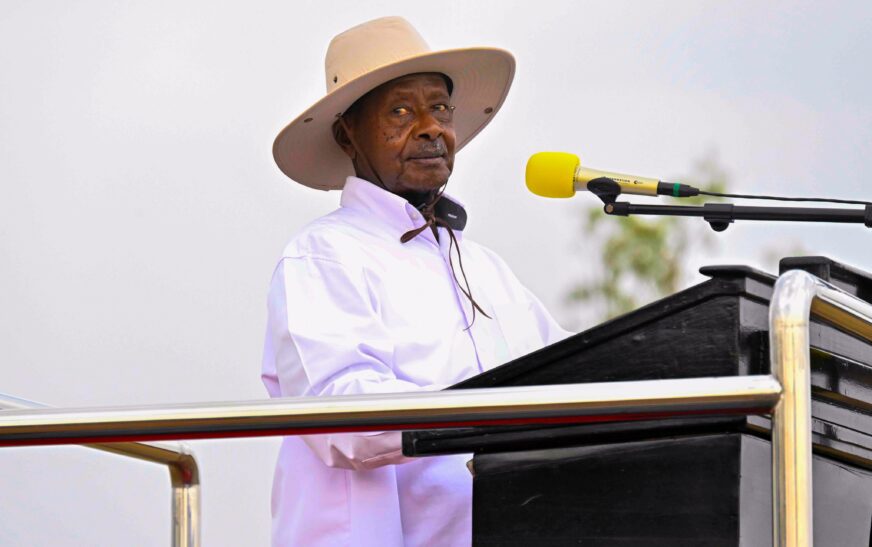

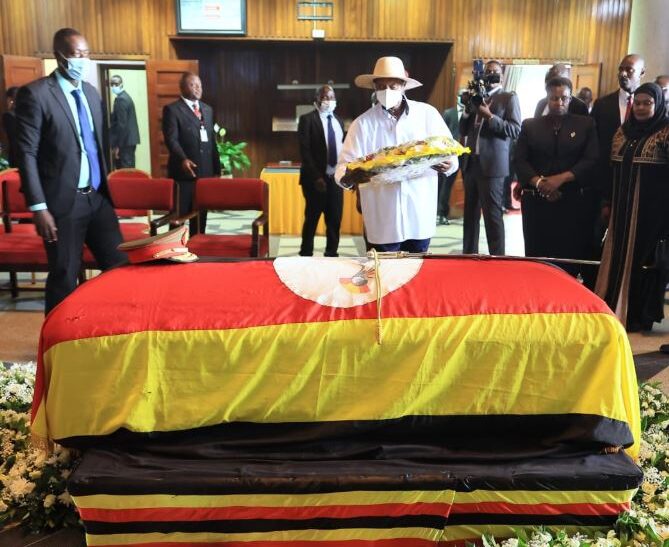
President Yoweri Museveni has paid tribute to fallen Adjumani West MP Gen Moses Ali, describing him as a “lover of freedom” who stood against injustice even during turbulent times.
Museveni revealed that although Gen Ali served under Idi Amin, he was uncomfortable with the regime’s brutality.
“I came to know that although he had been with Amin in the 1971 coup, Moses Ali was not happy with Idi Amin killing people, and by 1978, Amin had dismissed him,” Museveni said.
The president recalled first meeting Gen Ali in Libya among former Amin officials, noting that he stood out as a leader willing to cooperate.
“You could see that he wanted cooperation,” Museveni added, before launching into a broader critique of what he termed Africa’s “inferiority complex,” where citizens abandon their identity to imitate foreign cultures.
Gen Ali died at Nakasero Hospital after an undisclosed illness, bringing to an end a long and influential career in Uganda’s military and political landscape.
Gen Ali was one of Uganda’s longest-serving leaders, holding key positions in government for decades. He served as Third Deputy Prime Minister from 2011 to 2016, before rising to First Deputy Prime Minister, a role he held until 2021.
He remained a powerful figure within the ruling National Resistance Movement (NRM) and represented East Moyo County in Parliament from 2011, maintaining a strong political base in the West Nile sub-region.

Born on April 5, 1939, in Adjumani district, Gen Ali began his education at Erepi Church of Uganda before joining Old Kampala Secondary School.
He later undertook extensive military training in Israel and other countries, building a career that spanned both the armed forces and public service.
In addition to his military background, Gen Ali pursued legal studies, earning a law degree from Makerere University and a diploma from the Law Development Centre.
As Uganda prepares to lay him to rest, leaders say his legacy will be remembered for decades both as a soldier and a politician who remained at the centre of the country’s power dynamics.
Parliament’s tribute is expected to highlight his role in shaping Uganda’s governance and his enduring influence in national affairs.