
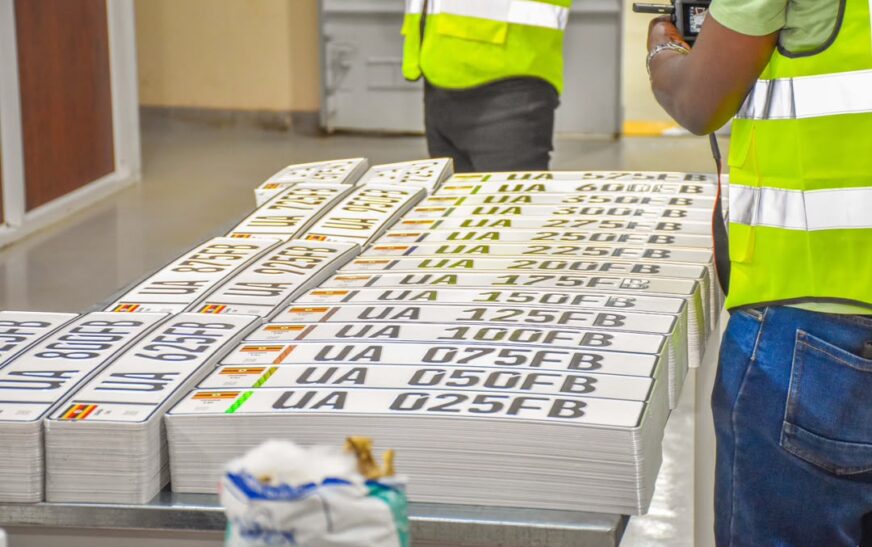
The Intelligent Transport Monitoring System (ITMS) has resumed full-scale production of Uganda’s digital number plates following the arrival of a fresh consignment of critical electronic components, easing months of delays caused by global supply chain disruptions.
The latest shipment follows disruptions in international shipping linked to geopolitical instability in the Middle East, which delayed the delivery of specialised components used in manufacturing the secure digital number plates.
The recovery in production comes after the Minister of Works and Transport, Fred Byamukama, directed ITMS to restore normal service delivery and clear the backlog of pending applications.
Speaking at the ITMS production facility, Production Manager Austine Egesa said production has significantly increased following the arrival of the electronic components.
“Following the Minister’s intervention, production of new number plates has significantly accelerated. People are working like ants. The factory is operating at full capacity, the backlog is steadily decreasing, component supplies have stabilised, and customers are already receiving their number plates,” Egesa said.»
Data from the Motor Vehicle Registration (MVR) Department shows that more than 47,000 motorists have applied to migrate from the old registration system to the new digital number plates. About 1,384 applicants who had completed payment were awaiting production and issuance of their plates, although the backlog has since reduced by 39.5 per cent.
However, despite the improved production capacity, motorists seeking to migrate from the old registration plates to the new digital system are likely to continue experiencing delays because of contractual limits governing the project.
A source familiar with the agreement between the government and the contractor told The Observer that the contractor is contractually required to produce only 100 migration number plates a day. Priority is instead given to motorists replacing lost, stolen, damaged or defective number plates.
“Based on the terms and agreements we have with government in the contract, ITMS only produces 100 number plates per day for those people who migrate from old to new digital number plates. Priority here is being given to those who have damaged or lost plates, or have issues with the functionality of their number plates,” the source said.

According to the source, the daily production limit for migration plates can only be increased once the government fulfils its obligations under the project’s financing model by reviving the traffic-fine enforcement mechanism that was designed to support implementation of the system.
Even with that constraint, ITMS currently produces approximately 2,500 number plates every day—equivalent to nearly 50,000 a month—for new vehicle registrations, a capacity considered sufficient to meet current demand.
ITMS Public Relations Consultant Steven Turyarugayo said the project team was working around the clock to restore normal operations.
“Our teams are working around the clock to ensure that production remains at full capacity. We are committed to implementing the Minister’s directive by clearing the current backlog and restoring efficient, reliable service delivery to all Ugandans,” Turyarugayo said.»
He said ITMS expects to streamline all operational processes within the next three weeks and fully stabilise first-time vehicle registration and post-registration migration services by August 30.
To minimise future disruptions, ITMS has diversified its supply chain by rerouting shipments through Oman and Qatar, a move expected to ensure a more reliable flow of electronic components into Uganda.
The Intelligent Transport Monitoring System is Uganda’s flagship smart transport initiative aimed at improving road safety, strengthening national security, enhancing vehicle traceability and modernising the country’s vehicle registration system through secure digital number plates.