
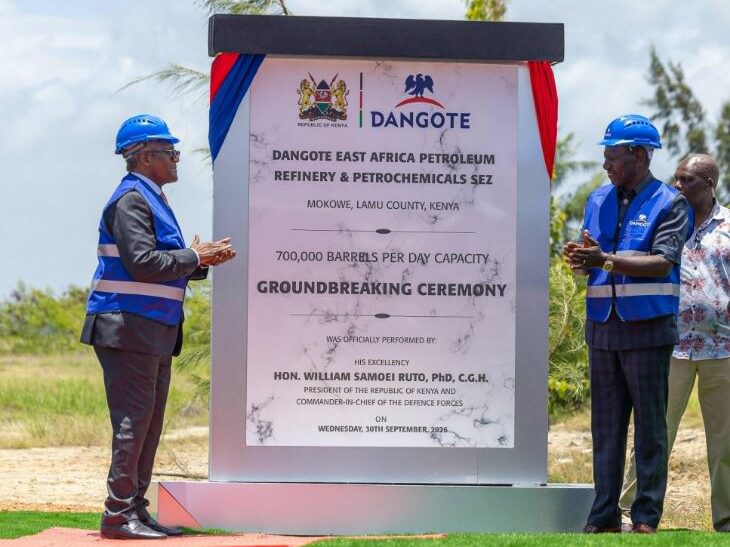
Nigerian billionaire Aliko Dangote and Kenyan President William Ruto have broken ground on a $16 billion (about Shs60 trillion) oil refinery in Lamu, Kenya, in a project expected to become East Africa’s largest industrial investment by processing capacity.
The refinery, which is expected to be completed by 2030, will have the capacity to process up to 700,000 barrels of crude oil per day, matching the capacity of Dangote’s refinery in Nigeria.
The groundbreaking ceremony was attended by several African leaders, including President Yoweri Museveni of Uganda, Ethiopian Prime Minister Abiy Ahmed, and the presidents of Togo and Benin.
Dangote said the project represents a new phase of African industrialisation in which countries increasingly invest in processing their own raw materials rather than exporting them in unprocessed form.
“This is Africa coming together to build Africa. Today we are not simply breaking ground for a refinery, we’re breaking ground for a new chapter in Africa’s industrial journey to a brighter future,” Dangote said.
He cited his refinery in Nigeria as proof that large-scale industrial projects can be delivered on the continent.
“Lekki proved that it can be done, Lamu must prove that it can be repeated,” he said.
President Ruto described the refinery as a major step towards increasing Africa’s capacity to finance, build and process products locally.
“It is a declaration that Africa has entered a new age in which we will increasingly finance, build, process and add value here at home,” Ruto said.
The Lamu refinery is expected to become Kenya’s largest infrastructure project since independence, surpassing the $5.1 billion Standard Gauge Railway.
Land compensation concerns
The project has, however, faced opposition from some residents of Lamu, who have demanded increased compensation for land acquired for the development.
A group of 133 residents has petitioned Kenya’s High Court seeking to stop construction.
Environmental campaigners have also raised concerns about the potential impact of the refinery on local communities and the surrounding environment.
Walid Ali, co-founder of the Save Lamu campaign group, said residents want to examine the findings of the project’s environmental impact assessment.
“We are asking for the findings from the environmental impact assessment so that we can see what mitigation measures are being proposed,” Ali told the BBC.
Dangote dismissed the protests, saying the company had only taken the land it needed from land made available by the Kenyan government.
“Have you ever seen people demonstrating against themselves in terms of development?” he asked.
He maintained that the refinery would proceed as planned and be ready by 2030.

Regional investment
According to Reuters, Dangote has offered regional governments a combined 30 per cent stake in the refinery, potentially giving neighbouring countries an opportunity to participate directly in the project.
The refinery will also have a 1,000-megawatt power plant, which Dangote says will provide reliable electricity for the refinery and other industries expected to emerge around the project.
Dangote said reliable power remains one of the biggest constraints to industrialisation in Africa, particularly in countries that continue to export minerals and other raw materials without processing them locally.
The businessman has about $50 billion worth of projects in the pipeline and plans to develop up to 10,000 megawatts of power generation capacity across Africa by 2030, with the potential to double that capacity depending on demand.
The Lamu refinery will be Dangote’s largest proposed investment outside Nigeria.
Why Lamu?
The decision to establish the refinery in Kenya has raised questions because the country is not an oil producer.
Some critics have suggested that Tanzania or Uganda, both of which are developing their oil industries and preparing for crude exports, would have been more natural locations.
Kenya’s Energy and Petroleum Minister Opiyo Wandayi, however, said a refinery does not have to be located in an oil-producing country.
“Refineries get crude oil from the market. And the market is open,” Wandayi told the BBC.
Dangote made a similar argument, citing Singapore, which has major refining operations despite producing virtually no crude oil.
“Singapore doesn’t produce a single drop of oil, yet they have a lot of refineries,” he said.
The project is also expected to create about 60,000 jobs at the height of construction, according to Dangote, with additional employment expected through industries and businesses attracted to the area.
Kenya currently relies heavily on imported refined petroleum products, and the refinery could increase domestic and regional refining capacity.
However, the impact on fuel prices will depend partly on international crude oil prices, which remain a major component of pump prices.
The Lamu refinery will have the same planned processing capacity as Dangote’s Nigerian refinery, which can process 700,000 barrels of crude oil per day.
Dangote is also seeking to expand the Nigerian facility after raising up to $2.1 billion through a share sale earlier this month.