
The $300 million Mahathi Infra Uganda Limited petroleum transportation and storage project on Lake Victoria should be viewed as more than a private commercial investment. It is emerging as a strategic regional infrastructure project with implications for Uganda’s energy security, Kenya’s Kisumu Port and the wider East African transport network.
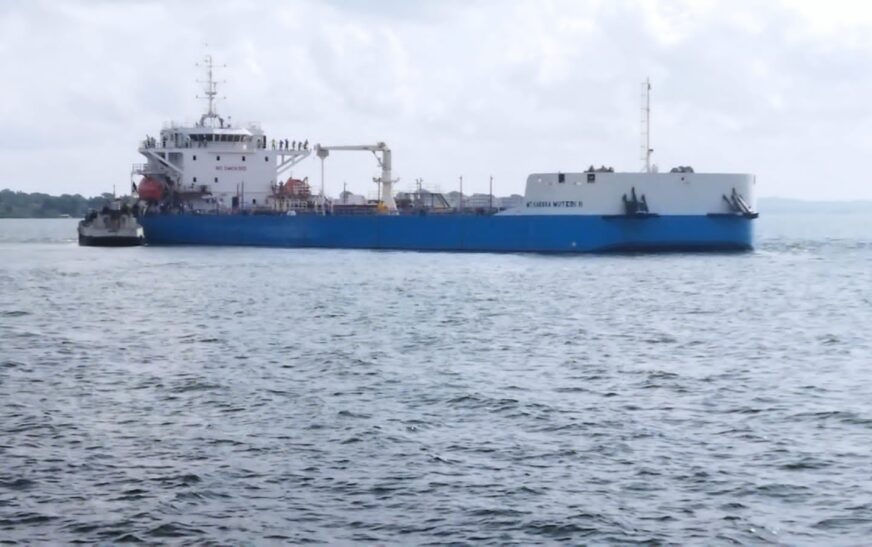
Mahathi transports refined petroleum products from Kisumu in Kenya to its terminal at Kawuku in Uganda using specialised vessels, including MT Kabaka Mutebi II and MT Elgon.
The vessels can transport approximately 4.5 million litres of fuel in a single voyage, a volume equivalent to roughly 120 to 150 road tankers, depending on the capacity of the trucks.
Each successful voyage therefore takes a substantial number of heavy fuel trucks off the Northern Corridor, potentially reducing road congestion, road damage, accident exposure and emissions while easing pressure on border-clearance facilities.
For Uganda, the system also provides an alternative fuel supply route and could strengthen resilience during road closures, accidents, political disruptions or other emergencies affecting the road network.
Lessons from the Great Lakes
The United States and Canada offer one of the clearest examples of how commercial transportation can coexist with environmental protection on major freshwater bodies.
The Great Lakes-St Lawrence system supports major cities, industries, agriculture, fisheries, tourism and drinking-water supplies for millions of people. Yet commercial shipping, including the movement of petroleum products and other regulated cargo, continues under strict safety and environmental controls.
Lake Ontario has for generations been part of the international commercial network linking Canada and the United States to the Atlantic Ocean through the St Lawrence River and Seaway.
Petroleum products and other regulated cargoes move through the system under the oversight of agencies including Transport Canada, the United States Coast Guard, environmental authorities, port authorities and the binational Seaway administration.
Lake Superior provides an even stronger comparison. It is the world’s largest freshwater lake by surface area and one of the most environmentally sensitive inland water bodies in the world.
Despite this, it supports major ports such as Duluth-Superior and Thunder Bay and remains an important link in the North American maritime economy.
Shipping on Lake Superior is governed by strict requirements covering vessel construction, navigation, pilotage, dangerous cargoes, waste discharge, ballast water, spill preparedness and marine liability.
The lesson from North America is not that environmental protection should be ignored. Rather, sensitive freshwater bodies can support economic activity when governments enforce high safety and environmental standards.
Companies such as Algoma Tankers in Canada and Andrie in the United States have operated specialised vessels carrying petroleum and liquid-bulk cargo within the Great Lakes-St Lawrence system.
The Great Lakes Commission has similarly promoted an approach that combines environmental stewardship with economic development through stronger regulation, technology and enforcement.
Europe also regulates rather than simply bans
Europe provides another example of how inland waterways can support commercial transportation while remaining subject to stringent environmental controls.
Not every European lake carries petroleum products. Many smaller lakes are primarily dedicated to drinking water, recreation, conservation or passenger transport.
However, Europe’s extensive network of rivers, canals and interconnected waterways carries petroleum products, chemicals and other dangerous goods.
The Rhine, Danube, Moselle, Main and Rhône systems are major commercial routes, with ports in countries such as the Netherlands, Germany, Belgium, France, Austria, Hungary and Romania forming part of important industrial and energy supply chains.
These operations are governed by the European Agreement concerning the International Carriage of Dangerous Goods by Inland Waterways, commonly known as ADN.
The rules provide requirements for vessel construction, cargo tanks, equipment, documentation, crew training, fire protection, loading and unloading, emergency response and pollution prevention.
European inland navigation regulations also apply to a number of navigable lakes and lake-connected systems.
Lake Constance, Lake Geneva, Lake Maggiore, Lake Garda, Lake Vänern and Lake Mälaren operate under national or cross-border navigation controls suited to their individual circumstances.
Lake Vänern in Sweden, for example, is connected through the Göta älv and Trollhätte Canal to the North Sea, while Lake Mälaren connects Stockholm and Sweden’s inland commercial centres to the Baltic.
These examples show that the debate does not have to be framed as a choice between protecting a lake and using it for economic activity.
The issue is whether commercial activity can be conducted under appropriate environmental, engineering and operational safeguards.
Caspian offers another lesson
The Caspian Sea, although saline and therefore not a direct ecological equivalent of Lake Victoria, also demonstrates the strategic importance of inland petroleum transportation.
For decades, tankers have moved crude oil and refined petroleum products between Kazakhstan, Azerbaijan, Turkmenistan, Russia and Iran.
Ports such as Aktau in Kazakhstan and Baku in Azerbaijan form part of the wider trans-Caspian energy corridor, with petroleum moved by water before being transferred to pipelines and other transport systems.
The experience demonstrates the importance of having alternative transport corridors. For landlocked countries such as Uganda, diversification of transport routes can strengthen energy security by reducing excessive dependence on a single road, railway or pipeline system.
China shows what inland waterways can deliver

China has also developed an extensive network of rivers, canals and lake-connected waterways for the movement of fuel, chemicals, containers and bulk commodities.
The Yangtze River Economic Belt, Pearl River system and Beijing-Hangzhou Grand Canal form part of one of the world’s largest inland navigation networks.
Commercial routes connect with major freshwater lakes, including Dongting and Poyang, while China has continued tightening controls on dangerous-goods vessels, port operations, emissions, waste disposal and emergency response.
At the same time, it has invested in inland ports, navigation channels, digital vessel monitoring and modern fleets.
The underlying principle is straightforward: moving large volumes of cargo by water can reduce logistics costs, ease pressure on roads and support industrial growth.
Environmental risks are addressed through regulation, modern equipment, monitoring and emergency-response capacity rather than automatically rejecting inland navigation.
Safety must remain central
Mahathi’s vessels are reported to have double-hull construction and other marine safety features.
A double hull provides an additional layer between cargo tanks and the outer shell, reducing the likelihood that a collision or grounding will immediately rupture a fuel tank.
However, no responsible operator or regulator should describe any vessel as completely incapable of sinking or leaking.
Marine safety depends on several layers working together, including vessel design, independent classification, inspections, qualified crews, preventive maintenance, safe loading procedures, weather monitoring, fire-control systems, insurance and emergency preparedness.
GPS and electronic navigation systems are important, but they do not replace trained masters, pilots and engineers.
The Kisumu-Kawuku route should therefore continue to be managed using accurate hydrographic information, marked navigation channels, weather monitoring, communication systems and shore-based oversight.
Environmental approvals and operating conditions administered by the National Environment Management Authority in Uganda and Kenya should also remain continuing obligations.
Such oversight should include environmental monitoring, terminal inspections, spill-prevention plans, emergency drills, waste-management controls, community engagement and periodic compliance audits.
Given that Lake Victoria is shared by Uganda, Kenya and Tanzania, the three countries also have a strong interest in developing effective cross-border emergency-response mechanisms.
A regional economic opportunity
Beyond fuel transportation, the project has implications for East African integration. Lake Victoria connects Uganda, Kenya and Tanzania and remains one of the region’s most important shared economic resources.
Expanding safe commercial navigation could give practical meaning to efforts to develop regional transport corridors and reduce the heavy dependence on roads. Kisumu stands to benefit through increased port activity, employment, warehousing and marine services.
Uganda could benefit from lower logistics costs, improved fuel-supply resilience and reduced dependence on long-distance road convoys.
Tanzania and other neighbouring countries could also benefit if a wider lake-transport network develops.
Government support for such infrastructure should therefore be distinguished from preferential treatment for a private company.
The broader issue is whether strategic infrastructure that improves regional trade, energy security and transport efficiency can operate within a predictable regulatory environment.
Mahathi’s investment represents significant private capital in vessels, storage facilities, terminals, technology, employment and specialised skills.
The appropriate government response is therefore firm regulation combined with policy stability.
Authorities should enforce safety and environmental standards while providing investors with clear rules and avoiding contradictory directives or unnecessary uncertainty.
The experience of the United States, Canada, Europe, China and countries around the Caspian shows that inland petroleum transportation can form part of a broader national and regional development strategy when properly regulated.
For Uganda and Kenya, the challenge is to apply that lesson to Lake Victoria without compromising the lake’s environmental integrity.
That means strict safety standards, continuous monitoring, effective emergency preparedness, transparent environmental oversight and strong enforcement.
Mahathi’s Lake Victoria project can provide Uganda and Kenya with an additional fuel transportation corridor, reduce pressure on roads and strengthen supply resilience.
But its long-term success will depend not only on the vessels or terminals, but also on the ability of regulators and governments to maintain high standards while providing a stable environment for strategic infrastructure investment.