
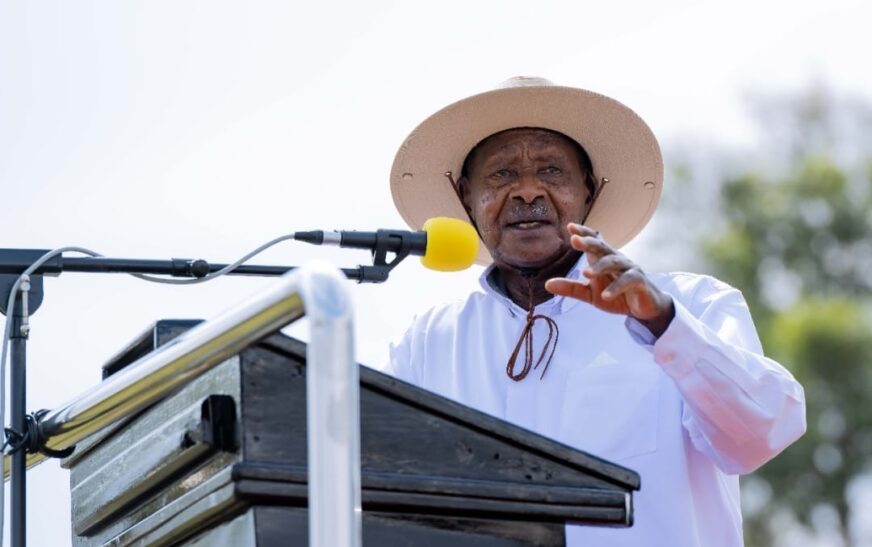
President Museveni has asked Kampala city traders to suspend their ongoing shop-closure strike as government works to address their grievances, with a meeting between the President and the traders scheduled for Tuesday next week.
Prime Minister Robinah Nabbanja told Parliament on Thursday, November 19, that the President had made the request following a series of meetings between traders, sector ministries and the Uganda Revenue Authority (URA) held on Tuesday and Wednesday.
Traders, operating under the Kampala City Traders Association (KACITA) and other associations, closed their shops on November 17 to protest high taxes on textiles and garments, delays in customs clearance and what they described as unfair URA enforcement practices.
Updating Parliament on the strike, Nabbanja said discussions had established that the dispute between traders and URA largely stemmed from the tax policy on textiles and garments, which she described as the central issue behind the other complaints.
“The meeting established that the impasse between URA and the traders largely concerns the tax policy on textiles and garments. This was discovered as the central issue from which others emanate,” Nabbanja said.
She said Museveni had directed that the matter be handled through Cabinet and subsequently Parliament, given that it involved policy decisions, and urged traders to call off the strike as government worked towards a lasting solution.
“It is the guidance of the President that since this is a policy matter that needs to be addressed through Cabinet, then Parliament, he requested the traders to suspend the strike until when we shall give them a clear answer after the Cabinet meeting,” she said.
Nabbanja said government had agreed to review the tax policy on textiles and garments and align it with those of other East African Community (EAC) partner states to harmonise the region’s tax regime.
“Today, the President also directed me to present a Cabinet paper, so that government can handle the issue conclusively. We do not want a repeat of strikes in the city,” she said.
To address the wider concerns, government will establish an inter-agency revenue harmonisation committee to engage traders and resolve cross-cutting challenges affecting their businesses.
The committee, which will be chaired by Nabbanja, will comprise the ministers of Finance, Planning and Economic Development; Trade and Cooperatives; Public Service; and the URA Commissioner General.
Nabbanja said the absence of effective engagement between traders, URA and government had contributed to the dispute, adding that government wanted to create a platform through which grievances could be addressed before they escalate into industrial action.
“There has been no link between the traders, URA and government. We thought it wise that before going on strike, people can converge and agree on a number of issues,” she said.
On complaints about goods held at customs, Nabbanja said she had directed URA to expedite the release of consignments and ensure that cases were handled promptly.

“I directed URA to expedite the release of the goods and ensure that the cases are handled promptly. Traders who meet the applicable compliance should pay the requisite taxes and have their goods released within three days,” she said.
The Prime Minister also revealed that government was losing revenue because some traders had resorted to under-declaring or evading taxes under the existing tax regime.
She told Parliament that some traders were reportedly offloading goods in Kenya, paying taxes there before transporting them into Uganda on buses as small cargo.
“We were told that because of what the tax regime brought, this resulted into traders offloading goods in Kenya, pay taxes there and transport them to Uganda using buses under the category of small cargo,” Nabbanja said.
She added that URA had deployed several enforcement teams to address the practice, while Museveni is expected to meet the tax authority on Monday, November 23.
Deputy Speaker Thomas Tayebwa directed Nabbanja to return to Parliament with an update on Wednesday, November 25, following government’s engagements with the traders.
Meanwhile, as government pursued negotiations with KACITA, another traders’ umbrella body, the Federation of Uganda Traders Association (FUTA), asked Parliament to intervene in its dispute with URA over prolonged import clearance procedures.
FUTA, led by its president John Kabanda, appeared before Parliament’s Committee on Trade and Tourism, chaired by Boniface Okot, where members raised concerns about delays in clearing imported goods, which they said were increasing the cost of doing business.
Kabanda said some containers had remained at URA facilities for months, with others held for nearly a year, leaving traders struggling with mounting storage charges, bank loans and declining value of their merchandise.
“Some containers have been held at URA for months, others for almost a year and traders continue to pay rent, bank loans, URA storage while goods lose value, customers are lost and many traders have collapsed into debt,” Kabanda said.
Okot asked the association to provide documentary evidence to support its allegations against URA, promising that the committee would engage the relevant stakeholders to find a solution.
“Parliament is interested in these matters, we shall look at them comprehensively, we shall engage URA and other stakeholders to ensure they facilitate your trade,” he said.